
Popery, The Inquisition, And The Jesuits – Part III.
Continued from Popery, The Inquisition, And The Jesuits – Part II.
Jesuit Intrigues, Political Plots, and the Popish Threat
Rapin, the elaborate and faithful historian, used the names of Jesuit and Catholic as synonymous, and as true to each other in their engaged plots (see Burnet’s Own Times, Vol. II, pp. 153, 208, and 379, Edit. 1724; and Baxter’s Life and Times, Part III, p. 185)—“That Papists have easily dispensations to take any tests or oaths,”—and shewing that Jesuits cannot be tolerated with safety in England, nor can Papists safely succeed to power or influence in the state.
Dr. Titus Oates’s discovery of the plot of the Papists to kill the King (Charles II, 1678) and bring the kingdom to Popery, and the murder of Sir Edmundsbury Godfrey by them, for his diligent search after the conspirators, are stated in Baxter’s Life and Times (Part III, p. 183 and 186), as well as by Burnet and Rapin, and Turberville’s evidence on his death-bed, implicating Lord Stafford and Lord Shaftesbury in the plot.
Hume, in his history (Charles II, 1678), admits that “the restless and enterprizing spirit of the Catholic Church, particularly of the Jesuits, is in some degree dangerous to every communion; such zeal of proselytism (says he) actuates that sect, that its missionaries have penetrated into every nation of the globe; and in one sense, there is a Popish plot perpetually carrying on against all states, Protestant, Pagan, and Mahometan.”
Lord Russell’s Testimony and the Irish Rebellion of 1641
Lord Russell, it is said, declared that he looked “on Popery as an idolatrous and bloody religion,” and added,—
- “I did believe, and do still, that Popery is breaking in upon this nation; and those who advance it, will stop at nothing to carry on their design. I am heartily sorry that so many Protestants give their helping hand to it, but I hope God will preserve the Protestant religion and this nation, though I am afraid it will fall under very great trials and very sharp sufferings.” (See Tindal’s Rapin, Vol. XIV, pp. 189, 191, and 235, Ed. 1731; and Burnet’s Own Times, Vol. II, p. 155, Ed. 1724, as to the trials for the Gunpowder Plot of 5th November.)
In Mr. Baron Maseres’s preface to his edition of Sir John Temple’s History of the Irish Rebellion, adverting to the Scottish colonists in Ireland, living in terms of friendship and familiarity with the native Irish—The Popish inhabitants there paid such implicit obedience to their priests, that under their wicked suggestion they entered into a general conspiracy, to massacre, on a certain appointed day (23rd October, 1641), all their Protestant neighbours, both Scotch and English, without sparing even women and children, and which was executed on the appointed day—and so continued until the English Parliament sent an army to resist them.
Such (as is there observed) have been the dreadful consequences that have resulted to the Protestants in England and Ireland, in the reigns of Elizabeth, James I., and Charles I., from the admission of the spiritual authority of the Pope. Sir Richard Musgrave, in his History of the Rebellion in Ireland, in 1798, says, “the common people of Ireland, who profess the Roman Catholic religion, and of the Romish priests, by whom they are implicitly directed, continue still as hostile to their Protestant fellow subjects (whom they call heretics) as they were at the time of the detestable massacre of them, in the year 1641.” Sir Richard Musgrave’s further observation, as to the admission of Papists to offices, &c., is well worthy of the attentive consideration of government.
The Irish Rebellion of 1798 and Priestly Atrocities
The Brief Account of the Jesuits furnishes palpable evidence of the great venality and corruption of morals which prevailed in the Catholic priesthood of Ireland, as well as of their seditious and rebellious determination.
In the rebellion of 1798, Quigley, a Popish priest, displayed the greatest activity in the revolt, organizing “the Defenders,” as they were called, and “the United Irishmen.” He was afterwards hanged at Maidstone. In that rebellion of 1798, the Papists made a dreadful massacre at Scullabogue (June 1798), when they destroyed a great multitude of Protestants, by enclosing them in a barn, and then setting fire to it, under the orders of a priest named Bryan Murphy, of Taghmon. One hundred and ninety-nine Protestants perished by the fire, or were shot at the door of the barn; there was a similar massacre at the Church of Gorey, the facts all established by evidence.
Roche, the Catholic priest, commander of the rebel camp at Slievekelta, publicly exhorted the rebels, assuring them “that they were fighting for their religion, their liberty, and the rights of their ancestors, and that they must persevere.” Sermons to the same tendency were daily preached by the priests, at the heads of the rebel columns in their camp. Roche and Bagenal Harvey, at Three Rock camp, Wexford, denounced all Protestants as heretics. Harvey was a man of humanity, though of absurd political speculations; he was filled with horror on hearing of the massacre at Scullabogue, and the day after, he issued general orders, denouncing the punishment of death on all who should murder their prisoners. For this praiseworthy act he was deposed, and “Roche, the priest,” was placed in his stead, as more suited “to carry into effect the sanguinary objects of his employers.”
Murphy, the priest, at the battle of Arklow, exhorted the rebels that they were fighting in the cause of God—that the more of the heathens (the King’s army) they should kill, the sooner they would go to heaven; and if any of them died in battle, they would be sure of immediate salvation. He produced several bullets from his pocket, and declared that they had hit him in several parts of his body at the battle of Gorey, and that they could do him no harm. He was killed at Arklow. Wherever the rebels marched they murdered the Protestants, declaring that there should be only one religion, and that if there was but one drop of Protestant blood in a family, they ought to put that family to death.
Roche pretended that he caught the bullets that came from the King’s troops, and gave them to his men. The rebels’ oath was:
- “I, A. B., do solemnly swear, by our Lord Jesus Christ, who suffered for us on the cross, and by the blessed Virgin Mary, that I will burn, destroy, and murder all heretics, up to my knees in blood, so help me God.”
Sir Richard Musgrave details numerous similar acts of atrocity, founded upon the evidence he adduces, all tending to the same inveterate disposition of the Papists for the destruction of the Protestants, and the ready absolution by the priests of the murderers, and the actual benediction by their Bishop Caulfield, preparatory to the slaughter of their prisoners—the Protestants—on the Wexford Bridge (20th June, 1798). Sir Richard Musgrave also states the Confession of Faith, found in the box of a priest at Gorey, in which the Pope is twice blasphemously called “Christ’s Vicar, the Lord God, the Pope, and the Holy Father, the Lord God, the Pope,” and there declared that the Pope, together with the primates, bishops, monks, friars, and priests, can “make vice virtue and virtue vice, according to their pleasure.”
Cardinal Bellarmine, the Jesuit, maintained the same. (See also the narrative of Dr. Stock, as to the landing of the French in Ireland, in 1798). Unchanged Popery, as it is, must be the enemy of liberty, civil and religious, and therefore subversive of the happiness of man.
Jesuit Subversion under Queen Elizabeth
Rapin, in his History of England (Vol. IX, p. 6, Edit. 1729), after speaking of the seminaries at Rome and Douay, whose main object was to send priests to England to preach sedition and rebellion, and who inculcated, also, pernicious principles, insisting that the Pope had, by Divine right, full power to dethrone Kings, and that Queen Elizabeth, being excommunicated and deposed by Pope Pius V.’s Bull, her subjects were freed from their allegiance, states that four of these dangerous emissaries were condemned and executed for daring to insist and maintain publicly that the Queen was lawfully deposed.
“Two other of those emissaries, Robert Parsons and Edmund Campion, Jesuits, were sent over to England to preach those tenets, having obtained the Pope’s Bull, April 14, 1580, declaring that Pope Pius’s Bull bound Elizabeth and the heretics, but not the Catholics, till a favorable opportunity offered to put it in execution.” These two Jesuits professed the Protestant religion, even held places in the University of Oxford, afterwards withdrew from England, returning from time to time—appearing one while like clergymen, at another like soldiers, or in some other disguise—frequenting the houses of the Catholics, inspiring them with sedition and rebellion. Campion, Skerwin, Kirby, and Bryant, Jesuits, were afterwards tried and executed for treason.
Again England was suddenly overrun with Romish priests, Jesuits, and other Catholics; some of them owning that they were come into England with power to absolve every one in particular from his oath of allegiance, from which Pius V.’s Bull had absolved the whole nation.
Again, after enumerating the dangers which threatened the kingdom in 1585, Rapin observes:
- “I mentioned not the Court of Rome or the English Catholics, who always continued in the same mind. The Queen of Scots was all along the stumbling-block,—it was she who gave birth to all the devices. They had a mind to free her from captivity in order to set on her head the Crowns of England and Scotland, and restore by her means the Catholic religion in the two kingdoms.—Nothing shews her (Elizabeth’s) capacity more than her address in surmounting all the difficulties and troubles created by her enemies, especially when it is considered who those enemies were,—persons the most powerful, and the least scrupulous in Europe,—the bare naming of them is sufficient to convince all the world. The Court of Rome under several Popes, Philip II. King of Spain, the Duke of Alva, Henry II. and Charles IX., Kings of France, Catherine of Medicis, the Duke of Guise, Cardinal Lorraine, Mary Queen of Scots, all the Romish clergy, and particularly the Jesuits” (P. 221)
.
Sully observed, as to the intrigues of the Catholics and Jesuits:
- “Quelque tems avant la mort d’Elizabeth les partisans de Espagne ayant comme à l’ordinaire, les Jesuits à leur tête, exciterent des brouilleries dans les trois Royaumes de la Grande Bretagne, la religion leur servit de prétexte quoique la politique en fût le véritable objet.” (Sully’s History, Vol. IV, b. 5, p. 357, Edit. 1768.)
(Translation from French: “Some time before the death of Elizabeth, the partisans of Spain—with the Jesuits, as usual, at their head—stirred up unrest throughout the three kingdoms of Great Britain; they used religion as a pretext, though politics was the true objective.”)
Hume states that the Jesuit Campion was detected in treasonable practices, and punished accordingly. He further observes:
- “The Bull of Pius, in absolving the subjects from their oath of allegiance, commanded them to resist the Queen’s usurpation; and many Romanists were apprehensive that, by this clause, they were obliged in conscience, even though no favourable opportunity offered, to rebel against her, and that no dangers or difficulties could free them from this indispensable duty; and as to the proceeding and to the general inculcation of the Pope’s supremacy, and his authority of deposing kings, &c.” (See Hume’s History, Elizabeth, 1581 and 1678, as to the danger from the Jesuits against all states.)
Camden adverts to the practices of the Romish priests in bringing the Queen’s authority to be null, and the absolution promised by the priests from every mortal sin, and which they were enabled to do the more securely, because the more secretly, under the seal of confession. That Pope Pius V. employed Robert Ridolphus to stir up the Catholic priests in England, and which he did most sedulously. (Camden’s Annals, 1568.) He also adverts to the continental seminaries of Jesuits, from which their emissaries (Campion and Parsons) were sent to England to inspire sedition and revolt. (Camden’s Annals, 1580 and 1581.)
The conduct and confession of Parry (1585)—the behaviour of the Jesuits when they saw that all hope of setting up Popery by means of Mary Queen of Scots had failed (1586)—the trial of the Earl of Arundel (1589)—the behaviour of the Jesuits in Scotland (1592 and 1593) under Crichton, the Jesuit—the conduct of Parsons, Dolman, Cardinal Allen, Cullen, Holt, Owen, Inglefelt, Williams, and others (in 1594)—with his admirable reflections on the providence of God in the signal preservation of Elizabeth; and their infamous abuse of religion and its sacraments to the vilest purposes of regicide and rebellion. (See Camden’s Annals, 1594.)
The annals of 1598, as to the conspiracy of Squire and Walpole, and his recital of the Bull of Pope Clement VIII., sent to the Irish rebels then in arms against Elizabeth, and which rebellion the Pope calls “An expedition against heretics,” and declares himself willing to grant the rebels all possible testimonies of his special grace and favour for having undertaken it!
Camden’s account also of the briefs sent by the same Pope to the clergy and people of England, to prevent any monarch ascending the throne after the Queen’s death who would not assert and maintain the Catholic religion—which Bulls produced the 5th November attempt on the life of James I., the Protestant successor. (1600 and 1602.)
The acts of the reign of Elizabeth show decisively the general feeling of the country, that the Jesuits and Catholics were assailing the constitution and safety of the Queen’s life. (See Burnet’s summary of her reign—his Abridgement of the History of the Reformation, Book IV, p. 381.)
John Knox and the Scottish Reformation
Knox (who had been one of the chaplains of King Edward VI.), when Popery prevailed in Scotland, narrowly escaped with his life from Cardinal Beaton, or Beatoun (Archbishop of Glasgow), and Bishop Hamilton. He was cited before Bishop Tonstall for preaching against the Mass, and he was compelled to leave England on Queen Mary’s accession. He returned to Scotland in 1559—preached publicly against the idolatrous religion of the Church of Rome, and the corrupt lives of the clergy.
Mary, Queen of Scots, proclaimed, by her privy council, death to any disturber of the Mass; notwithstanding which, Knox boldly declared against it, and so continued to his death, which occurred 24th November, 1572, having supported the Reformation, and eventually delivered Scotland from Papal corruption. At his funeral Earl Morton exclaimed:
- “There lies one who never feared the face of man; who has been often threatened with dirk and dagger, but has yet ended his days in peace and honor; for he had God’s providence watching over him in a special manner whenever his life was sought.” (See Cook on the Reformation in Scotland, and M’Crie’s Life of Knox.)
State of Pre-Reformation Superstition and Wealth in Scotland
Robertson, in his History of Scotland, upon the state of Popery in that country, at the period of Knox, considered the Reformation to be one of the greatest events in the history of mankind. The revival of learning in the fifteenth and sixteenth centuries roused the world from its lethargy for many years, broke the fetters by which the mind had been so long restrained, and pushed its inquiries with great boldness and success. No sooner did mankind recover the capacity of exercising their reason, than religion became the first object of their attention.
Before Luther published his famous Theses, which shook the Papal throne, science and philosophy had laid open to many of the Italians the imposture and absurdity of the established superstition—although little disposed to assume the character of Reformers. But the German theologian boldly erected the standard of truth, and from the heart of Germany his opinions spread with astonishing rapidity all over Europe, and bore down the feeble opposition of an illiterate and immoral clergy.
The superstition of Popery seems to have grown to the most extravagant height in those countries situated towards the extremities of Europe. The imagination and sensibility of frame in the inhabitants of southern climates rendered them susceptible of the deepest impressions of superstition, terror, and credulity. Ignorance and barbarity were no less favorable to the same spirit among the northern nations—they knew little, and were disposed to believe everything; the most glaring absurdities and the most improbable fictions were received with implicit assent and admiration!
The power and wealth of the Church kept pace with the progress of superstition, it being the nature of that spirit to observe no bounds in its respect and liberality towards those whose character it esteems sacred. The Scottish kings, under its influence, made vast additions to the immunities and riches of the clergy. The profuse piety of David I. (who on that account acquired the name of Saint) transferred almost all the crown lands, of great extent, into the hands of the ecclesiastics. Imitated by his successors, that spirit spread among all orders of men, who daily loaded the priesthood with new possessions. The riches of the Church, all over Europe, were exorbitant, and by the time of the Reformation, concluded to be little less than one-half of the national property, which had fallen into the hands of a society “always acquiring, and can never lose.”
This extraordinary share in the national property was accompanied with proportionable weight in the supreme council of the kingdom—the ecclesiastics forming a considerable body there: and it appears from the ancient rolls of Parliament, the proceedings in a great measure were under their direction.
By the dignity, titles, and precedence of the Popish clergy, they were regarded by the credulous laity as beings of a superior species; they were neither subject to the same laws, nor tried by the same judges. Every regard that religion could invent and supply was placed around their power, their possessions, and their persons; and endeavours were used, not without success, to represent them all as equally sacred.
A very slender portion of knowledge drew the admiration of rude ages, which knew little. Almost all the high offices in civil government devolved upon them. From the earliest ages of the monarchy to the death of Cardinal Beaton, fifty-four persons had held the high office of Lord Chancellor, and of these, forty-three had been ecclesiastics. The lords of session were supreme judges in all civil matters. The president, and one half of the senators in that court, were churchmen; and the clergy, by the law of celibacy, and undistracted by those cares which occupy other men, made the interest of their order their only object, and they were at full leisure to pursue it.
The nature of their function gave them access to all persons, and at all seasons. They could employ all the motives of fear and of hope, of terror and of consolation, which operate most powerfully on the human mind; they haunted the weak and the credulous; they besieged the beds of the sick and the dying; they suffered few to go out of the world without leaving marks of their liberality to the Church; and taught them to compound with the Almighty for their sins, by bestowing riches upon those who called themselves His servants, and who could promise to pray for them when departed.
They also assumed to themselves the disposition of the estates of those who died intestate.
At the same time, no matrimonial or testamentary cause could be tried but in the spiritual courts, and by laws which the clergy themselves had framed. The penalty, too, by which the decisions of those courts were enforced added to their authority. A sentence of excommunication was no less formidable than a sentence of outlawry. It was pronounced on many occasions, and against various crimes, and besides excluding those upon whom it fell from Christian privileges, it deprived them of all their rights as men or citizens—and the aid of the secular power concurred, with the then superstition of mankind, in rendering the thunders of the Church no less destructive than terrible!
To these general causes may be attributed the immense growth both of the wealth and power of the Popish Church.
Clerical Corruption and the Persecutions of Cardinal Beaton
Though the laity had contributed, by their own superstition and profuseness, to raise the clergy from poverty and obscurity to riches and eminence, they began by degrees to feel and to murmur at their encroachments. The indecent and licentious lives of the clergy gave great and just offence to the people, and abated their veneration to that order. Immense wealth, extreme indolence, gross ignorance, and the injunction to celibacy had concurred to introduce this corruption of morals among many of the clergy, who, presuming too much upon the submission of the people, were at no pains either to conceal or to disguise their own vices.
Cardinal Beaton, or Beatoun, with the same public pomp which is due to a legitimate child, celebrated the marriage of his natural daughter with the Earl of Crawford’s son; and, according to Knox, he publicly continued, to the end of his days, a criminal correspondence with her mother, a woman of rank, and by whom he had several other children. The other prelates seem not to have been more regular and exemplary than their primate.
Cardinal Beaton evinced his attachment to the religion and interests of Rome in conducting a very severe inquisition into heretical doctrines, and in causing prosecutions to be instituted against several persons, of whom some were men of family and distinction. It is said that he presented a list of three hundred and sixty of the chief nobility to the Scotch King (James V.) as suspected of heresy, and if the King’s death had not prevented the execution of his sanguinary purposes, these, and probably many more, must have fallen sacrifices to his persecuting power.
James, the King, fell at Solway Moss (1542), and this cardinal attended him in his last moments; and it is alleged that he forged the King’s will, appointing him and three noblemen to the regency during the minority of his daughter Mary. He obtained, soon afterwards, the commission of legate à latere from Rome, enabling him to proceed in his favourite design of extirpating heretics. In the execution of this design he caused several persons to be condemned and executed, and, among the rest, Mr. George Wishart, the famous Protestant preacher in Scotland, who was burnt at St. Andrew’s, at which castle (20th May, 1546) the cardinal was afterwards murdered in revenge for his sanguinary proceedings. (Robertson’s Scotland, Vol. I, p. 326.)
Testimony of Continental Reformers
Dean Milner, in his Church History, states that in a manuscript history, from 1524 to 1541, composed by Frederic Myconius, coadjutor of Luther and Melanchthon:
- “the state of religion in the sixteenth century was corrupted greatly, that all were condemned who were destitute of the intercession of saints and of pontifical interest—that in the room of Christ were substituted, as saviours and intercessors, the Virgin Mary, like a Pagan Diana, and other saints, who, from time to time, had been created by the Popes. That men were not entitled to the benefit of their prayers except they deserved it of them by their works—(works such as enriched the priests and monks). Those who neglected these were consigned to hell, or at least to purgatory, till they were redeemed from it by a satisfaction, made either by themselves, or by their proxies. That gross wickednesses were practised under the encouragement of indulgences, by which the guilt of the crimes was easily expiated.”
He says:
“the lives of the clergy were most scandalous—I speak of those I have known in the town of Gothen,” &c.
To this may be added the testimony of Pellicanus, another of Luther’s followers, that a Greek Testament could not be procured, at any price, in Germany—that Paris could not furnish a single person capable of supporting a controversy with Luther on the foundation of Scripture.
The Popish Doctrine of Indulgences and Its Abuses
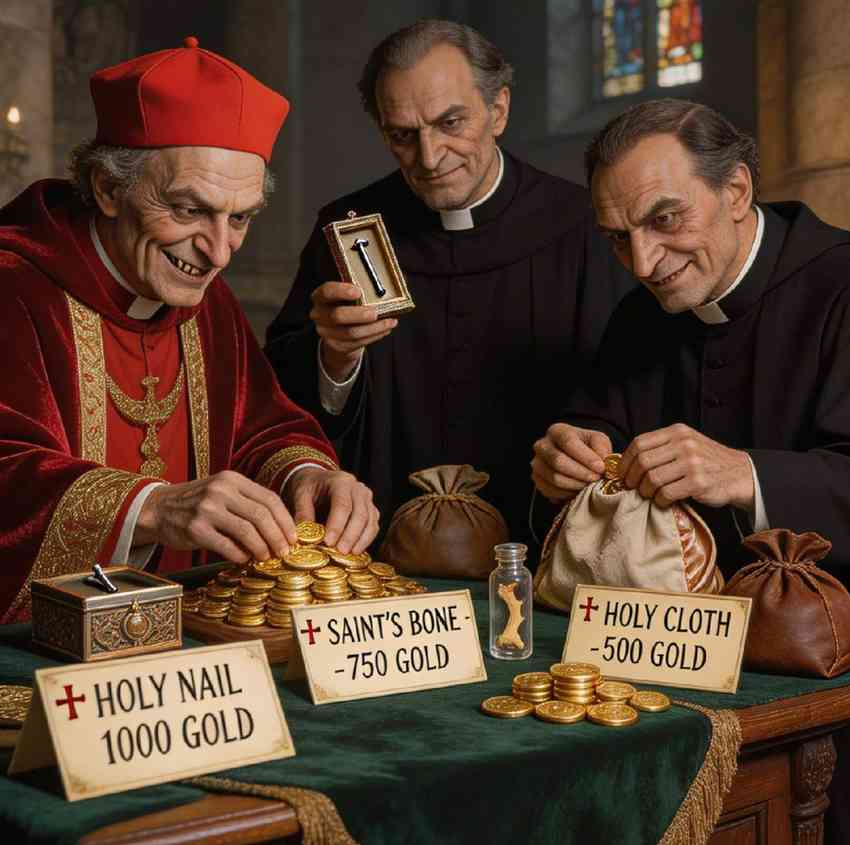
That the Popish doctrine of Indulgences was then in the highest estimation; and, according to the Papist bishop, Bossuet (Bishop of Meux), imposed painful works or sufferings on offenders, which, being undergone or discharged with humility, are called satisfactions; and when regarding the fervor of the penitent, or other good works, she remits some part of the task, this is called an indulgence. That the power to grant indulgences has been committed to the Church by Jesus Christ, and the use of them is beneficial to salvation; and that those who depart this life indebted to Divine Justice for some of the pains reserved, must suffer them in another life—the state of purgatory.
That reliefs are, however, provided in this case also. The benefit of indulgences extending, it seems, beyond the grave; and the doctrine of commutation for offences, applied in real practice by the friends of the deceased, being held to be valid in heaven. The gravamen of this being, that there was an infinite treasure of merit in Christ and the saints, abundantly more than sufficient for themselves, so that what might be attributed to the Saviour, was also to the saints. This treasure, under the conduct of the see of Rome, was sold for money to those who were able and willing to pay for it, so that few were willing to undergo the severe penance of austerities when they could afford to commute for it by pecuniary payments.
The Popes, the bishops, and clergy, had the disposition of this treasure; and as the Popes had the power of canonizing new saints at their will, the fund was ever growing, and thus the riches of the Church, secularized under the appearance of religion, was as a sea without a shore. Such their doctrine insisted, that by their rules, and in the way of indulgences, pardon was to be obtained without the satisfaction of Christ; but that the inheritance of eternal life was to be obtained by “indulgences.”
Sleidan, in his history, states, that Pope Leo X., making use of that power, sent abroad into all kingdoms his letters and bulls, with promises of full pardon for sins, and of eternal salvation to such as would purchase the same with money. This impious system was assailed by the Reformation, and thus, in the demolition of that vile perversion and superstition, there arose, and was revived in simplicity, that apostolic doctrine, in which is contained the great mystery of the Scriptures. (Dean Milner’s History of the Church, vol. iv., p. 277 and seq.)
Historical Remissness, Papal Claims, and the Great Schism
Rapin, in his Summary (vol. vi., Tindal p. 454, Ed. 1729), says—
- “The Church was never more remiss—the greatest part of the people’s religion was made to consist in pilgrimages and the worshipping of the Virgin Mary, saints, and relics. The authority of the Church had become the main point in religion. The Papal power had increased exceedingly, every century; each Pope having endeavoured to enlarge it as much as possible. They at length disposed of all the Church preferments in Christendom, and became the supreme judges in all causes ecclesiastical. The court of Rome, claiming cognizance of all Church matters, the prerogatives of sovereigns were all annulled by the non-obstante clause inserted usually in every bull. The Pope also claimed his right over temporals, under colour that no case could happen but wherein religion was concerned. Kings were not out of their reach; most marriages of princes having occasion for the Pope’s dispensation. Neither peace nor truce of any moment was concluded without the Pope being mediator or guarantee; and even, in some instances, the Pope enjoined peace, or truce, without the consent of the parties concerned.”
History declares that the Popes, for the most part, were neither learned nor religious—that Rome and Avignon (the seats of the Popes) were the centre of pride, avarice, luxury, sensuality, and of all the most scandalous vices; and yet all the preambles of their bulls were stuffed with expressions of their zeal, their charity, their humility, and their justice. The cardinals were worldly-minded men. The legates, incendiaries, sowing discord among princes, or to spur them on to shed the blood of their subjects, to further the interests of the Roman see, making no conscience to break through all the rules of religion and equity in order to compass their ends. The bishops were made purely as sticklers for the court of Rome. Cruelty, injustice, and dishonesty were deemed to be virtues when employed in the persecution of such as they termed heretics, and, especially, of such as dared to question any of the Pope’s or the clergy’s pretended rights. Of course they opposed reformation.
Rapin, after giving an account of the schism in the popedom which began in 1378, and lasted fifty years, through which period there were actually two Popes, and at one time three, proceeds—
- “The Popes during that period were men who sacrificed the peace and quiet of the Church to their own interest; damned without mercy, all not of their party,—that several of them were deposed for heresy, simony, and perjury. Castile, Arragon, Navarre, and Portugal had stood neuter some years without owning any of the contending Popes. France had withdrawn her obedience from Benedict XIII., without transferring it to Gregory XII. The whole world contemned their excommunication.”
The Council of Constance and the Persecution of Huss and Jerome
Fearful of this inducing the people to do without a Pope, the Council of Constance endeavoured to stem that current—but they still pursued the pretended heretics, who questioned the clergy’s privileges, with fire and sword, rather than recede from the least of their interests. John Huss and Jerome of Prague were burnt alive at Constance; their crime being, that they were the followers and defenders of Wickliff, who rejected the invocation of saints, the adoration of the cross and images, pilgrimages, and relics; and that the “Hierarchy” had no foundation in Scripture, was against the excessive authority which the Popes, the Cardinals, and Bishops had usurped; and taxed the clergy with leading very immoral and dissolute lives; and that the revenues of the Church were misused.
But it was notorious that John Huss did not adopt all the opinions of Wickliff, but enough for the Council of Constance to deem him by their rules a heretic, especially upon the point of transubstantiation; according to Æneas Sylvius, alias Pope Pius II., in his History of Bohemia. The fathers of the council knowing the invincible obstinacy of these people, judged that the corrupted members of the Church, who were incurable, ought to be cut off lest they should infect the rest of the body,—accordingly sentence was passed upon them, all the fathers unanimously agreeing that persons who rejected sound doctrine, approved by the Church, deserved to be burnt. So that Huss and Jerome’s heresy consisted in their accusing the clergy of being corrupt; and after thirty years that Wickliff had been buried, they had his bones dug up and burned.
The word Church, as stated by Rapin, was equivocal, sometimes meaning the Pope, sometimes the councils; the Christian laity not reckoned to have any share in that word.
From the time the last schism was closed, to the end of the fifteenth century, the papal chair was filled with Popes cruelly bent upon the destruction of the Hussites:
Pius II. excommunicated, by a Bull, all persons that should dare to appeal from the Pope to a general council.
Paul II., when a Cardinal, with the rest of the Cardinals agreed upon oath to redress certain abuses, but he was no sooner elected Pope than he broke his oath; and never were the gratiæ expectativæ (or bulls for Church preferment before vacant) more frequent than whilst he sat in the chair.
Sixtus IV. raised by his Bull the hierarchy to the greatest height, just when there was the general complaint of the excessive power the clergy had usurped.
Innocent VIII., because he had quarrelled with Ferdinand of Arragon, King of Naples, induced Charles VIII. to carry his arms into Italy.
Alexander VI. (Borgia) was one of the vilest men of that age; Mezerai, the Roman Catholic writer, gives this character of him, “that he would have been the wickedest man in the world, if he had not had a bastard son (Caesar Borgia) who was more wicked than himself.”
All those Popes were guilty of blood-thirstiness in persecuting the Bohemians contrary to the faith of their agreement.
English Resistance to Papal Encroachments and Statute of Præmunire
“That, of course, (as observed by Rapin,) no reformation could be expected from the Pope or his councils; and, referring to England, he considered the people to be chiefly Wickliffites; that the English for ages had felt the oppression of the Pope and Clergy; that in all Christendom there was no people who had experienced more the rigour of the Church’s dominion”: and adds, “the history of England makes this appeal so visibly, that a man must have been blind not to see it.”
Martin V., in 1426, wrote a violent letter to Chichely, Archbishop of Canterbury, upbraiding him for not getting the statute of Præmunire repealed (after the silence of the Popes as to that statute for so many years). Rapin gives large extracts from the letter. The Archbishop applied to parliament for the repeal in vain.
The statute of Præmunire, and the statute of Provisors (Edward I.); the statute as to paying into the apostolic chamber more than usually done (Henry IV.) was to remedy the Pope’s grievance, that no person should have provision of any benefice that was void, till he had compounded with the apostolic chamber, and had paid beforehand the sum agreed upon. (See Blackstone under Præmunire, Vol. 4, p. 103, &c.)
Rapin refers also to the Pope’s attempts for the appointment of Archbishops, &c., in England, that on various pretences they advanced this assumption, that they would fain have established the rule at once, that the disposal of all the bishopricks belonged to them “of divine right,” but as they found it something difficult, they bethought themselves of another expedient, and that was, to get possession by degrees, that they might in time found a right upon precedent, until, at length, hardly was there a vacant bishoprick which they did not fill by way of provision.
Martin V., in two years, filled, by way of provision, thirteen bishopricks in the province of Canterbury—“The best preferments, for the most part, were conferred upon foreigners, who understood not a word of English, nor resided in England; and sometimes upon children themselves,” viz., he made Prosper Colonna, his nephew, then not above fourteen years old, Archdeacon of Canterbury. Henry V., of England, complained of this, and that prince suppressed alien priories without the Pope’s consent.
In 1438, the University of Oxford complained that Church preferments were bestowed without any regard to learning or merit.
The Popes insisted that no national synod should be held without their license, in order to avoid the examination into the bounds of the Papal authority. Even Louis XIV., powerful and formidable as he was, could not obtain the Pope’s leave to call a national council but upon such terms as rendered it impracticable, though that monarch’s aim was solely to improve the Constitution.
Burnet’s Revelations of Monastic Corruption and Immorality
Burnet’s History of the Reformation in England follows up what has been advanced from Rapin; and Burnet’s Abridgement of his history affords much information of the necessity of the Reformation:
“Pope Clement VII. created fourteen cardinals, for money, in 1572.” Burnet says “he might be excused from simony, because they took no cure of souls.” (P. 6.)
“Cardinal Wolsey’s ambition and profligacy are well known. He had the influence to induce the King (Henry VIII.), by a special grant, to give him power to dispose of all the ecclesiastical preferments in England—thus making him the Pope in England; and, as Burnet says, he had all the qualities for a great minister, and all the vices ordinary in a great favourite.”
According to Burnet, “the Abbot of Winchelcomb contended, in his sermons and works, that all the clergy, even of the lower orders, were sacred, and could not be judged by the temporal courts, whatever crimes they might commit—whether murder, theft, or otherwise.”
Hunn was murdered in prison by the Popish clergy, where he had been placed for heresy, that is, “for having in his possession Wickliff’s Bible.”
That, but for the support which Wickliff received from the Duke of Lancaster, his life would have been sacrificed, for “exhorting all people to read the Scriptures.” His followers were sought for by the Popish clergy, and were delivered to the secular arm—the fire!
That the bishops were grossly ignorant, seldom resided in their dioceses, except it had been to riot at high festivals; and all the effect their residence could have was, to corrupt others by their ill example. The abbots and monks were given up to luxury and idleness—that the restraining them from having wives of their own, made them concluded that they had a right to all other men’s.
Historical Evidence from Visitors’ Reports (Grose’s Antiquities)
Grose, in his Preface to his Antiquities of England and Wales, fol. edit., p. 57, states the Letters of Doctor Layton to Cromwell, about 1537. The originals are in the Bodleian Library, viz.:
- “Pleaseth your worship to understand that we came from Glastonbury to Bristow. I here send you for relics two flowers, that on Christmas Even will spring and bear flowers.
“Ye shall also receive a bag of relics, wherein ye shall see strange things—as God’s coat, our Lady’s smock, part of God’s supper, and part of the stone on which Christ was born in Bethlehem. These were all of Maiden Bradley, whereof is a holy father prior, who hath but six children, and but one daughter married yet of the goods of the monastery, but trusting shortly to marrie the rest. His sons be tall men, waiting upon him. He thanks God he never meddled with married women, but all with maidens, the fairest that could be gotten, and always married them right well. The Pope, considering his fragilitie, gave him licence to keep a ——, and he has good writing, under seal, to discharge his conscience, and to choose Mr. Underhill to be his ghostly father, and he to give him plenary absolution. I send you, also, our Lady’s girdle, of Bruton, a solemn relic, sent to women in travail; Mary Magdalene’s girdle, which Matilda, the Empress, founder of Fairley, gave with them, as sayeth the holy father of Fairley. I have crosses of silver and gold, Sir, which I send you not now, because I have more to be delivered this night by the Prior of Maiden Bradley. There is nothing notable, the brethren be kept so straight, that they cannot offend, but fain they would, if they might, as they confess, and such fault is not in them.
—BR. Layton.
From St. Austin’s, without Bristol.”
Another letter from Price to Lord Cromwell in the same Preface:
- “My singular good lord, &c.—As touching the Abbot of Bury nothing suspect as touching his living; but it was detected he lay much forth at Grainges, and he spent much money in playing at cards and dice. It is confessed and proved that there was here such frequency of women coming and resortying as to no place more. Among the relics are found the coals St. Lawrence was roasted with all; the parings of St. Edmund’s nails; St. Thomas of Canterbury’s pen-knife and books; and divers skulls for the headache; pieces of the holy cross, able to make a whole cross; other relics for rain, and for avoiding the weeds growing in corn, &c.—Your servant bounden,
—JOSEPH RICE.
From Bury St. Edmunds.”
This Preface of Grose contains statements of numerous enormities of the abbots, monks, and clergy, and some of the blackest dye; and there are, also, in the Cottonian Library in the British Museum (Cleopatra, E. 4), original papers and letters relating to monasteries and their vices, especially during the reign of King Henry VIII.
Persecution of Reformers and Papal Financial Exactions
Turning now again to Burnet:
- “The inferior clergy, equally ignorant, and having no place of retreat to conceal their vices in, as the monks had, they became more public. All ranks of churchmen became despised and hated, and the worship of God so defiled with gross superstition, that all men were easily convinced that the Church required reformation.—The books of the Germans were brought into England, and translated, and many were prevailed on by them. This occasioned a hot persecution, and six men and women were burnt at Coventry in Passion Week, only for teaching their children the Lord’s Prayer and the Ten Commandments in English! others were burnt, and many compelled to abjure, to save their lives.”
Burnet adverts to Wolsey’s intrigues to be elected Pope, and the briberies offered, and observes: “And, indeed, it would puzzle a man of an ordinary degree of credulity, to think that one chosen by such means could be Christ’s Vicar, and the Infallible Judge of Controversy!”
Boniface VIII. raised his pretensions to that impudent pitch, that he declared all power, both ecclesiastical and civil, was derived from him, and established that as an article of faith necessary to salvation!
That 800,000 ducats had been transmitted to Rome since the commencement of the reign of Henry VII., for Bulls from the Pope for obtaining and holding bishopricks or livings in England.
Burnet states Henry VIII.’s remonstrance against the allegiance to the Pope being paramount to that to himself, their oaths being equivocal!
Cardinal Campeius, not residing in his diocese, was deprived of his bishoprick, for carrying his revenue out of the kingdom.
Burnet gives an abstract of Fisher’s Book against purgatory, showing that there was no mention of purgatory in Scripture; that Ambrose, Jerome, and Augustin did not believe it; that the monks brought it in, and, by many wonderful stories, possessed the world with the belief in it. Unable to confute Fisher with the pen, the clergy resorted to the fiery ordeal, and Fisher was burnt by Gardiner, Bishop of Winchester.
Burnet gives an account of the visitation of the monasteries and other religious houses. That the foundation of their wealth was the belief of purgatory, and of the virtue of Masses to redeem souls out of it; so that it was piety in parents, for their own souls and families, to endow those houses with land, upon condition that they should have masses said for them, more or less, according to the measure of the gift. This was like to have drawn the whole wealth of the nation into those houses, if the statute of mortmain had not put some restraint upon that superstition.
(To be continued.)
Related posts:

"Plans to Destroy the American Constitutional Republic" - By Darryl Eberhart
Mystery Confusion - Authoritarianism versus Totalitarianism

Life in The Word Chapter IX. The Word Exhibits The Characteristic of Growth
Popery The Enemy and Falsifier of Scripture II. Proofs of the Falsification of Scripture b...
The Sower and the Virgin – Historical Retrospect.—Purification Before Birth.

The Significance to the USA of Mexico's Cinco de Mayo Celebration

The World And Its God Chapters XIX - XXIV.
Papal Blessings And Curses
