
T. C. Hammond On The Antichrist

Thomas Chatterton Hammond [T. C. Hammond] (1877–1961) was ordained in the Church of Ireland and served as Superintendent of the Irish Church Missions to the Roman Catholics (1919–1936), during which time at least 1,000 individuals and families were converted to Christianity from Romanism; he then became Principal of the main Protestant Episcopalian theological college in Sydney, Australia, and Rector of St Philip’s, York Street, Sydney, from 1936. He was a central figure in shaping the conservative evangelical (also Reformed and Protestant during his jurisdiction) character of the Sydney Diocese and was known for his weekly radio broadcasts on 2CH, which frequently critiqued Roman Catholicism and answered errors broadcast on radio by the former Tractarian offspring/Anglo-Romanist and pervert to Rome, Leslie Rumble (aka “Dr. Rumble”).
Hammond’s eschatology is best understood in the context of his lifelong mission to bring Roman Catholics to Christ and his work in overwhelmingly Romanist southern Ireland (now called the Republic of Ireland), rather than as a speculative end-times system; he was firmly in the confessional Bible-Protestant old-Evangelical Historicist eschatological position of the Reformers and the Puritans.
A summary of Canon T. C. Hammond’s eschatology is as follows:
- The papacy as the present Antichrist
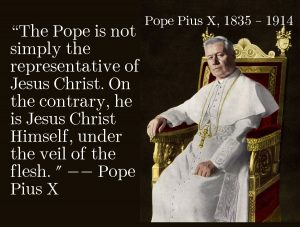
The notes explicitly reject the Jesuit futurist expectation of a single future world ruler. Hammond argues that “even now there are many antichrists” (1 John 2:18) and that the Man of Sin is already revealed in the papacy. This is a classic historicist reading: the “falling away” and the “man of sin” of 2 Thessalonians 2 are fulfilled in the Roman Catholic system, not in a yet-future individual. His citation of Pope Pius X’s claim to be “Jesus Christ himself” is presented as the definitive proof of this blasphemous exaltation. - Babylon as Rome
Hammond identifies Romanism with “Babylon the Great” of Revelation 17–18, the “mother of harlots” and the city on “seven mountains.” This is not a future geopolitical Babylon but the Church of Rome itself, understood as a corrupt system that has replaced the finished work of Christ with its own priesthood, sacraments, and claims of authority. - Rejection of futurism as a Jesuit diversion
The notes argue that the futurist interpretation of prophecy was a Jesuit invention (attributed to Ribera) designed to deflect attention away from Rome as Babylon and Antichrist. Hammond extends this critique to J. N. Darby and the Brethren, whose dispensational futurism he regards as a distraction from the present spiritual conflict. He explicitly dismisses speculation about a revived Roman Empire, the identity of Antichrist, and the details of the millennium as “wasted time.” - The intermediate state and final judgment
Hammond affirms a fixed intermediate state based on Luke 16: the wicked in torment, the righteous in “Abraham’s bosom.” He explicitly denies purgatory as a “third place” invented by Rome for financial gain. At Christ’s return, the lawless one will be destroyed by the brightness of His coming (2 Thess. 2:8), and final judgment will fall upon the Roman system as Babylon is overthrown. - Eschatology as a call to Protestant witness
For Hammond, eschatology is not primarily about chronology but about allegiance. The present age is defined by the conflict between Christ and antichristian Romanism. The practical response is not to chart future events but to know Christ, to be born again, to protest Roman idolatry, and to evangelize. This explains why the sermon moves so quickly from 2 Thessalonians to a call for gratitude for deliverance from “Romish Popery” and for continued public witness against it.
In light of his biography, this eschatology is coherent with his entire career. The Irish Church Missions were dedicated to evangelizing Roman Catholics and engaging in public controversy with Romanist apologists. His Sydney ministry continued that same mission through the main Protestant Episcopal theological college in Sydney, the Australian Church Record, and his 2CH radio broadcasts. The sermon’s eschatology is therefore not an abstract theological position but the apocalyptic framing of a lifelong biblical mission: Rome is not merely wrong; it is the eschatological opponent of Christ, and the Protestant task is to resist it until Christ returns.
Related posts:
Reformation Day - October 31
The Antichrist: His Portrait and History - Chapter VII. Antichrist Revealed by Chain of Ev...

Revelation 9:12-19. The Sixth Trumpet

Martin Luther's 95 Theses

Lectures On The Apocalypse – Chapter IV. The First Seal Opened.

The Bible and the Priest of Rome

Is the Prophecy of Matthew 24:29-31 a Future Endtime Event?

Popery: Its Character And Its Crimes - By William Elfe Tayler
