The End Justifies The Means – J. Beaufort Hurlbert Part I.
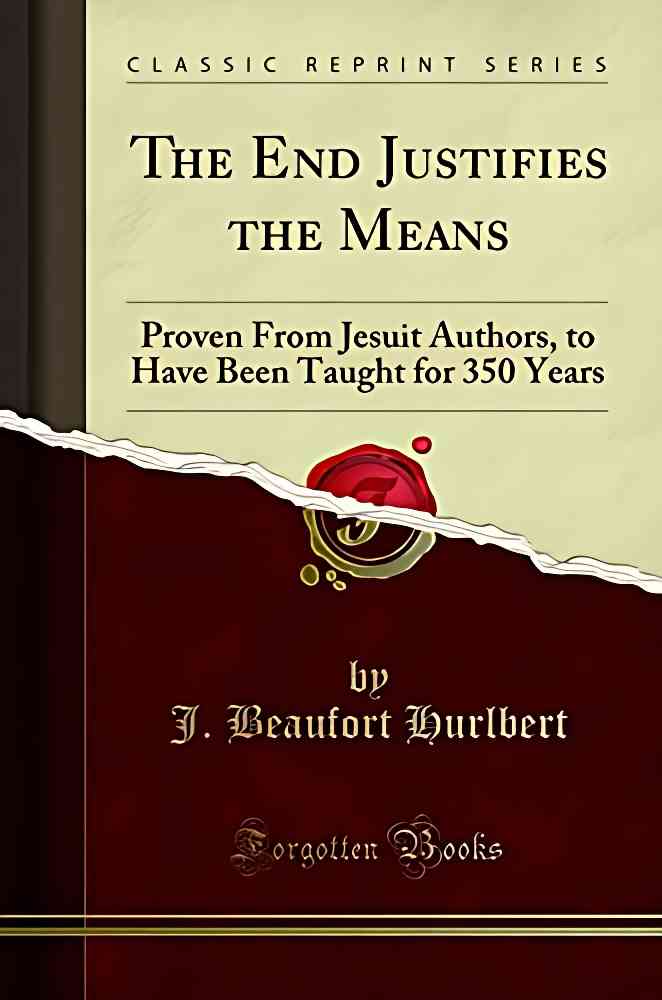
Justifies The
Means
BY
J. BEAUFORT HURLBERT, M.A., LL.D
MONTREAL.
1890.
PREFACE
In a Lecture delivered in St Patrick’s Church, Ottawa, on Sunday evening, February 24th, 1889, and which was afterwards published, the Rev. M. J. Whelan gave the following challenge:—
“A reward of five hundred dollars will be given by me to any one who shall produce a bona-fide passage that will convict the Jesuits, or any Jesuit, or any approved Catholic Theologian of teaching the doctrine that ‘the end justifies the means,’ as that maxim is vulgarly understood. This offer will stand until the 12th day of July next, being the first anniversary of the Jesuits’ Estates bill, of Quebec.” (The Jesuits: their Apologists and their Enemies, p. 26).:
On the following Sunday evening, March 3rd, the same challenge substantially was repeated. He said:—
“I now renew the offer: five hundred dollars will be paid by me to any one who shall produce a bona-fide passage that will convict the Jesuits, or any Jesuit, or any approved Catholic Theologian of teaching that ‘the end justifies the means,’ as that maxim is vulgarly understood, i.e. ‘that it is lawful to do evil that good may come.” (Ibid. p. 40).
He then made the following proposition:—
“A Commission of Inquiry, to be composed, say, of five members: we to select two competent, moral theologians; the other side to appoint two representatives; these four to choose the fifth member of the Commission. Let a day be fixed for the opening of the Inquiry, and let it be agreed that all passages to be cited from Jesuit authors, or other approved Catholic casuists shall be filed with the Commission, at least thirty days before the inquiry begins; two copies of each passage, or extract, to be supplied, with the title and the page, from which it is said to be taken.” (Ibid. p. 40).
After full deliberation I formally accepted this challenge previous to the 12th day of July, and appointed the Rev. Principal MacVicar and the Rev. Professor Scrimger, of the Presbyterian College, Montreal, as my representatives on the Commission of Inquiry. Father Whelan, on his part, appointed the Rev. Father Jones and the Rev. Father Doherty, both Jesuits, as his representatives. By arrangement, these four met at St. Mary’s College, Montreal, on the 29th August last, for the purpose of selecting the fifth member of the Commission. My representatives proposed the name of the Rev. J. Clarke Murray, LL.D., Professor of mental and moral Philosophy in McGill University, a gentleman who is well known as a writer on these subjects, and fully qualified in every respect to act. The two Jesuit Fathers declined to accept Dr. Murray, and offered to take any Professor of Moral Theology in any Roman Catholic Institution, thus insisting that he must be a Roman Catholic. On the ground that no theologian of the Romish Church could be supposed to be impartial in his decision, the offer was, of course, rejected. Being thus unable to come to any agreement as to the fifth member of the Commission, the inquiry necessarily fell through, and I had no opportunity of laying before them the passages which I had ready from various Jesuit authors in support of my contention. I, therefore, now lay them before the public that all may judge for themselves as to what the Jesuit teaching on this point really is.
The passages, except a few too offensive for the eye of the general reader, have been translated into English, but as a guarantee for the correctness of the rendering, the original Latin, some short quotations excepted, is given in an appendix, with full references, so that they may be found in the works without difficulty by those who have them within reach. The public have a right to know the principles of the Order which has been chartered and subsidized by the Government, and encouraged to extend its operations in the country. I feel satisfied that no unbiased mind can study the extracts given here without being convinced that they practically teach the obnoxious principle that “the end justifies the means.”
By adopting the references to the opinions of Jesuit authors given in Busembaum, Gury, etc., I have been able to condense quotations to much narrower limits than at first intended; none can charge these accredited writers with having made false translations—the usual answer to criticisms upon Jesuit teachings. The additional reproach of ignorance of Jesuit Latin, if it is Latin, is taken as a compliment by every Latin scholar.
To the many friends who have aided me in this work, and to the many more who have offered their assistance, I tender my sincere acknowledgments. Amongst these, I must specially name the Rev. Principal MacVicar and the Rev. Professor Scrimger, of the Presbyterian Theological College, Montreal, who not only acted as arbitrators, but in other ways gave valuable assistance.
OTTAWA, Feb. 1890. J.B.H.
THE END JUSTIFIES THE MEANS.
Cui concessus est finis, concessa etiam sunt media ad finem ordinata. (Layman’s Theologia Moralis, 1625). Cum finis est licitus, etiam media sunt licita. (Busembaum’s Medulla, Frank, 1653). Cui licitus est finis, etiam licent media. (id). Cui enim licet finis ei et media permissa sunt. (Voit, Wurzburg, 1860).
Visum est nobis in Domino preter expressum votum, quo Societas summo Pontifici pro tempore existenti tenetur, ac tria alia essentialia paupertatis, castitatis, et obedientiae, nullas constitutiones, declarationes, vel ordinem ullum vivendi posse obligationem ad peccatum mortale vel veniale inducere. Nisi superior ea in nomine Domini nostri Jesu Christi, vel in virtute sanctae obedientiae juberet; quod in rebus, vel personis illis, in quibus judicabitur, quod ad particularem unius-cujusque, vel ad universale bonum multum conveniet, fieri poterit. (Constitutiones Soc. Jesu, Rome, 1570, ch. 5, part VI. See translation p. 37).
“Their doctrines destroy the law of nature; they break all the bonds of civil society, by authorizing theft, lying, perjury, the utmost licentiousness, murder, criminal passions, and all manner of sins; their doctrines root out all sentiments of humanity, overthrow all governments, excite rebellion, uproot the foundation of religion, and substitute all sorts of superstition, irreligion, blasphemy and idolatry.” (Act of Parliament of France, 1762, dissolving and banishing the Jesuit Society).
“My brethren, consider the dangers to which the church must be subject when it takes its teachings from the Jesuits, as their doctrines are in contradiction to history, to the fathers of the church, to the Word of God, to everything, in short, that is held most sacred by true Christians.” (Bishop Strossmayer, at the Ecumenical Council in Rome, 1869).
Pope Clement XIV., in suppressing the Jesuits, in 1773, charged them with idolatrous ceremonies, scandalous maxims, contrary to good morals, producing dangerous seditions, tumults, discords, scandals, which weakened or entirely broke the bonds of Christian charity. For these and other reasons stated, he decreed the eternal suppression and annihilation of the “Company of Jesus,” not to be rescinded in aftertime by any one or upon any grounds. (Clement’s brief, 1773).
“Like lambs have we crept into power; like wolves have we used it; but like dogs shall we be driven out.” (Borgia, 3rd General of the Jesuits, 1565.)
PASSAGES
FROM APPROVED JESUIT AUTHORS SHOWING THAT THEY TEACH THE PRINCIPLE THAT “THE END JUSTIFIES THE MEANS,” AS THAT MAXIM IS VULGARLY UNDERSTOOD, i.e. “THAT IT IS LAWFUL TO DO EVIL THAT GOOD MAY COME.”
BUSEMBAUM.
The first author to be quoted is HERMANN BUSEMBAUM. His famous work, the Medulla Theologiae Moralis, or Marrow of Moral Theology, was first published at Munster, Westphalia, in 1645, and has been reprinted more than two hundred times. It was issued recently under the authority of the Congregation de Propaganda Fide.
The edition quoted from is that published simultaneously in two volumes at Paris, Leipsic, and Tournay, in 1876, and bears the double imprimatur of Fr. Dominicus Buttaoni, O.P.S.P.A.M., and of Joseph Canali Archiep. Colossen. Vicegerens. It also states on the title page that it is “according to the last edition of the Holy Congregation of the Propaganda.” (Juxta editionem ultimam S. Congregationis de Propaganda Fide). All the quotations are made from the first volume.
Busembaum states the maxim in the following terms: “WHEN THE END IS LAWFUL THE MEANS ALSO ARE LAWFUL.” (Cum finis est licitus, etiam media sunt licita).
The paragraph in which it occurs is part of the discussion on the question as to the lawfulness of escape on the part of a prisoner, and reads as follows:—
(1) “It is lawful also, at least in the court of conscience, as long as violence and injury are avoided, to deceive one’s jailers, e.g. by giving them food and drink so that they may be overcome with sleep, or by taking means to get them out of the way, also to break through fetters and prison walls, because when the end is lawful the means also are lawful. And although other prisoners should escape at the same time through the breaking of the wall, he will not be responsible for the harm, for he is only its accidental cause, since he does what he has a right to do. Nor does it matter that certain laws and magistrates severely punish such jail-breakers, for that is done either because they follow the contrary opinion, or on the assumption that violence is done to the jailers because that punishment has been enacted in the public interest.” (pp. 386-7). (I).*
* These figures at the end of translations refer to the Latin text in the appendix.
In one form or another this case is discussed by all the Jesuit and other Roman Catholic casuists, and substantially the same answer is given by them all. The means indicated: deliberate deception of the guards and jail-breaking by force, are such as are punishable by the laws of all countries, but they are regarded as justified by the end.
The usual mode of rebutting the charge, as based on this citation, is to assert that the means are not necessarily evil. If they mean by this that it is not necessarily evil to give meat and drink to another, or to make a hole through a wall, then it can only be characterized as an evasion of the point; for the other in this case is a jailer who is being thereby tricked, and the wall is the wall of a prison which no one has a right to break through, except when duly authorized.
If they mean that these things are still not evil under the circumstances, then all that can be said is, that under the influence of their system of casuistry they have developed peculiar ideas of right and wrong which the world’s legislators have never adopted nor are likely to adopt in practice.
It does not improve the matter in any way that the end proposed, viz., illegal escape from imprisonment, is itself of very doubtful propriety; but that had been already justified in a preceding paragraph and is regarded as perfectly allowable whenever it can be successfully accomplished without personal violence, even when there is no doubt as to the justice of the sentence.
The same principle is a second time stated by Busembaum in almost the same terms;—“To whom the end is lawful the means also are lawful.” (Cui licitus est finis, etiam licent media, p. 610). The whole paragraph will be found in the appendix, (2) but, for reasons which will be at once obvious to the Latin scholar, cannot be given here, much less discussed. (2).
Far more frequently, however, the principle that the end justifies the means is taught indirectly, is implied without being stated. For the sake of certain ends, means which elsewhere are characterized as evil are declared to be permissible, or at least regarded as venial, in other words so slightly sinful that they do not even need to be mentioned in confession. The following passages give some of the most striking of these. As far as possible, they have been grouped according to subjects.
BRIBERY.
(3). “It is lawful to purchase by a payment of money exemption from inquisition as to your faith, and often the great virtue of discretion consists in preserving one’s life for the glory of God, and in concealing one’s faith by lawful means.” (p. 57). (3).
DISSIMULATION.
(4). “It is, however, a lawful method when there is cause, (e.g. to avoid a great danger, to obtain a victory, to elude enemies,) to make use of the robes and badges of infidels when they have any other use than that of manifesting their religion, such as the national dress which they would use if they were converted, e.g. the dress and badges of the Turks. This is true even if the dress be that of the clergy, so long as this is not specially for the purpose of professing their error, but is only the mark of more refined culture, such as the preacher’s gown in Germany, or of a more exalted life, like the Bonze’s robe in Japan. The same is to be said of the badges used by the Jews, e.g. the yellow ring on the cloak at Frankfort, etc.; because these badges are merely political and serve to distinguish one race of men from another, and are not strictly professions of faith. This opinion is probable.”
“It is likewise lawful when a Catholic is passing through heretical countries and he is in grave danger of life for example, or property, (but not if it be merely to escape derision or annoyance, as Bec. has it), to dissemble his faith by eating meat on a fast day; because the precept of the church does not bind under such a danger. Nor is this denying his faith, since the eating of meat has not been instituted as a profession of religion, and Catholics, even, who are bad and gluttonous, do it. But if from circumstances it should become a sign of profession, as if, e.g. out of hatred for the faith messmates should make a rule that he who is an enemy of the pontifical faith should eat meat, he would sin against the faith who should eat without protesting. It would be different if he protested.” (pp. 57-8). (4).
EQUIVOCATION AND MENTAL RESERVATION.
(5). “Is it lawful to make use of equivocation in an oath?”
Answer.—There is no harm in swearing with equivocation when there is just cause, and the equivocation itself is lawful; because where one has a right to conceal the truth and it is concealed without falsehood, there is nothing irreverent in such an oath. Even if it be done without just cause it will still not be perjury, when what one swears is true, in some sense of the words at least, or through a mental reservation. It will, however, be according to its nature a mortal sin against religion to use the oath for the purpose of deceiving another in an important matter, since there is grave irreverence. This is the common opinion of the doctors. * * On this point see the 25th proposition condemned by Innocent XI. * * Hence—
“1. He is guilty of a grave sin who makes use of equivocation when he is not interrogated but swears of his own accord; because then he is bound to use words in their ordinary sense, says Toletus, seeing there is no reason for equivocating.
“2. He also is guilty of a grave sin who makes use of equivocation when an oath is lawfully imposed, as by a judge or a superior in an important matter.
“3. But if he so swears in a trivial matter, jokingly and without disobedience or perceptible injury to another, it will be only a venial sin, according to the probable opinion of Sanchez, as opposed to some others, because he is merely lacking in discretion or judgment.
“4. It is lawful to make use of equivocation, if the oath is unlawfully imposed; as e.g. if he who imposes the oath has no right to do so, such as an incompetent judge, or if he does not follow the proper procedure.
Likewise if it is imposed by means of force or violence, or threats, e.g. if a husband exacts an oath from his wife regarding a secret adultery, or if thieves demand a ransom under oath.
“5. One who has only sworn outwardly, without the intention of swearing, is not bound, unless, perhaps, for the sake of avoiding scandal; since he has not really sworn but has only made sport. In the civil court, however, he can be compelled to keep it.” (pp. 122-3). (5).
This is a clear case of means, confessedly evil, being justified by the end. Such equivocation is a grave sin, according to Busembaum himself, when there is no sufficient reason for it; it is lawful when there is just cause. The case was, in fact, too flagrant to be let pass by Rome. Pope Innocent XI. condemned the following propositions, among others, in 1679:—
“24. That to call God for witness to a trifling lie is not so great an irreverence that he should or can condemn a man for it.
“25. That it is lawful for cause to swear without any intention of swearing, whether the matter be trivial or grave.
“26. That if any one, either alone or before others, either when interrogated or of his own accord, either for the sake of sport or for any other cause, swears that he has not done a thing, when, in fact, he has done it, meaning in his own mind something else which he has not done, or some other way than that in which he did it, or with any other added fact, does not really lie, and is no perjurer.”
Surely the Jesuits ought not to complain at our condemning what the Pope has formally condemned, ex cathedra. The paragraphs, however, still continue to be printed, though with a note of warning.
“Whether, and in what way, a criminal is bound to confess the truth.”
“Answer I.—If he is not interrogated lawfully, he is not bound to confess his crime, but can evade the judge’s question either by ambiguous words or even by denying it with some mental reservation, and in a good sense, so that there is no lie. * * Weigh carefully, however, propositions 26, 27 and 28 of those condemned by Innocent XI. * * The reason is that in that case the judge has no right to interrogate or to impose any obligation on the accused. So say Lessius, Layman and Bonacina. Hence—
“1. A criminal is not bound to confess his crime unless the judge is properly authorized; (2) if he begins the trial of his own motion, without previous accusation, at least virtually; (3) if partial proof has not preceded and no bad record or clear indication of crime exists. The reason is because in these cases the judge does not interrogate lawfully.
“2. Nor is he bound to confess, if he doubts whether the judge is interrogating him lawfully; because he is not bound to obey, to his own great disadvantage, unless it is certain that the higher authority can command. So Lessius, Filliutius, Layman, Sanchez, Salmeron, Cardinal de Lugo, etc. against Sylvius, Bonacina and others.
“3. The judge is bound to make known to the accused the state of the case, what the evidence is, how the crime is proved, etc., so that it may be certain to the accused that he is lawfully interrogated; because otherwise he will not be bound to answer, and so deprive himself of the honour, or other property he possesses in good faith.
“4. If the judge interrogates the accused, lawfully indeed, but only from a false assumption of guilt, e.g. as to whether he rushed out from such and such a house with a drawn sword, he can deny it, (as also may any witness), although it may be partially proved, if he has so come out, not, however, from the commission of a crime but for some other reason; because if the judge knew the truth he would be unable to interrogate him.
“Answer II.—Although the commoner and surer opinion is that of St. Thomas, that if the accused is lawfully interrogated by the judge, he is bound, in conscience, openly to speak the truth, yet that which, according to Sylvius, is taught by Sa and Lessius, is also probable that he is not bound to do so, at least on pain of mortal sin, in capital and more important cases, if there is any hope of escape, and no great danger to the State is feared. Compare Tanner and Cardinal de Lugo, who says that this opinion is highly probable and safe in practice. The reason is, (a) because human law does not commonly require it in case of so great danger, e.g. of death: (b) because it seems inhuman that he who cannot be convicted should be bound to furnish weapons against himself, whereby he may be put to death, or made to suffer grave punishment, as e.g. imprisonment for life; (c) because so heroic a course cannot fairly be commanded.
“Observe, I say, (1) in capital cases; because it is different when the question is one of ecclesiastical penalties, which are disciplinary. (2). If there is hope of escape; because otherwise all motive for concealment ceases. Hence—
“1. In view of what has just been said, it is not always the duty of the confessor to urge the criminal to confess his crime.
“After sentence a criminal is not bound to confess a crime which he wrongfully denied before; because the trial being concluded there is no further obligation on the criminal. See Layman. Nay, it is probable he is not bound to do so before sentence either, although still before the judge, until he is interrogated again.
“Answer III.—If any one, for the sake of avoiding sore torments, falsely attributes a crime to himself, for which he may be punished by death, it does not seem to be a mortal sin. So teach Angles, Sylvius, Lessius, Tanner, against Navarrus and others. The reason is because he has not lied wrongfully, since one is not bound to preserve life in such torments.” (pp. 383-4). (6).
HOMICIDE.
(7) “Although it is not lawful to kill another for any insulting language, (e.g., if a man of respectability is called a liar) since that can be easily repelled by other means, and generally is so, yet that it is lawful to do so, if an aggressor should try to strike or slap a very distinguished man in such a way that he could not otherwise avoid it, is taught by Diana, Lessius, Hurtadus and twelve others. * * This, however, seems dangerous in practice and has recently been condemned by Innocent XI. proposition 30.” * * (p. 176) (7).
(8) “It is not lawful to kill, if the injury is already inflicted, or if the aggressor has fled; because that would not be self-defence but vengeance, as is taught by Toletus and Rodriguez: but Henriquez, Navarrus and Fern say if the injured party would suffer great loss of honour unless he at once pursued the fugitive, he can pursue him and beat him as much as may be sufficient for vindicating his honour. Layman, Bonacina, Lessius, Filliutius, Cardenas, Lugo, etc. think this can hardly be done practically without vindictiveness, although speculatively it would seem to be probable. Yet Lugo, Molina, Lessius, etc. grant, with Diana, that it is lawful to kill a man with a dart or arrow, when fleeing, e.g. with a horse, because the aggression still continues. Moreover, although it may not be lawful to do so after he has reached a place of safety, if you cannot recover your property through the law you may go to the place where it is kept and seize it, and if forcible resistance is made, repel force with force.”
“For the defence of life and limb it is lawful for a son, or an ecclesiastic, or a subject, to defend himself against his father, abbot, or sovereign, if need be, by killing them; unless, in the last case, great troubles, such as war, should arise from his death.
“It is lawful also to kill one of whom it is certain that he is plotting against your life, as if a wife e.g. knew that she would be killed in the night by her husband and could not escape, she might forestall him.
“Hence, also, some, as Sanchez and others, say that it is lawful to kill one who by false accusation or evidence before a judge, is taking such steps as will certainly lead to your being put to death, mutilated, or even (as others admit with some hesitation) deprived of your property, honour, etc., because this is not an aggression but only a just defence, provided you are certain of the injury he intends, and there is no other way of escape. Lessius, Filliutius and Layman, however, dare not defend this owing to the risk of great abuses. * * As to the doctrine of this paragraph note propositions 17 and 18 of those denounced by Alexander VII.” * * (pp. 177-8.) (8).
DEFAMATION OF CHARACTER.
(9) “Hence, also, if any one unjustly injures your good name, and you cannot protect it or recover it in any other way than by damaging his, it is lawful to do so, as far as is necessary for the preserving of your reputation, so long as you avoid falsehood, * * for that is forbidden by Innocent XI. in his 44th condemned proposition, * * and do not injure him more than you are injured, a due regard being had to your respective positions.” (p. 295.) (9).
(10) “Question.—Is it lawful to defame another in order to avoid great sufferings?”
Answer.—“It is lawful if the charge is true; because no injustice is done to the other party, since you have the right to reveal that, in case of necessity.” (p. 299.) (10).
(11) “You are excused from restoring another’s good name,—
“6. If you cannot do so without risk to life, or if the reputation to be restored is of less value than that of the detractor:—Thus; e.g. a prelate is not bound to restore that of a man of mean degree, if he cannot do so otherwise than by the loss of his own much more important reputation. In that case it is enough if he praises the person whom he has disparaged, or gives him a money compensation.” (p. 302.) (11).
SECRET COMPENSATION.
(12) “Nor again, does he steal who takes a just compensation, if he cannot otherwise obtain his due: e.g. if a servant cannot obtain his just wages, or he is wrongfully induced to work at an unfair wage. * * On this compensation read carefully prop. 37, of those condemned by Innocent XI.” * * (p. 199.) (12).
(13) “If the son, e.g. of a merchant or an innkeeper is managing his father’s business, he can demand from his father a salary as great as he would give to a stranger; and if he cannot obtain it or dare not ask for it he may take it secretly. This is the opinion of Layman, and Diana, and is probable.” (p. 203.) (13).
(To be continued.)
Related posts:

What was the Leaven of the Pharisees?

Popery: Its Character And Its Crimes – Part II. Popery A Moral Pestilence. Chapter X. The ...

The Two Babylons Chapter I. Distinctive Character of the Two Systems.

Proof That "Extraterrestrial" Beings Are Demons

The Key to Pope Francis's Identity - Part III. Master of the Jesuit Spiritual Exercises

Dr. Ronald Cooke on Miracles
The Battle over the Identity of the Catholic Church at the Time of the Reformation and Aft...

The Movers and Shakers of this World