Romanism The Enemy of Civil Liberty – By David Elliott, D.D. Part 2

Continued from Part 1
I would further direct the reader’s attention to another form in which this power of the pope has been applied to the detriment of civil liberty. By the 17th canon of the Council of Clermont, bishops and priests are forbidden to take the oath of fidelity to kings or to any layman. The Third Council of Lateran—A.D. 1179—with Pope Alexander III. at its head, forbids, under the pain of excommunication, “all laics from obliging ecclesiastics to appear before the judges;” thus exempting them from obedience to the civil power.
The same council forbids the exaction of taxes from the clergy. And the Fourth Council of Lateran—A.D. 1215—with Innocent III. at its head, renewed this canon, and sentenced to excommunication all who offended against it. Boniface VIII. also published a constitution of like tenor, in which he avers that the laity have no power to tax ecclesiastics, and ordains the punishment of excommunication against all who shall pay such tax, or who shall impose it, whether they be kings, princes, magistrates or others. Thus, the pope and his councils claim and exercise an entire control over the civil power, to restrain and dispose of it as they please. Magistrates must not, in the discharge of their official functions, call ecclesiastics before them, nor attempt to impose on them any tax: nor, if this is done, must the clergy submit to such exactions, on pain of subjecting themselves to the severest penalties of the Church.
In the reign of Edward I. of England, in the thirteenth century, there is a very instructive piece of history, which strikingly exhibits the hostility of the pope to the principles of civil liberty. The encroachments of the papal power, during the reigns of John and Henry III., had drawn forth the complaints of the English against the Church of Rome. But the pope in his turn also complained. In “The Collection of Public Acts,” these complaints are found embodied in a bull of Pope Clement V. Among these complaints of the pope, one is, “That clergymen were subjected to the trial of twelve lay persons, and were acquitted or condemned by the verdict of these twelve incompetent judges.”
Here, you will observe, the pope quarrels with the “trial by jury,” which, since the days of Alfred the Great, has ever been considered the great palladium of civil liberty: “an institution,” as has been well remarked, “admirable in itself, and best calculated for the preservation of liberty and the administration of justice that was ever devised by the wit of man.” Yet of this institution the pope complains as being an intolerable grievance, and claims that his clergy be delivered from it.
But, to come nearer home, even in our country we have had an exemplification the exercise of Romish ecclesiastical power in regard to the right of property—a mere matter of secular interest. The facts to which we refer took place in the State of New York, in or about the year 1843. Bishop Hughes, the Roman Catholic bishop of that State, claimed that the property of the St. Louis Church, in the city of Buffalo, should be vested in him. To this the congregation demurred and refused to submit. As a punishment for their contumacy, the bishop withdrew from them their pastor, the Rev. Alexander Rex, and left them entirely destitute of pastoral care and without the enjoyment of the ordinances of religion. Now, what was this but the “interdict” of Innocent III. in miniature?—depriving the people of religious privileges to secure a concession in favor of his secular interests? And what makes it the more oppressive, in cases of this kind, is the fact that the only redress which the people have is through the pope, as by their canon law the authority of the bishop is necessary to give a priest the right to perform divine service in any of the churches in his diocese. So that even here, in this land of boasted freedom, the civil rights of men, in reference to their worldly property, are attempted to be superseded and wrested from them by ecclesiastical inflictions imposed upon them by the sworn officer and representative of the pope of Rome.
And is not this a constituent part of the system of Romanism? Undoubtedly it is. The pope, as we have seen from the teaching of Bellarmine, “has supreme power in temporal matters;” or, as Pope Innocent told Richard I., “he holds the place of God upon earth.” Of course, according to this doctrine, he has a right to any property he chooses to claim, and his bishops are bound to enforce his claim. For his bishops and clergy are required to swear “to be faithful and obedient to St. Peter and to the Holy Roman Church, and to our lord the pope, his successor, to receive and execute all his commands,” etc.
In view of all these facts, which might be easily multiplied, is it not evident that this doctrine of the pope’s supremacy is highly dangerous to men’s rights, and that the system of which it is an essential part is hostile to civil liberty? But on this part of the argument we cannot longer dwell, but pass on to observe,
3. That Romanism destroys men’s security in the enjoyment of civil liberty, by the loose and disorganizing character of its moral principles, which break down moral obligation, and subvert the very foundations of confidence and trust.
The Roman Catholic Church teaches that faith is not to be kept with heretics, and by heretics she understands all who do not adhere to the Church of Rome. This doctrine, that faith is not to be kept with heretics, is abundantly sustained by the history of the Roman Catholic Church. Thus, Pope Martin V., in an epistle to Alexander, duke of Lithuania, says, “Be assured thou sinnest mortally if thou keepest faith with heretics.”
On this same subject, Pope Gregory IX. enacted the following law, viz.: “Be it known unto all who are under the jurisdiction of those who have openly fallen into heresy, that they are free from the obligation of fidelity, dominion, and every kind of obedience to them, by whatsoever mean or bond they are tied to them, and how securely soever they may be bound.” And in the decretals of this pope, the broad principle is laid down, “That an oath disadvantageous to the Church is not binding.”
Of the same character is the doctrine of Cardinal Perron and the French clergy. After the murder of Henry IV., an oath was proposed abjuring the doctrine that it was lawful to assassinate kings, or depose them for heresy, and absolve their subjects from allegiance. Against this proposal the clergy, with Cardinal Perron at their head, remonstrated, declaring, “That if such a law were established, they would entirely destroy the communion which they had hitherto maintained with all other churches; that such an oath could not be taken without acknowledging that the pope and the whole Church had erred, both in faith and in things pertaining to salvation.” This doctrine of the clergy of France accords with that of Gregory IX., already recited.
Indeed, the general principle seems to have been fully settled in the Roman Catholic Church, that it is right to break public obligations for the benefit of the Church. Hence, popes and councils have acted on this principle. Thus, the pope persuaded Ladislaus, king of Hungary, to break the truce of ten years, made with Amurath, sultan of the Turks, and absolved him from the oath whereby it had been confirmed. And when Henry I. of England scrupled to break a promise he had made, Calixtus told him that “He was pope, and would absolve him from his promise.” Henry II. also received a papal dispensation to violate his father’s will, which he had sworn to observe.
A still more prominent illustration of this doctrine we have in the decree of the Council of Constance—A.D. 1415—on the subject of “the safe conduct” granted to heretics by temporal princes; especially in reference to the case of John Huss of Prague, the celebrated Bohemian Reformer. The decree runs thus:
- “The Holy Synod of Constance declares, concerning every safe conduct granted by the emperors, kings and other temporal princes to heretics, or persons accused of heresy, in hopes of reclaiming them, that it ought not to be of any prejudice to the Catholic faith or to the ecclesiastical jurisdiction, nor to hinder, but that such persons may and ought to be examined, judged and punished according as justice shall require, if these heretics shall refuse to revoke their errors, although they shall have come to the place of judgment relying upon their safe conduct, and without which they would not have come hither: and the person who shall have promised them security shall not, in this case, be obliged to keep his promise, by whatever tie he may have been engaged, when he has done all that is in his power to do.”
Upon this decision of the council, Huss was condemned and burned, notwithstanding that he had come to Constance relying on the safe conduct given him by the Emperor Sigismund. Now, it is well known that the Council of Trent has confirmed the decrees of all the preceding general councils, and, consequently, that of Constance, which was held from 1414 to 1418 inclusive—something more than a century before that of Trent. Accordingly, in the creed of Pope Pius IV., which is a summary of the doctrines of the Council of Trent, the following is one of the articles to be professed, viz.:
- “I also profess, and undoubtingly receive, all other things delivered, defined and declared by the sacred canons and general councils, and particularly by the Holy Council of Trent.”
Indeed, the Council of Trent formally allows the violation of a solemn contract and oath in the case of a man who is betrothed to a woman, but who, before consummation, enters into religious orders. So that the Church of Rome, by her standard council, whose decisions all true Catholics acknowledge to be binding, has fully endorsed the doctrine that the most solemn promises and compacts may be violated for the benefit of the Church.
Nor is the conduct of the Council of Constance, in violating the safe conduct given to Huss, and putting him to death, approved only by the Roman Catholics of that period, but also by those of our own time. In proof of this, I refer to the “Eighth Report of the Commissioners of Irish Education Inquiry,” printed by order of the House of Commons of Great Britain, as given by Lord Bexley in his address to the freeholders of the county of Kent, October 25, 1828. Examinations were instituted by these commissioners in relation to the doctrines held by leading Catholics who had charge of the education in institutions supported by government. Among others, the Rev. Dr. Crotty, president of Maynooth College, was examined touching the decree of the Council of Constance, which violated the safe conduct of Huss, which decree the doctor boldly justified, on the ground that Huss merited his fate by attempting to escape when he found he was to be burnt alive.
From the examinations, also, of Dr. Anglade, professor of moral theology, and of Dr. McHale his predecessor, it appears that in the text-book of the course of divinity used in the college, it is distinctly laid down that there is, in the Church, a power of dispensing with oaths as well as with sins.
In conformity with this doctrine, thus contained in their text-books and taught by their professors of theology, it was that Pope Clement VI. granted a special indulgence to King John and Queen Joan of France, and to their heirs for ever, that their confessors might commute, for such other works of piety as they might deem expedient, such vows and oaths as they had taken or might take in all time to come, and which they might not profitably keep: denouncing the wrath of Almighty God, and of his blessed apostles Peter and Paul, against all who should presumptuously attempt to alter this grant. The perfect absurdity of such a grant as this may divert the mind from its presumptuous wickedness. But when we reflect that this is only a practical exemplification of a doctrine belonging to their system, laid down in their standard books and taught in their halls of divinity, it assumes a more serious aspect, and ought to be looked upon with abhorrence, as highly detrimental to the civil and social interest of any community.
For what, now, I would ask, is the effect of this whole doctrine upon civil liberty and the rights of men? If the pope alone, or the pope and his councils together, have the power to annul contracts, to release men from their official promises and oaths, to loose the bonds which hold society together and ensure its harmonious operation, what security is there for the enjoyment of liberty or the possession of any right? Suppose the pope, having the power, should think it for the benefit of the Church that the people of these United States should be freed from their obligation to obey the Constitution and laws of the country, and so ordain; and suppose he should think it better not to execute treaties, or fulfill contracts into which the government has entered, and so order—who would feel secure, or that his liberties were safe? And would not all agree that such assumptions of power, in dispensing with moral obligations, were destructive of all security in the enjoyment of any civil privilege? I doubt not but that every loyal American citizen will thank God that the pope has no such power in our country. But if he had, may I not ask, after the fore going statements, whether the accredited principles of Romanism would not authorize him to exercise it?
4, But I proceed to remark, further, that Romanism destroys men’s security in the enjoyment of civil liberty by its intolerant and persecuting character, It may again be proper to say that we do not speak of individuals in the Roman Catholic Church, but we speak of their system, and of the workings of that system, as they have appeared in the past history of the Church and of the world. And here, again, we appeal to their own authorities in proof of what we have affirmed.
As has been already remarked, Bellarmine is admitted by Roman Catholics to be an orthodox expositor of their doctrines. He delivered his lectures in the college at Rome, by the appointment of Pope Gregory XIII., only fourteen years after the close of the Council of Trent, and on this account may be supposed to be well informed on the subjects treated, and to speak the very language of his Church. And what says Bellarmine on the point now before us? “Heretics,” he affirms, “are to be destroyed root and branch, if that can possibly be done: but if it appear that the Catholics are so few that they cannot, conveniently with their own safety, attempt such a thing, then it is best, in such a case, to be quiet, lest upon opposition made by the heretics the Catholics should be worsted.”
Again, he says,
- “It is not lawful for Christians to tolerate an infidel or heretical man, if he endeavor to draw his subjects into his heresy or infidelity; but it belongs to the pope, to whom the care of religion is committed, to judge whether the king draws them into his heresy or not. It is therefore the business of the pope to judge whether the king should be deposed or not. If the Christians in former times did not depose Nero, Diocletian, and Julian the apostate … it was because they had not sufficient power. For that they had a right to do it is evident from the apostle Paul, in his First Epistle to the Corinthians, sixth chapter, where he orders the Christians. to establish new judges of temporal affairs, that they might not be obliged to carry their causes before a judge who was a persecutor of Jesus Christ. As they might establish new judges, they might also choose new kings for the same reason, if they had the power.”
Tn accordance with this doctrine of Bellarmine, the bishops and clergy, in the oath of allegiance to the pope which they are required to take, swear, among other things, that they will “persecute and oppose all heretics, schismatics and rebels to their sovereign lord the pope or his successors.” Hence, as a learned historian remarks, “All clergymen of the Church of Rome, not born within the verge of the ecclesiastical state, are subjects of a foreign power, and bound by the most sacred ties to lay violent hands on all who profess a religion different from their own.”
The same intolerant doctrine is taught by the Council of Lateran, under Innocent III., A.D. 1215. The council, after declaring that they “excommunicate and anathematize all heresy, condemning all heretics, by what names soever they are called,” add the following: “These, being condemned, must be left to the secular power to be punished.”
And, that there might be no flinching on the part of the secular powers, the same council provide that they are to be admonished and compelled to punish such offenders. To secure this, they must take the following oath, viz.:
- “That they will endeavor, bona fide and with all their might, to exterminate from every part of their dominions all heretical subjects universally that are marked out to them by the Church, so that from this time forward, when any one is promoted to any power, spiritual or temporal, he shall be obliged to conform to this. But if any temporal lord, being required and admonished by the Church, shall neglect to purge his land from this heretical filthiness, he shall be tied up in the bond of excommunication by the metropolitan and his comprovincial bishops. And if he should neglect to make satisfaction within a year, it should be signified to the pope, that he might, from that time, pronounce the subjects absolved from allegiance to him, and expose his territories to be seized on by Catholics, who, expelling the heretics, shall possess without contradiction.”
And, that Catholics might be encouraged in this work of persecution, it is added in the same chapter that “Catholics who, having taken the badge of the cross, shall set themselves to extirpate heretics, shall enjoy the same indulgence, and be fortified with the same privilege, as is granted to those who go to the recovery of the Holy Land.”
As further proof of the persecuting character of popery, I would refer to the bull of Pope Innocent VIII. (the original of which is said to be in the library at Cambridge, England), which he issued for the extirpation of the Vaudois. This bull was given to Albert de Capitaneis, his legate and commissary general, for his expedition in the year 1487. In this document, which was the most fatal and notable of all the bulls against the Waldenses, he authorized his legate to call upon and receive all the archbishops, and bishops, and other brethren, with the inquisitor—
- “That they should take arms against said Waldenses and other heretics, and, with common counsels and means, crush and tread them as venomous serpents.”
He moreover entreated Charles, king of France, the noblemen of the kingdom, the confederates of Germany, and all the faithful, to “afford help to the said archbishops, bishops, etc., by suitable aids and by their secular arms, and that they vehemently and vigorously set themselves in opposition to these heretics, that so they may make them to perish, and entirely blot them out from the face of the earth.”
Such is a very brief outline of the substance of this famous bull. Its effects were of the most desolating and horrible character, as it is stated that, in consequence of it, not less than eight hundred thousand of these Waldenses were destroyed.
Of a like intolerant character is the bull of Pope Paul V., called “in cona Domini,” dated April 4, 1613. To show what comprehensiveness of detail is included in this remarkable document, I will quote part of the first section, which commences as follows, viz.:
- “We excommunicate and anathematize in the name of God Almighty, Father, Son and Holy Ghost, and by the authority of the blessed apostles Peter and Paul, and by our own, all Hussites, Wicklifites, Lutherans, Zwinglians, Calvinists, Huguenots, Anabaptists, Trinitarians, and apostates from the Christian faith, and all other heretics, by whatsoever name they are called, and of whatsoever sect they be.”
Every reader of history is familiar with the Edict of Nantes, which was drawn up at Nantes, A.D. 1598, by Henry IV. of France, in favor of the Protestants. In this edict, the liberty of worshiping God according to the dictates of their own consciences was granted to Protestants, and a full security given for the enjoyment of their civil rights and privileges, without persecution or molestation from any quarter. Through the insidious arts of the priests and Jesuits, this edict was revoked by Louis XIV. in 1685, in consequence of which the Protestants were deprived of the liberty of worshiping according to their own convictions. And what added to the grievance was, that the revocation was followed by an express order to all the Reformed churches to embrace the Romish faith.
The effect of this was, that those who could not leave the country were “assailed by every barbarous form of persecution.” And what is worthy of notice in this connection is, that although there had existed long and violent quarrels between Louis and the pope, no sooner had the king revoked the Edict of – Nantes than the pope wrote him a highly complimentary letter, in which he extols him for his “excellent piety,” for having wholly abrogated all those constitutions that “were favorable to the heretics of his kingdom.”
The same spirit of persecution is further seen in the bull of Pope Urban VIII., dated from the Vatican, May 25, 1643. This document was produced in the Court of the King’s Bench on the trial of Connor, Lord Maguire, February 10, 1644, In this bull the pope recites the great zeal of the Irish in propagating the Christian faith, and endeavoring by force of arms to deliver their nation from the oppressions of the heretics and to extirpate the workers of iniquity, and then grants them a full and plenary indulgence, and absolute remission of all their sins, so long as they should militate against said heretics and other enemies of the Catholic faith.
But we would fail of doing justice to our argument on this part of our subject if we did not refer to the Inquisition, as furnishing a striking illustration of the intolerant and persecuting spirit of Romanism. This tribunal, dignified by the title of the “Holy Office,” and of which the pope is the supreme head and lawgiver, was instituted against the Albigenses, by Pope Innocent III., in the early part of the thirteenth century, although he died before he succeeded in giving it permanent form. Its object was to search out heretics, to try and condemn them as enemies to the Romish faith, and thus to complete what “the preaching of missionaries, anathemas, crusades and wars could not fully accomplish.” This tribunal soon “usurped a jurisdiction over the persons, lives and fortunes of men independent of the civil authority, to which they left nothing but the drudgery of executing their iniquitous acts.” And, although in its institution it was only proposed to punish the crime of heresy, the inquisitors were vested with power to pursue and bring to confession all who were suspected; hence, assuming that those who were guilty of certain crimes against the civil law must be guilty of heresy, multitudes were thrown under suspicion, and arraigned and tortured for the purpose of bringing them to confession of their guilt. Its officers, called “familiars,” were everywhere dispersed throughout the country. Whoever was suspected was addressed in the name of the Holy Inquisition, and, whether it were father or mother, son or daughter, brother or sister, husband or wife, they must be given up, without a murmuring word or any attempt to have them released. The proceedings respecting them were all of the most secret character, and the tortures they underwent were shocking to the sensibilities of the human heart.
How opposite all this is to the enjoyment of civil liberty needs no argument to prove. The mere statement of the facts is sufficient to show that a system which authorizes such a tribunal—one so tyrannical and irresponsible—must be adverse to the liberties of any country. It conflicts with the liberty of conscience and the free exercise of our opinions and privileges, and places all at the sovereign disposal of the pope and his sworn emissaries.
Before closing this discussion, we have some facts of a more recent date which we desire to present, for the purpose of showing that this doctrine of intolerance and persecution is still held by the Roman Catholic Church. As late as the year 1808, Pope Pius VII. addressed a circular to all the cardinals in relation to the alterations made by Napoleon Bonaparte in the Gallican church. This circular contains the following passage in reference to these alterations, viz.:
- “It is proposed that all religious persuasions should be free, and their worship publicly exercised; but we have rejected this article as contrary to the canons and councils of the Catholic religion, to the tranquillity of human life, and to the welfare of the state.”
It will be observed here that one of the grounds on which the pope rejected the proposed freedom of all religious denominations to enjoy their own modes of worship was, that it was “contrary to the canons and councils of the Catholic religion”—thus recognizing the validity of the old enactments of the Church against heretics, and showing that on this subject she remains the same that she always was. The pope of 1808 cannot consent that all religious persons shall have liberty to worship God publicly and without molestation, according to their own views, because it is contrary to the canons and decrees of his Church!
Still later, in the latter part of the year 1823, the Rev. Dr. Doyle, Roman Catholic bishop of Kildare, Ireland, published “a vindication of the principles of the Irish Catholics,” which was intended to conciliate opposition and to place popery in the most favorable light. In this publication he says,
“ Religious intolerance is a species of intolerance distinct in itself; it would appear to be one of the first consequences following from the idea of a divine revelation” *—the amount of which statement appears to be this: that, while he admits the intolerance of the Church and the existence of a divine revelation, he assumes it as a necessary corollary, from the infallibility of the revelation, that the Roman Catholic Church, which is infallible, may enforce its reception, as interpreted by her, by temporal penalties or physical coercion.
* As late as the early part of the year 1867, the Roman Catholic paper of St. Louis, Mo, the organ of the archbishop of that city, uses the following ominous language, viz.: “The Church is, of necessity, intolerant, Heresy she endures when and where she must, but she hates it, and directs all her energies to its destruction, If Catholics ever gain an immense numerical majority, religious freedom in this country is at an end.”
Such appears to be the logic by which the bishop attempts to prove the divine right of the Roman Catholic Church to burn heretics or to deprive them of the privilege of worshiping God according to the dictates of their own consciences. And having laid down this proposition, he proceeds to ask, “ What can influence the bulk of mankind, ignorant and stupid as they are, but authority? What can preserve the Christian world from relapsing into the errors and impieties from which Christ has redeemed it but authority? What preserves unity in any church or state in the universe but authority? What fills, at the present day, these islands [England and Ireland] and Germany with the most frantic opinions, but the want of an authority sufficient to coerce them?” So that, according to this liege subject and sworn officer of the pope of Rome, it would be a most desirable consummation if they possessed sufficient authority and power to coerce the Protestants of Great Britain and Germany to give up their frantic opinions on the subject of religion. And no doubt it would be equally gratifying to this benevolent bishop to be enabled to exercise the same authority in regard to the Protestant citizens of the United States.
But it may be interesting to come a little nearer to our own time, and to learn the opinions of Pope Gregory XVI., the immediate predecessor of the present incumbent of the papal chair. These we learn from his encyclical letter, bearing date September, 1832. In that letter, while lamenting the disorders and infidelity of the times, he says:
- “From this polluted fountain of ‘indifference’ flows that absurd and erroneous doctrine, or rather raving, in favor and defence of ‘liberty of conscience,’ for which most pestilential error the course is opened by that entire and wild liberty of opinion which is everywhere attempting the overthrow of religious and civil institutions, and which the unblushing impudence of some has held forth as an advantage to religion; hence that pest, of all others to be dreaded in a state, unbridled liberty of opinion, licentiousness of speech, and a lust for novelty which, according to the experience of all ages, portend the downfall of the most powerful and flourishing empires. Hither tends that worst and never sufficiently to be execrated and detested liberty of the press for the diffusion of all manner of writings which some so loudly contend for and so actively promote.” (Appendix 3, etc.)
The pope complains also of the dissemination of unlicensed books, and, adopting the words of one of his predecessors—Clement XIII.—affirms that “no means must be here omitted, as the extremity of the case calls for all our exertions to exterminate the fatal pest which spreads through so many works; nor can the materials of error be otherwise destroyed than by the flames, which consume the depraved elements of the evil.”
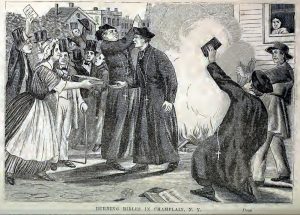
After reading this, need any one be surprised at the burning of the Bible by Roman Catholics, as has been done even within these United States? It was only carrying out in practice the doctrine of the pope’s letter, and “consuming the depraved elements of the evil” of which he complains, and which could not “otherwise be destroyed than by the flames.”
When the Mexican nation formed for themselves a new constitution, about the year 1843, they inserted an article in which they profess and declare that they “will protect the Roman Apostolical Catholic religion to the exclusion of all others.” Provision also is made in favor of soldiers and priests in another clause, in which it is said that “the military and ecclesiastical body shall remain subject to the same authorities under which they are placed by existing laws.” These “existing laws,” it is well known, exempted the persons mentioned from amenability to the civil authorities. Here, then, we have a specimen of papal liberty: no religion is tolerated or protected in the enjoyment of its privileges but the Roman Catholic, and an express provision is made that her military and ecclesiastical bodies shall not be amenable to the same laws by which other citizens are bound. And let it not be overlooked here that this exemption of the clergy from the operation of the civil laws of the country is precisely the same which was promulgated by the Third Council of Lateran in the twelfth century, and by the Fourth Council of Lateran and by Boniface VIII. in the thirteenth century, thus proving that the system of Romanism is the same in every age, and where opportunity is afforded it operates in the same intolerant form.
In closing our proof on this point, I refer, without details, to the edict of the Inquisition of Ancona against the Jews, issued by Fra Vicenzo Salena, the inquisitor-general of Ancona, appointed by the then reigning pontiff, Gregory XVI. By this edict the Jews were deprived of their most precious domestic, civil and religious privileges, and subjected to the severest penalties for its infraction; and as this edict is dated June 24, 1843, it cannot be excused or discredited as belonging to the dark ages. Surely, in view of these facts, the veriest skeptic must cease to doubt or to demand further proof that popery is the same now that it was in the time of Hildebrand, and that if “the penalties prescribed in the edicts of the Holy Inquisition” are not inflicted in other parts of the world than in Italy and South America, it is not for want of the will on the part of the pontiffs and their officials, but the want of power.
We have thus discussed the question in reference to the opposition of Romanism to civil and political liberty. This we have done not by loose declamation or embellished rhetoric, but by the presentation of facts and arguments, the greater part of them drawn from their own books, from the decrees of their councils, the bulls of their popes, and the acts of their official and authorized agents. From these undoubted sources we have shown you that Romanism deprives the people of the free use of the Bible, the great text-book of civil liberty, and, by doing so, saps its very foundations. We have presented to you the proof that it vests in the hands of the pope, or the pope and the general councils, a despotic and irresponsible power, altogether incompatible with the safe enjoyment of personal and public liberty. We have shown you that, by the teachings of Romanism, moral obligation is set aside, oaths and compacts disregarded, and human rights sacrificed for the benefit of the Church. We have, moreover, demonstrated that this system is intolerant and persecuting in its nature, and that now, as in former days, the opportunity and the power only are wanting to make the flames of the Inquisition the arbiters of men’s opinions and the purifiers of their faith.
What impressions these statements may make on men’s minds we do not know. But the subject has been discussed from a deep conviction that it is one with which American Christians and citizens should be acquainted. At the present time it is especially important to scan its nature and with watchful eye observe its progress. Special efforts are and have been making by the see of Rome and her adherents on the continent of Europe to propagate Romanism in these United States. Immense sums of money are expended annually for this purpose. Multitudes of Roman Catholic emigrants are encouraged and aided to come over to this fair land and possess it. Jesuit priests, the faithful and well-trained officials of the pope, are constantly arriving. Bishoprics are being erected, and bishops, consecrated by pontifical hands, are placed in all our large cities to sustain the interests of Rome and to exert their influence in favor of principles which, if carried into practical effect, would subvert our liberties.
This is no idle dream, as some would have it believed. It is a living, acting reality, which, if it has not done so already, must, before very long, force itself on the attention of all. We ask our fellow-Christians to look at it, to examine its workings, and to offer up prayers to God continually that the Protestant Church and country may be led to the adoption of such moral and religious means as may most effectually stem its progress.
We ask no inquisitorial power, no infuriate mob, to aid us in withstanding the march of popery. “The weapons of our warfare are not carnal.” It is by moral force alone that we hope to prevail. It is by the word of God, by the power of the Holy Ghost, by the administrative energy of the Lord Jesus Christ, the only Head of the Church, that we look for the destruction of this despotic power, and the establishment and triumph of pure religion and civil liberty throughout the world.
Download
Romanism-the-enemy-of-civil-liberty in a single PDF file. It’s only 221 KB compared to the 5.2 MB file I got the text from.
Related posts:

The Sacraments Part II

The Grand Design Exposed Chapter 2 The Knights Templar Paves Way For Protestant Reformatio...
The Papal System - XXXVIII. The Scriptures

The Prophetic Outlook Today - The Judgment Of The Great Harlot

Genocide in Satellite Croatia Chapter III. The Fall of Yugoslavia and the Creation of the ...
The Red Republic Chapter 6—The Broad Street of The Great City.
Lectures on Romanism By Joseph F. Berg – Lecture X. Christ And Antichrist Contrasted.
Papal Power