
God’s Pilgrims – Chapter 10 Judgment Beginning at the House of God
Continued from Chapter 9 The “Glory” to be Revealed in Us
CHAPTER 10 Judgment Beginning at the House of God
THE application of the foregoing Scriptures is, as to their main features, at least, clear enough; though as to some of the details there may be room for questions, and need of further light.
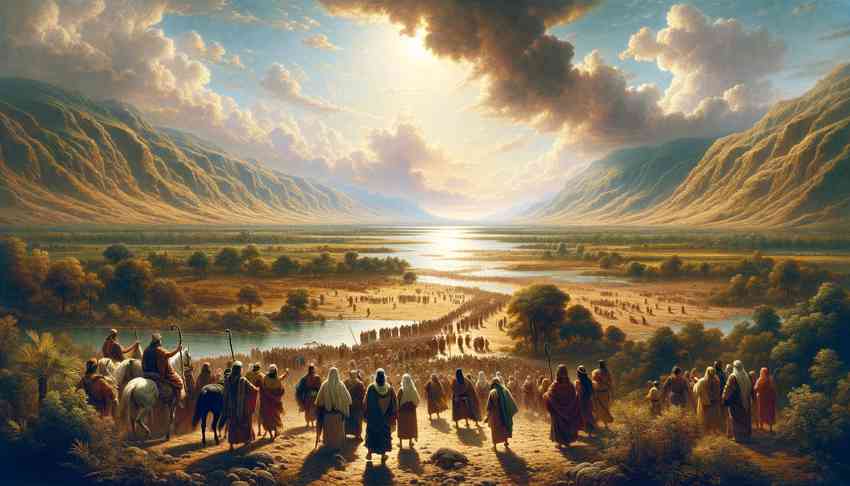
Canaan is put before us plainly as a type of the rest that remaineth for the people of God, and of the inheritance that the heirs of God are to share with the Firstborn in the age to come. That the rest and the inheritance are identical, or at least are very closely connected, appears from Deuteronomy 12:9: “For ye are not as yet come to the REST and to the INHERITANCE which the LORD your God giveth you.” What corresponds to this type is the renewed and restored Creation delivered from the curse, blessed with fruitfulness, and radiant with the glory of the Personal Presence of the Lord of Glory. That will be the place and the era of the Kingdom of God, the fulfillment of innumerable prophecies, when God shall set His King upon His holy hill of Zion. It will be the dispensation of the fullness of times, when the “adoption,” or placing of the sons of God, will occur. It will be the times of restitution of all things which God has spoken by the mouth of all His holy prophets since the world began.
From the Scriptures discussed above, we understand that the entrance into the glory of that Kingdom is a prize, or reward. A man must be born again in order to enter, or even see the Kingdom of God (John 3:3, 5); and also in order to enter that Kingdom he must do the will of God. For the Lord has plainly declared, “Not every one that saith unto Me, Lord, Lord, shall enter into the Kingdom of heaven; but he that doeth the Will of My Father, Who is in heaven” (Matthew 7:21). So also Hebrews 10:36 says that it is after we have, in patience, done the Will of God that we are to receive the promise. The Kingdom is for the poor in spirit, and for those who are persecuted for righteousness’ sake (Matthew 5:3, 10). It is to be sought, and the Father’s good pleasure it is to give it to the “little flock” who sell that they have, and give alms, and provide themselves bags that wax not old, a treasure in the heavens, that faileth not (Luke 12:31-34). No man looking back is fit for it (Luke 9:62). It is difficult for a rich man to enter it (Luke 18:24-25). The Apostle Paul exhorted the disciples, in various places, to continue in the faith, telling them, “that we must through much tribulation enter into the Kingdom of God” (Acts 14:22). And again he wrote commending the saints at Thessalonica for their patience and faith in all the persecutions and tribulations they endured, telling them that it was a manifest token of the righteous judgment of God, that they might be counted worthy of the Kingdom of God, for which they also suffered. We also understand from the Scriptures that the prizes or rewards of the Kingdom are graded and proportioned to the endurance, faith, and obedience of the children of God. There will be many places and stations in that Kingdom, more or less honorable, according to their nearness to the Person of the King. The Epistle speaks of the “habitable earth to come” of a “country” which will be in the earth, of a “city” which will be in the country, and of a “house” which will be in the city.
The dominion and authority of the Son will, of course, extend over the whole creation, which is broader even than the “habitable earth to come.” But we know that, even on earth, there will be nations who will render to the Lord only “feigned obedience,” and whom He must rule with rigidity — with a rod of iron. Those nations will rise in rebellion after the millennium (Revelation 20:8). During all the Kingdom of the Son, there will be “enemies.” “Rule Thou in the midst of Thine enemies” is the word of Psalm 110; and in Psalm 45 we read, “Thine arrows are sharp in the heart of the King’s enemies.” The Son must reign until He hath put “all enemies” under His Feet; and the last enemy that shall be destroyed is death. And when all things shall be subdued unto Him, then will He deliver up the Kingdom to God even the Father (1 Corinthians 15:24-28).
From these and other Scriptures it is evident that there will be, within the domain ruled by the Son, locations varying widely as to their conditions, from positions of the highest honor, glory and blessedness in “His own House,” to positions just the reverse among His “enemies.” There will be both the light of His own Presence within, where there is rejoicing and singing, and there will be also the “outer darkness, where shall be weeping and gnashing of teeth” (Matthew 25:30). The idea, which many Christians entertain, that the conditions prevailing in the coming Kingdom will be those of uniform blessedness, all saints being on exactly the same level, is certainly not according to the teaching of Scripture. On the contrary, it very clearly appears from the testimony of the Word of God, that there will be conditions of very diverse character; inasmuch as each believer may be assigned to just such a place as, according to the righteous judgment of the Lord, Who will review all his works, not overlooking so much as one “idle word,” he has merited.
According to our understanding of the teaching of God’s Word on this most solemn and important subject, all believers who sleep will be raised, and all believers who are alive and remain at the Coming of the Lord, will be changed and clothed with immortality, and all together will be caught up to meet the Lord in the air (1 Corinthians 15:23, 51-54; 1 Thessalonians 4:13-17). “For we must ALL appear before the judgment seat of Christ; that EVERY ONE may receive the things done in his body according to that he hath done, whether GOOD or BAD” (2 Corinthians 5:10). In view of this judgment of the believer’s works and conduct, the Apostle adds, “Knowing, therefore, the TERROR OF THE LORD, we persuade men”; a comment he certainly would not have been inspired to make, if nothing but rewards and blessings were to be bestowed at the judgment seat of Christ.
Inasmuch as judgment must begin at the House of God (1 Peter 4:17), we believe that at Christ’s judgment seat, the works of every saint of this dispensation will be passed upon, and each saint will be assigned to an appropriate place in the Kingdom of the Son. Whether or not, during the thousand years, there will be opportunity for gaining promotion is not revealed in the Bible, so far as the writer is aware. But certainly, not all who stand at Christ’s judgment seat will be assigned to places of honor, glory, and blessing. The Apostle John urges the little children to abide in Him “that (as the AV reads) when He shall appear, we may have confidence, and not be ashamed before Him at His coming” (1 John 11:28). This rendering does not give the force of the passage. The Apostle says, “And NOW little children, abide in Him, that WHEN HE SHALL BE MANIFESTED, we may have confidence, and not be PUT TO SHAME FROM BEFORE HIM at His Parousia (the second coming of Christ).” Abiding in Him now, at the present time, will give confidence then, and will insure us from being sent away in disgrace from His Presence.
Other Scriptures, particularly the words of the Lord Jesus Himself, add their clear warnings. In Matthew 25, where the Lord is speaking to His own disciples, not to the multitude, He instructs them as to the importance of watching, and of serving with diligence in regard to the responsibilities severally committed to them. He clearly states that the faithful servant will hear the word, “Enter thou into the joy of thy Lord,” and will be made “ruler over many things,” while the slothful and unprofitable servant will be cast into the outer darkness, where shall be weeping and gnashing of teeth (Matthew 25:14-30). It should be observed that this judgment takes place just before “the Son of Man shall come in His glory” (verse 31).
So also, in Matthew 24, He describes the conditions on earth just previous to His coming, as similar to those existing in the days of Noah, just before the flood. “For as in the days that were before the flood, they were eating and drinking, marrying and giving in marriage, until the day that Noah entered into the Ark, and knew not until the flood came and took them all away; so shall also the coming of the Son of Man be” (Matthew 24:38-39). The Lord does not speak here of the evil deeds and immoralities that the men of that day committed, but merely of the fact that, disregarding all warnings, they continued wholly absorbed in the things of this life, as if its course were never to be interrupted. In view of this, He counsels His disciples to “watch,” and says, “Therefore, be YE also ready, for in such an hour as ye think not the Son of Man cometh.” Inasmuch as a like warning is given to the Church in 1 Thessalonians 5:6, we shall greatly err if we think the above quoted words of the Lord have no meaning for us. In that connection, the Lord declares what the punishment of the wicked servant would be, namely, that “the Lord of that servant shall cut him asunder, and appoint him his portion (or share) with the hypocrites: there shall be weeping and gnashing of teeth” (Matthew 24:51). The hypocrites, according to Matthew’s Gospel, are the Scribes and Pharisees. The extent and duration of the “portion,” or share, which the wicked servant will receive with the hypocrites, is not indicated. Doubtless, it will be determined according to all the circumstances of each several case. In passing, judgment upon Nebuchadnezzar, the heavenly messenger said, “Let his portion be with the beasts of the earth;…and let seven times pass over him.” In another Scripture (Luke 12:45—48), the Lord indicates that the punishment will be proportional, saying, “And that servant, which knew his Lord’s will, and prepared not himself, neither did according to His Will, shall be beaten with many stripes. But he that knew not, and did commit things worthy of stripes, shall be beaten with few stripes. For unto whomsoever much is given, of him shall be much required.”
Again, in another place He said to His own disciples, “And take heed TO YOURSELVES, lest at any time YOUR hearts be overcharged with surfeiting and drunkenness, and cares of this life, and so that day come upon YOU unawares. For as a snare shall it come on all them that dwell on the face of the whole earth. Watch YE, therefore, and pray always, that ye may be ACCOUNTED WORTHY to escape all these things that shall come to pass, and to stand before the Son of Man” (Luke 21:34-36). To stand before the Son of Man will be the privilege of those who are accounted worthy of entrance into the Kingdom. That these words apply to believers of the present dispensation is evident from Paul’s words to the saints at Thessalonica, when he spoke of their growing faith and abounding love, and of the tribulations they endured, as a token of God’s righteous judgment that they might be “COUNTED WORTHY of the Kingdom of God for which they suffered” (2 Thessalonians 1:3-7); and when he further said, “Wherefore also we pray always for you, that our God would COUNT YOU WORTHY of this calling, and fulfill all the good pleasure of His goodness and the work of faith, with power” (verse 11).
Let us, therefore, give heed to the things that we have heard, and let us give all diligence to enter into that glorious rest that remaineth to the people of God.
Having considered the rewards promised to those who have heard the call to become Hebrews, and who have held the beginning of their confidence firm to the end, and having also considered the dangers to which they are exposed, let us again, at this point, bring to mind the resources that God has made available to offset those dangers, and to save His pilgrims therefrom.
First of all, we have a great High Priest Who has passed through the heavens — Jesus, the Son of God. He is able to save to the uttermost — that is, from every danger that threatens, and to every blessing that God’s grace has provided, them that approach God by Him. Therefore we should approach with a TRUE HEART in full assurance of faith (Hebrews 10:22). Our approach is perfect, because it is in virtue of a perfect Sacrifice; whereas the sacrifices offered under the old dispensation were imperfect, and “the law could never with those sacrifices make the comers thereto (the approachers) perfect” (Hebrews 10:1). The approach must be in the assurance of faith. “Without faith it is impossible to please Him; for he that cometh unto God (the approacher to God) must believe that He is, and is a Rewarder of them that seek Him” (Hebrews 11:6). Hence we should in faith seek constantly the services of our Great High Priest.
Second. In addition to the One Who makes intercession for us above, we have another Intercessor with us here below. “The Spirit Itself maketh intercession for us with groanings which cannot be uttered” (Romans 8:26). Our High Priest is “touched with the feeling of our infirmities”; and the “Spirit also helpeth our infirmities.”
Third. We have access every moment to a Throne of Grace. The Word of God exposes the thoughts and intents of our hearts, revealing the presence there of inclinations and desires contrary to the purpose of God, and which, if followed, would cause us to turn aside, and to depart from the living God. Hence the provision of “mercy” and “grace.” If the thoughts and intents of our hearts were what they should be, we would not need either; because mercy is for the erring, and grace is for the undeserving.
Wonderful and blessed is the provision that God has made for His pilgrims to save them from dangers and to help their infirmities.
(To be continued.)
Related posts:
The Chamber of Imagery in the Church of Rome Laid Open - Section IV: The Headship of Chris...

Scapegoating the Jews - By Darryl Eberhart

A Disputation On Holy Scripture Against The Papists. Question the First of the First Cont...
The Sower and the Virgin – Historical Retrospect.—Purification Before Birth.

Freedom And The Protestant Ethic
Lectures On The Apocalypse – Appendix Of Symbols

Foreign Conspiracy Against the Liberties of the United States - By Samuel F. B. Morse

The Sower and the Virgin – Historical Retrospect.—Fourth Period. 942 A.D.