Lectures on Romanism By Joseph F. Berg – Lecture IV. Invocation Of Saints. Part 1.

Continued from Lecture III. Purgatory. Part 2.
LECTURE IV.
INVOCATION OF SAINTS.
“GET THEE HENCE, SATAN: FOR IT IS WRITTEN, THOU SHALT WORSHIP THE LORD THY GOD, AND HIM ONLY SHALT THOU SERVE.”
In entering upon the consideration of the question, whether the worship of saints is authorized by Scripture or not, we should all feel the importance of decision. It is not of small moment whether the practice of the Romish church, in this matter, be right or wrong; for the subject is intimately connected with the worship of God, and affects, most materially, the mode of the sinner’s approach to Him. If it is right to invoke departed saints; if God has commanded us to wait upon them, then Protestants are guilty of gross disobedience in refusing to call upon them; but if there is no warrant in Scripture for the practice, and especially, if the revealed will of God is decidedly opposed to the intervention of the saints, as mediators or helpers, then all the worship that is offered them must be hateful to God, and ruinous to the souls of men.
The subject before us is, therefore, one of practical interest. The inquiry is nothing less than, “How am I to approach God with acceptance? How am I to pray to him?” Is it through the Lord Jesus Christ, as the one, the only mediator? Or through Him, and the saints in heaven? Through one advocate, or through a host of advocates? The Lord guide us by his good Spirit into the truth in this important inquiry.
Papists distinguish the worship which they offer to God, the Virgin Mary, and the saints, by the terms—latria, hyperdulia, and dulia.
In order to give the Roman Catholic side of the question all possible advantage, I will state their argument in their own language.
1. Concerning the invocation of saints, the Council of Trent teaches as follows:
- “The Holy Council commands all bishops, and others, who have the care and charge of teaching, that, according to the practice of the Catholic and apostolic church, received from the first beginning of the Christian religion, the consent of venerable fathers, and the decrees of holy councils, they labour with diligent assiduity to instruct the faithful concerning the invocation and intercession of the saints, &c., teaching them that the saints, who reign together with Christ, offer their prayers to God for men; that it is a good and useful thing suppliantly to invoke them, and to flee to their prayers, help, and assistance, because of the benefits bestowed by God, through his Son Jesus Christ our Lord, who is our only Redeemer and Saviour; and that those are men of impious sentiments who deny that the saints, who enjoy eternal happiness in heaven, are to be invoked; or who affirm that they do not pray for men; or to beseech them to pray for us is idolatry; or that it is contrary to the word of God, and opposed to the honour of Jesus Christ, the one mediator between God and men; or that it is foolish to supplicate, verbally or mentally, those who reign in heaven.”*
* Council of Trent Session xxv.
The Grounds of Cath. Doct, p. 68, contains the following words of wisdom:—
“What do you mean by the invocation of saints?
“I mean such petitions or requests as are made to desire their prayers and intercession for us.
“Do Catholics pray to saints?
“If, by praying to saints, we mean addressing ourselves to them, as to the authors or disposers of grace and glory, or in such manner as to suppose they have any power to help us, independently of God’s good will and pleasure, we do not pray to them; but if, by praying to saints, we mean no more than desiring them to pray to God for us, in this sense we hold it both good and profitable to pray to the saints.”
I shall postpone my remarks upon this second answer until the proofs which are advanced in support of the practice have been examined.
“How do you prove that it is good and profitable to desire the saints and angels in heaven to pray to God for us?
“Because it is good and profitable to desire the servants of God here upon earth to pray for us; ‘for the prayer of a righteous man availeth much.’. James-v. 16. Moses, by his prayers, obtained mercy for the children of Israel. Exod. xxxii. 11, 14. And Samuel, by his prayers, defeated the Philistines. 1 Sam. vii. 8—10. Hence, St. Paul, in almost all his epistles, desires the faithful to pray for him; and God himself commanded Eliphas and his two friends to go to Job, that Job should pray for them, promising to “accept of his prayers.” Job xlii. 8.
We do not deny that it is right to desire an interest in the prayers of God’s people, upon earth; but Protestants hold that there is a vast difference between applying to the saints on earth, and invoking the departed spirits of just men made perfect. When we go to a friend, in whose piety we have confidence, and ask him to pray for us, we have Scripture for the practice. “The effectual, fervent prayer of a righteous man availeth much,” but we have no such Bible warrant to authorize us to invoke departed saints. The Bible says not one word about the duty of asking the patriarchs, and prophets, and apostles, and martyrs, and, above all, the blessed Virgin, to intercede for us.
Besides, there is a wide difference between praying to a saint in heaven and asking a saint on earth to pray to God for us. But, in the Grounds of Cath. Doct., we are asked the following question: “Now, if it be acceptable to God, and good aid profitable to ourselves, to seek the prayers and intercession of God’s servants here on earth, must it not be much more so to seek the prayers and intercession of the saints in heaven; since both their charity for us, and their intercession with God, is much greater now than when they were here upon earth?”
Notwithstanding the great emphasis which Pope Pius’s priest lays upon this question (and from the style in which it is propounded, it evidently appeared, to his mind, to settle the whole controversy) there are several very serious difficulties in the way; and, before I shall ever invoke the saints whose names are on the Roman calendar, these difficulties must be removed.
1. In the first place, it is not proved that the saints in heaven are within hearing. Now this is a very important matter, as every one must allow. How shall St. Peter, or St. Winifred, help me if they cannot hear me? I think it is more than probable that the saints in heaven are ignorant of our wants and cannot hear our prayers because I read in the word of God: “The living know that they shall die; but the dead know not any thing, neither have they any more a reward; for the memory of them is forgotten.” Ec. ix, 5. On this principle, I suppose it was, that Elijah said to Elisha, “Ask what I shall do for thee, BEFORE I be taken away from thee.” 2 Kings ii. 9.
2. And then, there is another serious obstacle in the way. It is certain that the saints cannot hear all who call upon them unless they are omnipresent. How, e.g., shall the Virgin Mary hear all the suppliants, who invoke her at all hours of the day, and of the night, and in every part of the earth, where there is a Romish church, or priest, or layman, unless she is omnipresent? Now, you cannot separate the attributes of Deity. Show me a being that is infinite in any of the essential qualities of his character, and I am bound to ascribe to him, or to her, all the attributes of the Godhead. Then, if the Virgin Mary is omnipresent, she is a Goddess. If the Almighty, then, is the King of heaven, she must be the Queen of heaven; and this, by the way, is actually one of the titles ascribed to her in Roman Catholic prayer books. Queen of heaven! The Bible says nothing about Mary’s being the queen of heaven.
I must confess, however, that there is mention made, in the word of God, of this title. The expression occurs three or four times, in the forty-fourth chapter of Jeremiah, but I do not believe that the Virgin Mary was intended. At all events, I should be afraid to invoke “the queen of heaven” after reading what I find in this passage.
- “Thus saith the Lord of hosts, the God of Israel, saying, Ye and your wives have both spoken with your mouths, and fulfilled with your hand, saying, We will surely perform our vows that we have vowed, to burn incense to the queen of heaven, and to pour out drink-offerings unto her; ye will surely accomplish your vows, and surely perform your vows. Therefore hear ye the word of the Lord, all, Judah that dwell in the land of Egypt; Behold, I have sworn by my great name, saith the Lord, that my name shall no more be named in the mouth of any man of Judah, in all the land of Egypt, saying, The Lord God liveth. Behold, I will watch over them for evil, and not for good; and all the men of Judah that are in the land of Egypt shall be consumed by the sword and by the famine, until there be an end of them. Yet a small number that escape the sword shall return out of the land of Egypt into the land of Judah; and all the remnant of Judah, that are gone into the land of Egypt to sojourn there, shall know whose word shall stand, mine, or theirs.” (Jer. xliv. 25—28.)
3. But there is another thing, which I should like to have satisfactorily settled before I embrace the views of Pope Pius, on this question. It is this: I should wish to be sure that all the Roman Catholic saints are in heaven, because, if I were to invoke a saint who should happen to be anywhere else but in heaven, it would be a very grievous and serious mistake. Now, I confess, I am a little skeptical on this point; for I find, upon the list of Romish saints, a great many names that used to belong to persons, whose characters were not very saint-like, when they dwelt in this lower world. Indeed, in some instances, their real names were in such bad odor that his Holiness had to give them new names when he made saints of them; for they never would have been recognized as saints under their old ones; and, be it remembered, the Pope makes saints, not by sanctifying, but by canonizing. Now, this is a process in which I cannot place much confidence, principally because it is not recommended in the Word of God. I cannot see how the notorious Garnet, who was hanged for plotting against the British government, in the reign of Queen Elisabeth, should become worthy of the invocation of the faithful, by the Pope’s canonizing him as St. Henry? And I never shall ask St. Dominick; the bloody patron of the Holy Inquisition, to pray to God for me; for if he can be heard at all, he had better pray for himself.
The saints in the Romish church may be called Legion, for they are many. Their lives, published by the Bollandists, fill only fifty-four massive folio volumes, which extend no farther than the month of October; and the little Hagiography of Mr. Alban Butler extends through twelve closely printed volumes.
Among these reputed saints, there are a few who were holy men and who deserve to be held in everlasting remembrance. But there are others whose existence is altogether fabulous, and the mystery is, how sensible Roman Catholics can ever be brought to believe in the existence of such persons. There was the gigantic Saint Christopher, who is fabled to have carried Christ across an arm of the sea; Saint Amphibolus, who turned out to be the cloak of Alban, the reputed proto-martyr of England; Saint Longinus, the Roman soldier who thrust the spear into Christ’s body on the cross; Saint Ursula, with her eleven thousand virgin martyrs, of whom no traces are to be found in any history except the “Lives of the Saints,” &c. &c.
If the great Saint Francis had lived in this Christian country and age, his name would probably have been enrolled anywhere else sooner than upon the record of the saints. Our police and civil magistrates are not in the habit of canonizing men who throw away their clothes, and run about nudior ovo (more naked than an egg).
A Roman Catholic may, perhaps, wish kindly to obviate the first objection which I made, viz, that the departed saints cannot hear the prayers that are made to them, by telling me “If they cannot hear us, God can, and he can tell the saint that we are asking him (the saint) to intercede for us with the Lord. Now, does not this remove the difficulty? The saint will then be notified of all that he needs to know to enable him to intercede for us!” I have no doubt, my friend, that God can do this, but whether he will do it is another thing. God has not commanded you to invoke the saints; this is not pretended by anyone, and therefore, you have no right to expect that God will condescend to your whim in this matter. Besides, only see what a roundabout way this is of getting at the thing. You invoke one of the saints, “Oh! St. Nicholas, pray for me!” Then God, according to this theory, informs St. Nicholas that a certain sinner on earth wants him (St. Nicholas) to pray to him (the Lord) for some special blessing. Now, my friend, I think this is a singular method. Would it not be a great deal better not to trouble St. Nicholas, but to go at once to the good Lord in the name of the one mediator, Jesus Christ? I think it would.
But I am forgetting Pope Pius.* He justifies the invocation of the saints on the ground, that “both their charity for us, and their intercession with God, is much greater now than when they were here upon earth.”
* I mean the writer of the Grds, of C.D. whoever he was. The Grds. of C.D. are merely a development of the views contained in Pope Pius IV.’s Confession of Faith. I hope it is not a mortal sin to hold Pope Pius responsible for the sentiments of his commentator.
I should have been better satisfied if some proof had been advanced in support, particularly of the last proposition; as it is, they both rest upon mere assertion, and in addition to this, they have nothing to do with the subject. The question before us is not, “Whether the saints in heaven pray for men, but whether we should pray to the saints.” As to the former question, whether the saints in heaven pray for men, the Scriptures say nothing about it, and therefore it is not modest to be very positive one way or the other. We protest against making mediators of the saints by invoking them, or asking them to help us, and to pray for us. Whether the happy spirits in glory pray for us of their own accord or not is altogether another question, and one which we leave undecided.
The two following questions and answers in the Grounds of Cath. Doct. contains an apology, and not proof. I shall examine this apology when I have done with the proof, or apology for proof, which is offered in support of the practice of the invocation of saints.
“Have you any reason to think that the saints and angels have any knowledge of your addresses or petitions made to them?
“Yes, we have. First, because our Lord assures us, ‘that there is joy in the presence of the angels of God over one sinner that repenteth.’ For if they rejoice at our repentance, consequently they have a knowledge of our repentance; and if they have a knowledge of our repentance, what reason can we have to doubt of their knowing our petitions also? And what is said of the angels is also to be understood of the saints, of whom our Lord tells us, ‘that they are equal unto the angels.’”
This question ought, I think, to have been the first of all; but even supposing that all the evidence which is adduced to prove that the saints take knowledge of our addresses were to the point, this would not prove that it is right to invoke them. The saints may be aware that Roman Catholics call upon them, and in their hearts, they may abhor the invocation as idolatrous. Pope Pius does not stick to his text. He is to prove that it is right and lawful to invoke the saints, not that the saints know when we pray to them. Even this is far from being probable. But are we not told that there is joy in the presence of the angels of God over one sinner that repenteth?” Yes, we are. “Then the angels have a knowledge of our repentance.” Undoubtedly. “If they have a knowledge of our repentance, what reason can we have to doubt of their knowing our petitions also?” A very great reason, because the one case is clearly revealed in the Bible, but the other is not.
Let us look at the parable, and this will appear. The shepherd has lost a sheep, he leaves the ninety-nine in the wilderness, and goes after that which was lost till he finds it; and when he has found it, he lays it on his shoulders, rejoicing, and when he comes home, he calls together his friends and neighbours, saying unto them, “Rejoice with me, for I have found my sheep that was lost.” How natural everything appears if left as the Saviour has stated it. He says to the angels, “Rejoice with me.” They have the joyful intelligence directly from the Saviour. Now, if you will show me a passage which represents Jesus Christ as telling the saints or angels, “such and such a sinner is invoking you, and wishes you to ask me to grant such a favor,” I will admit that the cases are precisely parallel, but not before.
Let us examine the next proof.
2dly. “Because the angels of God (who) are always amongst us, and therefore cannot be ignorant of our requests; especially since, as we have seen from Rev. v. 8, and viii. 4, both angels and saints offer up our prayers before the throne of God, and therefore must needs know them.”
“The angels are always amongst us.” This language is objectionable, for the angels are not always amongst us; “they are ministering spirits sent forth to minister to the heirs of salvation,” and consequently must be sometimes in heaven, or they could not be sent forth.
The text to which we are referred in Rev. v. 8, will also be found, I think, by no means favorable to the practice of invoking the saints. “The four beasts and four and twenty elders fell down before the Lamb, having every one of them harps and golden vials full of odours, which are the prayers of the saints.” This text refers either to the church on earth, or to the church in heaven; if to the former, the explanation is as follows: the four beasts and four and twenty elders represent the ministers and people of Christ’s church; the harps, the songs of praise, and the odour or incense, their prayers. This is all typical of the worship of the church on earth. But if we understand the passage as alluding to the church in heaven, it can prove only one thing, and that is, that they may pray even there. It does not follow that they offer our prayers. This is the very point to be proved. It cannot even be made to appear that they pray for us. There is not a single prayer of the saints in heaven for those on earth, recorded in the whole apocalyptic vision, nor in any other portion of the Bible. The only prayer which we read of as coming from them is for themselves.
“I saw under the altar the souls of them that were slain for the word of God, and for the testimony which they held; and they cried with a loud voice; saying, How long, O Lord, holy and true, dost thou not judge and avenge our blood on them that dwell on the earth?” Now this does not prove that the saints in heaven intercede for us; and even if that point should be established, the main question is not reached, because it must be shown that we are warranted from Scripture in calling upon the saints by name, and in soliciting their intercession.
3dly. “Because it appears from Apoc. xi. 15, and x. 1, 2, that the inhabitants of heaven know what passeth upon earth. Hence St. Paul, 1 Cor. iv. 9, in speaking of himself and his fellow apostles, saith, ‘We are made a spectacle unto the world, and to angels, and to men.’”
There is nothing new in this paragraph; so far as Scripture proof to establish the invocation of saints is concerned, there is not a single iota of evidence offered in any one of the Scriptures to which we are referred. I shall, therefore, not detain you any longer on this point than simply to read the texts which are designated. (Rev. xi. 15.) “And the seventh angel sounded, and there were great voices in heaven, saying, the kingdoms of this world have become the kingdoms of our Lord, and of his Christ, and he shall reign forever and ever.” (Rev. x. 1,2.) “And I saw another mighty angel come down from heaven clothed with a cloud, and a rainbow was upon his head, and his face was as it were the sun, and his feet as pillars of fire: and be had in his hand a little book open, and he set his right foot upon the sea, and his left foot on the earth and cried,” &c.
And in the last place, “We are made a spectacle unto the world, and to angels, and to men.” (1 Cor. iv. 9.) It is worthy of remark that in both the passages from Revelation, the inhabitants of heaven seem to acquire their information respecting the affairs of men from another angel. This does not, therefore, sustain the theory that the saints and angels can always hear the prayers of those who invoke them. Much less does it prove that it is our duty, or that it is “good and profitable” to fly to them for help, even though we were made a spectacle to all the angels and saints in heaven!
The following paragraph is also designed to prove that the saints know what passes on earth:
4thly. “We cannot suppose that the saints and angels who enjoy the light of glory, can be ignorant of such things as the prophets and servants of God in this world have often known by the light of grace, and even the very devils by the light of nature alone; since the light of glory is so much more perfect than the light of grace or nature, according to the apostles, ‘For now we see through a glass darkly; but then face to face: now I know in part, but then I shall know even as also I am known;’ that is by a most perfect knowledge. Hence 1 John iii. 2, it,is written, ‘we shall be like him, (God,) for we shall see him as he is;” now it is certain that the servants of God in this world, by a special light of grace, have often known things that passed at a great distance, as Elisha, 2 Kings v., knew what passed between Naaman and his servant Gehazi; and 2 Kings vi. what was done in the king of Syria’s private chamber. It is also certain that the devils, by the mere light of nature, know what passes amongst us, as appears in many places in the book of Job, and by their being our accusers. (Rev. xii. 10.) Therefore, we cannot reasonably question but that the society in heaven knows the petitions which we address to them.”
Now, in my own mind, I have no doubt that the saints in heaven are made acquainted with events that transpire on earth, of special interest to the cause of Christ. That they do feel a deep concern for the spiritual prosperity of their brethren on earth cannot, I think, fairly be questioned; they are a part of the same spiritual household, and no doubt rejoice in anticipation of the day when their brethren on earth shall, like themselves, be perfected in love and see God as he is. But I do maintain that there has not yet been a single Scripture brought forward which approaches a proof that the departed saints know everything relative to every particular person upon earth. Now this must be proved before we can be certain that they hear us, and after this has been established, we ask again, “What has all this to do with the main question?” Where is the Scripture that tells us “it is good and profitable to invoke departed spirits?”
As to the plea that the very devils know what is done on earth, and that therefore the saints in heaven must know it, the inference is so glaringly false that it is not worth the trouble of refuting. Besides, the passages which relate to the perfect knowledge of the saints, very plainly refer to heavenly and not to earthly things. The perfect knowledge of every thing that is done on earth would, I suppose, hardly contribute to the happiness of those who are forever done with the turmoils and troubles of this world!
We come now to the closing paragraph on this head, and it is the strangest of all.
5thly. “In fine, because it is weak reasoning to argue from our corporeal hearing, (the object of which being sound, that is, a motion or undulation of the air, cannot reach beyond a certain distance,) concerning the hearing of spirits, which is independent on sound, and consequently independent of distance; though the manner of it be hard enough to explicate to those who know no other hearing but that of the corporeal ear.”
Pope Pius, having enjoyed the benefit of another revelation, I cannot pretend to cope with him here. He tells us, “ex cathedra,” that “the hearing of spirits is independent of sound.” If so, it is not hearing, but some other faculty for which we have no name! For there is no hearing that is independent of sound. Besides, I think his holiness forgets himself here, or else his new revelation differs widely from the old one. John tells us, “I beheld, and I heard the voice of many angels round about the throne, and the beasts and the elders; and the number of them was ten thousand times, ten thousand, and thousands of thousands; saying, with a loud voice, worthy is the Lamb that was slain to receive power, and riches, and wisdom, and strength, and honour, and glory, and blessing!” And then again he tells us, “I heard a voice from heaven, as the voice of many waters, and as the voice of a great thunder, and I heard the voice of harpers harping with their harps: and they sang as it were a new song.”—Ah! then, there is music in heaven! But if “the hearing of spirits is independent of sound,” where is the use of music? I hope Pope Pius has found out his mistake long since. It would rejoice my heart to know that his voice is heard in that happy chorus, and that even now, his hand is sweeping the strings of a golden harp among the ransomed in glory; but I fear his holiness has hardly got out of purgatory yet. The following question is the last in the chapter:
“Have you any other warrant in Scripture for the invocation of saints and angels? Yes, we have the example of God’s best servants.”
Ah! This is to the point. The example of God’s best servants! We are willing to follow that. “Thus Jacob, Gen. xlviii. 15; 16, begs the blessing of his angel guardian for his two grandsons, Ephraim and Manasseh. ‘God, before whom my fathers Abraham and Isaac did walk, the God which fed me all my life long until this day, the angel which redeemed me from all evil, bless the lads.’ The same Jacob, Osee xii. 4, ‘wept and made supplication to an angel;’ and St. John, Rev. i. 4, writing to the seven churches of Asia, petitions for the intercession of the seven angels in their favor, ‘Grace be unto you, and peace from him, who is, and who was, and who is to come, and from the seven spirits which are before his throne.”
“Thus Jacob begs the blessing of his angel guardian for his two grandsons, Ephraim and Manasseh. God, before whom my fathers Abraham and Isaac did walk, the God which fed me all my life long until this day, the angel which redeemed me from all evil, bless the lads.” Would God that Roman Catholics would never invoke any other than the angel who redeems us from all evil! He is none other than the angel of the covenant, the blessed Saviour, our Lord Jesus Christ. He alone can redeem from evil, and he redeems from all evil. Jacob places the angel that redeemed him in apposition with the God that fed him, showing that they were one. But Hosea tells us, “the same Jacob wept and made supplication to an angel.” He did, he wrestled with the angel of the covenant till the break of day, and he prevailed, and his name from that time was no more called Jacob, but Israel, because like a prince, he had power with God, and prevailed.
To this angel he no doubt refers in the former quotation, when he speaks of the angel who redeemed him from all evil; for Jacob was in a perilous condition at the time when he wept and made this supplication. Esau was near at hand with an armed force, breathing vengeance against his brother who had supplanted him and gained his birthright; but Jacob prayed and wept, and the angel redeemed him from this evil. The Lord Jesus Christ is frequently spoken of as the angel of the covenant, and whenever redemption from sin and all evil is spoken of, it is in connection with the name of Jesus. “In him, in him alone, we have redemption through his blood.” Oh! Remember that no created angel can redeem from sin. This is the prerogative of the blessed Saviour.
But we are reminded of the salutation of John to the seven churches, “Grace be unto you and peace from him, who is, and who was, and who is to come, and from the seven spirits that are before his throne.” “Grace and peace were prayed for (by John) from the seven spirits before the throne.” This is generally and justly interpreted as “the divine Spirit.” The number seven is used here, as in some other passages, in an enigmatical or mystical sense, to denote the abundance of the gifts and graces of the Holy Spirit. The apostle, therefore, wishes grace and peace to the seven churches, out of the abundant fullness of the Holy Spirit! Now, at all events, even if Roman Catholics reject this interpretation, they cannot make out anything to suit their purpose from this passage. Pope Pius says, “John writing to the seven churches of Asia, petitions for the intercession of the seven angels in their favor.” John does no such thing. He expresses a wish that the “seven spirits” may confer grace upon the churches. He does not ask these spirits to pray for the saints. Now, who confers grace? The Holy Spirit, and he alone, from the inexhaustible riches of God’s mercy, and the fullness of these heavenly gifts, is denoted by the mystical number of “seven.” Hence, John’s prayer is that the churches may be abundantly blessed by the gifts and graces of the Holy Spirit!
I have now reviewed this chapter on the invocation of the saints, and I think I have shown that Roman Catholics have no warrant from Scripture for the practice. I am sure I can show that the Scriptures do most pointedly forbid it. The testimony of the word of God is so ample on this head that I shall be obliged to pursue the plan which I adopted in the last discourse, and arrange the opposing texts in classes. I cannot undertake to quote them all singly.
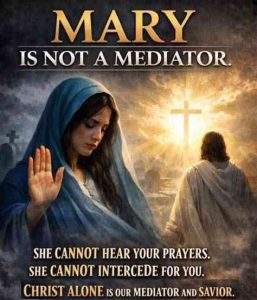
1. All those texts which represent Jesus Christ as the only mediator, directly condemn the invocation of saints. Let us hear the Lord Jesus himself, “I am the way, no man cometh unto the Father, but by me,”—not, I and my mother, and my apostles, and the patriarchs, and all the saints whom Pope Peter and his successors may canonize, are the way, and any man may come to the Father, by any one of us, but, “I am the way, no man. cometh unto the Father, but by me.”*
* Douay Bible, John xiv. 6.
The barrier to our approach to God was sin, but this Jesus has removed by the sacrifice of himself upon the cross, and now, through him, in his name, and in his name alone, we are invited to come to the Father. For, says Paul, “There is one God, and one Mediator between God and men, the man Christ Jesus, who gave himself a ransom for all.” What becomes of your host of mediators when the Bible tells me there is but one? “Ah!” says the Romanist, “the apostle means that Christ was the only atoning mediator, but not the only mediator of intercession.” Well, my friend, where does the apostle make this distinction? Show it to me in the word of God, and I will admit its justice. You look for it in vain, in the lively oracles of God, and well you may, for the distinction has never been made by the Holy Spirit. On the contrary, Paul refers to the ransom paid by Christ to show that it is this which constitutes Christ the only mediator. “There is one God, and one Mediator between God and men, the man Christ Jesus, who gave himself a ransom for all, to be testified in due time.” (1 Tim. ii. 5, 6.)
Why is it that the intercession of Christ is constantly alluded to in connection with his character and office as the High Priest of the gospel dispensation? Is not the great truth seen running through every Scripture, that refers to Christ as the only mediator, that he is such, because he alone has a right to mediate between God and sinners, inasmuch as he alone has atoned for sin? The distinction, therefore, which the church of Rome makes between Christ, as the only atoning mediator, and her host of interceding mediators, is a mere trick to elude the force of plain Scripture; for the Bible proves clearly that no one has a right to intercede between God and sinners, but the Saviour, who has atoned for the guilt of sinners! Now, if there is but one mediator, there cannot be many mediators; and if so, what good will our invocation of the saints do? This objection would naturally present itself to the mind of everyone familiar with the case and capable of thinking correctly on any subject. Pope Pius felt its force, and he tries to evade it. But he does not put the question fairly. Had he done so, he well knew it would be hard to find an answer that could justify the practice of the Romish church.
“Is there no danger, by acting thus, of giving to the saints the honour which belongs to God alone?”
“No; it is evident that to desire the prayers and intercessions of the saints, is by no means giving them an honour which belongs to God alone: so far from it, that it would even be a blasphemy to beg of God to pray for us; because, whosoever desires anyone to pray for him for the obtaining of a grace or blessing, supposes the person, to whom he thus addresses himself, to be inferior and dependent of some other, by whom this grace or blessing is to be bestowed.”
If the name of Christ had been substituted in place of God, the question would have been fairly put. The mediatorial honour of the Saviour belongs to him, not as God, but as the man Christ Jesus. As such, he intercedes for us with the Father; he mediates not in his divine, but in his human nature. Protestants never profess that the mediatorial office and work belong to God. Hence, you see the utter irrelevancy of the question in its present form.
It is easy, after placing the matter upon false premises, to refute an imaginary absurdity. Pope Pius’s priest insinuates, in his answer, that Protestants ask God to pray for them. He knew better; he knew that we depend upon the intercession of our great High-Priest, the Lord Jesus Christ; that we come to the Father through him alone; hence, there was no need for this expression of pious abhorrence of those who ask God to pray for them! This is a mere subterfuge, but it will not avail. The Saviour calls to everyone who would hide behind it,— “I am the way, no man cometh to the Father but by me.”
Continued in Lecture IV. Invocation Of Saints. Part 2.
Related posts:

Vatican Control through Civil Law

Calvinism Debunked

The Hierarchical Structure Of Roman Catholicism

Photos of U.S. Presidents meeting the Pope

A Sincere Roman Catholic Priest Finds Contradictions in the Teachings of the Holy Fathers

Lectures on Romanism By Joseph F. Berg – Concluding Remarks.
Who is the Prince of the Covenant of Daniel 11:22 ?

Papal Rome and the European Union - by Richard Bennett and Michael de Semlyen