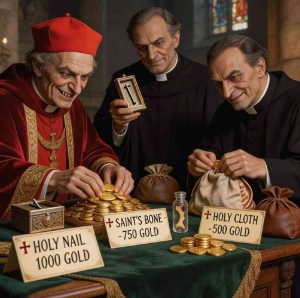
Lectures on Romanism By Joseph F. Berg – Lecture V. Veneration Of Images And Relics. Part 1.

Continued from Lecture IV. Invocation Of Saints. Part 2.
LECTURE V.
VENERATION OF IMAGES AND RELICS.
“Ye SHALL MAKE YOU NO IDOLS NOR GRAVEN IMAGE, NEITHER REAR YOU UP A STANDING IMAGE; NEITHER SHALL YE SET UP ANY IMAGE OF STONE IN YOUR LAND, TO BOW DOWN UNTO IT; FOR I AM THE LORD YOUR GOD.”
It is hard to conceive how a church professing to be the only one in which salvation may be obtained should sanction the veneration of images when the practice is so plainly forbidden in the word of God. Had I none before me, but such as were entirely free from all bias in favor, either of Protestantism or Romanism, I am confident, that, in order to convince them that the veneration of images, as practiced by the church of Rome, is directly at variance with the plain command of Scripture, nothing more would be necessary than simply to range the decrees of her councils, and the doctrines of her Catechisms, and authorized Confession of Faith, by the side of those precepts of God’s word, which refer to the worship of graven images. In order to convict Papists of evident departure from the truth of the gospel, I need do no more than place the decree of Trent against that of Sinai, and let the voice of Jehovah, uttered amid the thunderings and lightnings of the burning mount, rebuke the worm that dares to contradict him. Jehovah says, “Thou shalt not make unto thee any graven image, or any likeness of any thing that is in heaven above, or that is in the earth beneath, or that is in the water under the earth. Thou shalt not bow down thyself to them, nor serve them; for I, the Lord thy God, am a jealous God.”
Now, hear the Man of. Sin the Son of Perdition, who opposeth and exalteth himself above all that is called God, or that is worshiped; so that he, as God, sitteth in the temple of God, showing himself that he is God; “I most firmly assert, that the images of Christ, of the mother of God, ever virgin, and also of other saints, may be had and retained; and that due honour and veneration is to be given to them.”*
* Grounds of Cath. Doct. p. 6.
Jehovah says, “Thou shalt not make to thyself any graven image.” The man of sin says, “I most firmly assert that the images of Christ, of the mother of God, ever virgin, and also of other saints, may be had and retained; and that due veneration is to be given to them.”
But, plain as this case is, when viewed in the light of Scripture, the worship of images is strenuously upheld by papists, though by means of sophistry and false distinctions, they try to make it appear that, in reality, they do not violate the command of God. The second commandment of the Decalogue has always been a source of trouble to the doctors of the Romish church; so much so, that until they were shamed out of the fraud by Protestants, they uniformly omitted it in all their catechisms. I defy any man to show me the second commandment in any one of the manuals of the Romish church, before the Reformation! As late as 1658, we find Dr. Stillingfleet challenging a papist to tell him in what public office of their church the second commandment was to be found. Even yet, the priests have not been entirely cured of this attempt at imposition; for in the papal countries of Europe, the second commandment is not to be found in the catechisms in common use, if my information is correct; and I am the more inclined to believe its truth, because I find that there is no mention made of this commandment in the Christian’s Guide to Heaven, published with the approbation of the R. C. Bishop of this city.
Before a good papist goes to confess, he is directed to examine himself on the ten commandments. In this examination, there is not a word said about the graven images, which the Lord forbids us to make, in order to bow down to them; but, to eke out the full complement of ten commandments, the last, or tenth commandment, is divided so as to make two out of it.
I wish the bishop would let me supply a list of questions on the second commandment, because, as the case stands at present, the examination must be defective; and, as the Lord requires us to keep all his commandments, I think it would be safest to let the Almighty’s words stand as originally delivered to Moses, on the tables of stone. To be sure, it might occasion some little suspicion that all was not right if such a question as this were proposed. “Is there any image, or likeness of anything in heaven, or on earth, to which you have bowed down?” “Why, yes,” the Roman Catholic. must reply, “There is. I have bowed down to the crucifix in my chamber, and to the image of the Virgin Mary,” &c. Then the next question would be, “How often?” And, perhaps, it would be a difficult matter to answer that question satisfactorily, I do not, for a moment, dispute the policy of this omission. I think it is quite prudent; but whether it is altogether proper, or scriptural, is another question.
But I must proceed to examine the evidence offered in support of this practice of the Romish church. There is a long chapter on this subject in the Grounds of Cath. Doct., though there is very little matter offered as proof; the greater part of the chapter consists of apology. I have thought it best to make an analysis of the contents of this section, in order to hold up at one view the chief points upon which the veneration of images depends. The Grounds of Cath. Doct. (pp. 75—79) contains the following six propositions on this head.
1. Divine honours are not paid to images, but only relative honours.
2. The second commandment of the Decalogue, by no means, interferes with the use of images.
3. Several commands of God to Moses warrant the worship of images.
4. No trust or dependence is placed in images.
5. Sundry practices of Protestants are similar to the custom of the Romish church in this respect.
6. The dictates of common sense, as well as of piety and religion, teach that it is right to show proper veneration to images.
I. Roman Catholics maintain that they do not pay divine honour to images.
“What is your doctrine as to images?
“We hold that the images or pictures of Christ, of his blessed mother, ever virgin, and of other saints, are to be had and retained; and that due honour and veneration are to be given to them.
“Do you not worship images?
“No, by no means; if by worship you mean divine honour; for this we do not give to the highest angel or saint, not even to the Virgin Mary, much less to images.
“Do you not pray to images?
“ No, we do not, because, as both our catechism and common sense teach us, they can neither see, nor hear, nor help us.
“Why, then, do you pray before an image or crucifix?
“Because the sight of a good picture or image, for example, of Christ upon the cross, helps to enkindle devotion in our hearts, towards him that has loved us to that excess as to lay down his life for the love of us.
“What kind of honour do Catholics give to the images of Christ and his saints?
“A relative honour.
“What do you mean by a relative honour?
“By a relative honour, I mean an honour which is given to a thing, not for any intrinsic excellence or dignity in the thing itself, but barely for the relation it has to something else, as when the courtiers bow down to the ¢hair of state, or Christians to the name of Jesus,” &c.
As to the statement about the degree of honour paid to the Virgin Mary, we have already shown that divine honour is certainly paid to her; and I shall now show that to give, even what is called a relative honour, to images, is impious.
“By a relative honour,” Pope Pius says, “I mean an honour which is given to a thing, not for any intrinsic excellence or dignity in the thing itself, but barely for the relation it has to something else; as when the courtiers bow down to the chair of state, or Christians to the name of Jesus, which is an image or remembrance of our Saviour to the ear, as the crucifix is to the eye.” In other words, Roman Catholics show this outward honour to an image, on account of the person whom it represents, not because they believe there is any virtue in the image itself. Thus, when they bow to a crucifix, they consider themselves as bowing not to the wood or brass of which the crucifix is made, but to the Saviour, who is represented by it. Hence, the worship terminates upon the Saviour, and not upon the crucifix. This, I believe, is as fair a statement of the case as can be given.
1. I shall show that this distinction is altogether inadmissible. It is so, for the following reason: God has forbidden us to worship him in this way; of course, therefore, he will not accept the honour that is intended to be shown to HIM by bowing down to an image.
What is worship? So far as the act is concerned, it is nothing more than an external signification of honour and respect. Now this expression of honour, which is due to God, cannot be made acceptable when it is offered in a manner which God has forbidden, no matter what the intention of the worshiper may be. A man may intend to worship God when he bows down to an image, but if God has expressly said, “Thou shalt not bow down to it,” it is not probable that the Lord will consider himself honoured by the disobedience of his worshiper. If we once admit the doctrine that men’s intentions are to be the rule of divine worship, then we must concede to our Roman Catholic friends the right of promoting the glory of God by breaking his commandments. But if we declare the divine law to be the only rule of worship, all prohibited modes of honouring God must be an abomination to him.
Suppose Mehemet, the pacha of Egypt, should issue an edict, declaring it to be high treason for any of his subjects to bow down to a sign-post, ornamented with the figure of his head, under the pretence of giving the greater honour to their prince; what would he say, think you, if some of his subjects were to be brought before him, taken in the very act of disobedience? Would he be satisfied if they were to plead their intention of showing respect to him, after he had forbidden them to bow down to his image? Not he. I am disposed to believe that he would order the heads of his disobedient subjects to be fixed upon sign-posts, as a terror to others.
And will the great God, who absolutely forbids the worship of himself by means of an image, and who calls this worship idolatry, no matter with what intention it is offered, will he be pleased with the homage of those men who, in the very face of his prohibition, bow down to images, and plead their good intention? He will not. He is a jealous God.
It will, I presume, be admitted by everyone that God is the best judge of the propriety of the worship that is offered to him. Now, it is plain that He does regard all such worship as terminating on the image. One thing is certain: if it does not terminate on the image, it never reaches him. He abhors it. He will have none of it. How was it, when the Israelites, weary at the delay of Moses, who was on the mount, receiving the tables of stone, prevailed upon Aaron to make a golden calf? Said they, “These be thy gods, O Israel, which brought thee up out of Egypt!” They intended that the worship, which they paid to that idol, should terminate on God. They well knew that that stupid calf had not brought them out of the land of Egypt. They made it as a representation of the Lord Jehovah! Was he pleased? Was not the camp of Israel covered with the corpses of these idolaters? It is folly, then, to speak of worshiping God by showing honour to an image. Call it relative honour, or whatever you please, it is idolatry.
Indeed, the word “idolatry” is compounded of two Greek words, meaning image-worship. It may be worth mentioning, by the way, that the ancient Greeks and Romans justified bowing down to the images of Jove and Minerva, and their other gods and goddesses, by precisely the same plea which is now used by Roman Catholics. They did not honour the image, but the god who was represented by it. Indeed, the more enlightened, even among pagans, condemned the use of images. Zeno, and Plato, and Socrates, and others regarded all image-worship as contemptible.
I cannot dismiss this point without showing that the distinction between positive and relative worship is a mere imposition. In an exposition of the image-worship, enjoined by the second Council of Nice (which Romanists regard as a legitimate and infallible council), James Naclantus, bishop of Clugium, uses the following language:
- We must not only confess, that the faithful in the church worship before an image; as some over-squeamish souls might; peradventure, express themselves; but we must, furthermore, confess, without the slightest scruple of conscience, that they adore the very image itself; for, in sooth, they venerate it with the identical worship wherewith they venerate its prototype. Hence, if they adore the prototype with that divine worship which is rendered to God alone, and which technically bears the name of Latria, they adore also the image with the same Latria, or divine worship; and if they adore the prototype with Dulia, or Hyperdulia, they are bound also to adore the image with the self-same species of inferior worship.”*
* Faber’s Diff. of Rom. p. 210.
This, be it remembered, is an exposition of the doctrine of the second Nicene Council, published at Venice in the sixteenth century, with papal approbation.
2. The next proposition, which I will review, is, that the second commandment of the Decalogue, by no means condemns the use of images. This does not follow in the Grounds of Cath. Doct., immediately after the point which I have just discussed; but this is the proper place for it. Pope Pius asks, as well he may (Grounds, 77.)—
“But is it not forbidden (Exod. xx. 4.) to make the likeness of any thing in heaven above, or in the earth beneath, or in the waters under the earth?
“It is forbidden to make to ourselves any such image or likeness; that is to say, to make it our God, or put our trust in it, or give it the honour which belongs to God; which is explained by the following words; ‘Thou shalt not bow down thyself to them;’ that is, thou shalt not adore them; for so both the Septuagint and the Vulgate translate it; ‘nor serve them;’ otherwise, if all likenesses were forbid by this commandment, we should be obliged to fling down our signposts, and deface the king’s coin.”
My hearers need not be told, that Protestants do not condemn all likenesses; but all worship of images. We can admire sculpture and patronize the fine arts, without bowing down to graven images.
The best way of ascertaining the meaning of a commandment is to examine the terms in which it is expressed, and the reasons why the commandment was given. Exod. xx. 4, “Thou shalt not make unto thee any graven image, or any likeness of any thing that is in heaven above, or that is in the earth beneath, or that is in the water under the earth.”
There is no kind of image, graven or painted, whether of a real or imaginary being, that is not comprehended in the original language of this commandment. Not only is the making of similitudes in general forbidden, but any kind of likeness, whether of things in heaven, or things on earth, or things under the earth, is interdicted if made in order that men may bow down to them. Now, I cannot conceive how the Almighty could have revealed his will in relation to this matter more clearly than he has done. If the language is not sufficiently plain and emphatic in this case to preclude all misapprehension, then, I say, it is’ not in the power of words to convey any definite meaning. But Roman Catholics tell us that this commandment has reference solely to the idol gods of the heathen, and not to their pictures of the Father, Son, and Holy Ghost, and of the Virgin Mary and the saints, before which they do certainly bow down. But has the Lord said thou shalt not bow down to any graven image or likeness of things in heaven, or on earth, &c., except the images and pictures of the Trinity and the Virgin Mary and the saints? No. But he has said, “thou shalt not make to thyself any graven image,” &c., then certainly it is wrong to worship God, who is in heaven, under any similitude whatever.
If a king were to pass a law forbidding his subjects, under a severe penalty, to make any image or likeness of himself, with the intention of showing honour to him by kneeling before it, would not he be thought a strange interpreter of the law, who should tell the people, “The king does not forbid you to make any picture of himself, or of his Son, or of his favorites, and to bow down to them, because this must redound to his honour; and who does not see that if all likenesses were forbidden by this commandment, we should be obliged to fling down our sign posts and deface the king’s coin? But his majesty means that you must not make the image of an ass, or an ape, or a crocodile, and bow down to them, thinking to honour him by such worship.”
Now, my brethren, is not the exposition of the second commandment, as given by Romanists, very similar to this? The Lord forbids any image of himself to be used in connection with his worship; “but,” says the papist, “this does not exclude the crucifix, nor any picture of God himself; nor of his saints or angels, provided we intend to worship God and the saints by them, and do not suffer the worship to terminate on the images!” Again, if we consider the reason which the Scriptures give us for this prohibition of image-worship, our argument will appear still more conclusive. Hear the word of the Lord, (Deut. iv. 15, 16,) “Take ye therefore good heed unto yourselves, lest ye corrupt yourselves, and make you a graven image, the similitude of any figure, the likeness of male or female, &c., for ye saw no manner of similitude on the day that the Lord spake unto you in Horeb out of the midst of the fire.” If the Lord was warning the people merely against the idols of the heathen, why did he give this as the reason of the prohibition of image-worship, “For ye saw no manner of similitude in the day that the Lord spake unto you?” &c.
3. But another proposition laid down in the Grounds of Cath. Doct. is, that several commands of God to Moses warrant the use of images.
“How do you prove that it is lawful to make or keep the image of Christ and his saints?
“Because God himself commanded Moses, Exod. xxv. 18—21, to make two cherubims of beaten gold, and place them at the two ends of the mercy seat, over the ark of the covenant, in the very sanctuary. ‘And there, (says he, v. 22,) will I meet with thee, and I will commune with thee from above the mercy-seat, from between the two cherubims which are upon the ark of the testimony, of all things which I will give thee in commandment unto the children of Israel.’ God also commanded (Num. xxi. 8, 9) a serpent of brass to be made, for the healing of those who are bitten by the fiery serpent; which serpent was an emblem of Christ, John iii. 14, 15.”
If this means anything to the purpose, it implies that, because the Lord commanded Moses to make two cherubim and place them over the mercy-seat, therefore it is right for papists to bow down to the images of Christ and the saints. This is really too bad! Were these images of the cherubim placed there for the Jews to worship them? Why, my hearers, the Jews had no access to them, the High Priest and he alone could enter the Holy of holies, where the mercy-seat was kept, and even he could do so only once a year. The mercy-seat was an emblem (not a graven image,) of Christ, and the two cherubim of gold, with their faces toward the mercy-seat, were typical of the angels, who desire to look into the mysteries of redemption; the common people never saw the cherubim, consequently they could not bow down to them!
But then, we are told, God also commanded a serpent of brass to be made, for the healing of those who were bitten by the fiery serpents, which serpent was an emblem of Christ, &c. Yes, but it was not a likeness of Christ, though it was an emblem. “As Moses lifted up the serpent in the wilderness, even so must the Son of man be lifted up, that whosoever believeth in him should not perish, but have everlasting life.” As those who were bitten by the serpents, and who desired to be healed, were directed to look to the brazen serpent, so sinners who feel their guilt and condemnation are pointed to the Lamb of God who taketh away the sins of the world, through the atoning sacrifice which he offered on the cross. The object of the Lord in conferring a cure upon all who looked to the brazen serpent was to show that sinners are saved by faith in the Lord Jesus Christ, and thus to prove incontrovertibly that the Romish doctrines of penance and satisfaction, and works of supererogation are all inventions of the devil! As many of the serpent-bitten Jews as looked to the brazen serpent were cured at once; and as many as look unto the Lord Jesus Christ, feeling themselves to be miserable and wretched, shall also be healed; for he says, “Look unto me, and be ye saved, all the ends of the earth,” Is. xlv. 22.
By the way, the allusion to the brazen serpent is most unfortunate. It appears from 2 Kings xviii. 4, that the Israelites, after they had been inveigled into the idolatrous practices of their heathen neighbours, actually bowed down to this brazen serpent and burnt incense to it, and we are told that for this reason, good Hezekiah “brake in pieces the brazen serpent which Moses had made!”
4. But another proposition, asserted in the Romish Catechism, is that no trust or dependence is placed in images.
“Are you not taught to put your trust and confidence in images, as the heathens did in their idols; as if there were a certain virtue, power, or divinity residing in them?” “No, we are expressly taught the contrary by the Council of Trent. Sess. 25.”
The following is probably the passage referred to:—
“Moreover, let them teach that the images of Christ, of the Virgin Mother of God, and of other saints, are to be had and retained, especially in churches, and due honour and veneration rendered to them. Not that it is believed that any divinity or power resides in them, on account of which they are to be worshiped; or that any benefit is to be sought from them, or any confidence placed in images, as was formerly, by the Gentiles, who fixed their hope in idols. But the honour with which they are regarded is referred to those who are represented by them, so that we adore Christ, and venerate the saints, whose likenesses these images bear, when we kiss them, and uncover our heads in their presence, and prostrate ourselves,” &c.
If this be so, then, I ask, why not fling your idols to the moles and to the bats at once? If you place no trust in them, what good can you derive from bowing down to them?
But here Pope Pius involves himself and his children in a contradiction. The second Council of Nice curses everybody who refuses to worship images, and yet papists are taught that no trust or dependence is to be placed in them. This is strange. Roman Catholics are actually required, under the pain of a curse, to worship images, for the decrees of the second Council of Nice, on this point, are not to be misunderstood (as we shall presently see), and yet they are assured that this adoration will do them no manner of good. I will read the decree of this Council (A. D. 787) in relation to images. The decrees of this second Council of Nice, relative to image-worship, were reversed by several of its successors, and again re-enacted by others. This idolatry was established about the close of the ninth century.
- “The venerable images, both of the dispensation of our Lord Jesus Christ, as he became man for our salvation, and of our unpolluted lady the holy mother of God, and of the god-like angels, and of the holy apostles and prophets and martyrs, and all the saints, I salute and embrace and adore, according to their just degrees of honour, rejecting and anathematizing, from my whole soul and intellect, that synod, which was congregated through madness and folly; and which has been denominated the seventh Council; though by persons who think rightly, it is lawfully and canonically styled a false synod, as being: alienated from ail truth and piety, and as having rashly and boldly and atheistically barked against the heaven-delivered ecclesiastical legislation, and as having, insulted the holy and venerable images, and as having commanded them to be removed from the holy churches of God. Anathema to the calumniators of Christians! Anathema to the breakers of images! Anathema to those who apply to images the Scriptural denunciations against idols! Anathema to those who refuse to salute the holy and venerable images! Anathema to those who call the holy images idols! Anathema to those who aid and abet the dishonourers of the holy images!”*
* Council, Nicene. See Act 1, quoted by Faber, p. 213.
This seventh Council, which the Nicene Fathers thus unceremoniously disfranchised, was a genuine ecumenical synod and bore noble testimony against the vile abomination of image-worship.
But, my hearers, in addition to this, I must be permitted to adduce further testimony, which will prove that Roman Catholics do place trust in images. I will offer a few passages extracted from the book of the “Hours of the Virgin,” printed at Paris A. D. 1526, and in use in the church of Salisbury.
- “To all them that be in a state of grace who devoutly say this prayer before our blessed Lady of pity, she will show them her blessed visage, and warn them of the day and hour of death; and in their last end the angels of God shall yield their souls to heaven. Such a person shall obtain five hundred years, and so many lents of pardon, granted by five holy fathers, Popes of Rome.
“Our holy father, Sixtus IV., Pope, hath granted to all them that devoutly say this prayer before the image of our Lady, the sum of 11,000 years of pardon.
“These be the fifteen Oo’s which the holy virgin St. Bridget was wont to say daily before the holy rood in St. Paul’s church at Rome. Whoso says this a whole year, shall deliver fifteen souls of his next kindred out of purgatory, and shall convert other fifteen sinners to a good life; and other fifteen righteous men of his kindred shall persevere in a good life; and what ye desire of God ye shall have it, if it be to the salvation of your souls.
“To all them that before this image of pity shall devoutly say five paternosters, and five ave marias, and a credo, piteously beholding those arms of Christ’s passion, are granted 32,755 years of pardon: and Sixtus IV., Pope of Rome, hath made the fourth and fifth prayer, and hath doubled his aforesaid pardon.” (Faber 217.)
What a fearful amount of suffering papists must expect to endure in purgatory, when they can thus readily obtain a dispensation from so many thousand years of torment!
It will be a difficult matter to reconcile the privileges thus granted to the worshipers of images, with the assertion of the Catechism, that papists are taught not to place any confidence in them. I shall proceed to the next point.
5. That various practices of Protestants are similar to the custom of the Romish church in this respect.
“Have you any instances of this relative honour allowed by Protestants?
“Yes, in the honour they give to the name of Jesus, to their churches, to the altar, to the Bible, to the symbols of bread and wine in the sacrament, Such also was the honour which the Jews gave to the ark and cherubims, and which Moses and Joshua gave to the land on which they stood as being holy ground. Exod. iii. 5; Josh. v. 5, 15,” &c.
Besides these, there are two other cases mentioned. “When the courtiers bow down to the chair of state, or Christians to the name of Jesus, which is an image or remembrance to the ear, as the crucifix is to the eye;” they then, according to Pope Pius, give precisely the same honour to these things as papists show to images. The Grounds of Cath. Doct. were not originally published in this country; we have yo “chair of state” here, and so long as Protestant principles and influence prevail, we are not likely to have any. But even were this government a monarchy, Protestants would never worship the chair of state as an image either of the Deity, or of the king. All the respect which is ever shown it in civilized kingdoms, whether from Romanists or Protestants, is civil, and not religious honour; but at all events, it is a silly custom, and one for which Republicans have a strong antipathy.
As to bowing at the name of Jesus, I can see nothing in this which justifies bowing down to an image of Jesus. Some Episcopalians, I believe, imitate Roman Catholics in this custom, and I am sure I have no objection to any heartfelt homage paid to the blessed Saviour. I conceive, however, a vast difference between bowing down to an image of Jesus and bowing reverently when the name of the Saviour is pronounced; though without wishing to be captious, I must say that I think the custom of bowing at the name of Jesus is not required by Scripture. We are told in the word of God that at the name of Jesus every knee shall bow, of things in heaven, and things on the earth. This refers to the final subjugation of all things under the power of Christ, and does not mean that we are to bow whenever the name of Jesus is pronounced; for if this be the meaning, in order to obey to the letter, we must drop on our knees whenever we hear the name of Christ, no matter where we may be, whether in the street or elsewhere.
“But,” says Pope Pius, “the name of Jesus is an image to the ear, as the crucifix is to the eye.” With all deference to his holiness’s infallibility, it sounds to me very much like nonsense to talk of an “image to the ear.” Images are meant only for the eye; they are dumb idols that cannot speak, and therefore have nothing to do with the ear. We might as well speak of a sound for the eye as talk of an image for the ear. As to the case itself, it would have been as much to the purpose if his holiness had declared that a Protestant’s going to church when the bell rings is the same as a papist’s bowing before a crucifix.
Continued in Lecture V. Veneration Of Images And Relics. Part 2.
Related posts:
Why I left SGI and Turned to Jesus
Book Report: The Jesuit Vatican Global Conspiracy
Is It Mary, Or The Lady Of The Jesuits? By Justin D. Fulton - Introduction
First Elements Of Sacred Prophecy: Chapter V. Supplementary Objections.
The Six-Pointed Star – Chapter 3. Star of Which David?
The ANTICHRIST Has Been Here All Along

Babylon Mystery Religion Chapter Seventeen The Mass

History of the Papacy By Rev. J.A. Wylie, LL.D