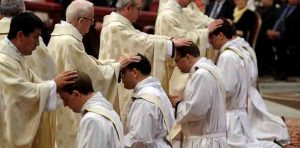
Papal Theonomy and America Today – Realism or Surrealism
Continued from Jesuit Theonomy and the State
Realism or Surrealism
Is America headed for Revival? For a spiritual reconstruction? Or is it headed down into even deeper apostasy? Certainly no one can answer such questions glibly or categorically. There are some good signs here and there. There are some bad signs in other places. So to try to even hazard a predictive guess is not an easy matter. There are really only two possible future scenarios for the Christian as far as America is concerned: 1. America is going to be reconstructed by the Christian Coalition and when fully Christianized will then begin the task of Christianizing the world. Or, 2. The apostasy and spiritual declension will continue and the country will sink further into Romanized paganism, and at some point the Lord will return to claim His Church.
Very few people see America going down into total apostasy. Ever those who are now looking for the Lord’s Return also are looking for a revival and a return to biblical Christianity. Many are praying to this end.
It is interesting to note that Joseph Mede, writing in 1627 in his The Key of Revelation, put forth the idea that Gog and Magog did not represent Russia and the northern Asiatic kingdoms but rather represented North America. He believed that North America would rise up to battle the saints. He proceeded to state that the American coalition would lose:
- They shall not succeed and prosper in their attempts; they shall not be able to hurt the church and city of God, but shall be destroyed in an extraordinary manner, by fire from heaven.1
It is surely quite remarkable that this man, (writing first in Latin) could have foreseen what he calls “this new apostasy and rebellion against God and His Christ.”2 For when he was writing, North America was primarily Puritan and Protestant. Whether Mede knew something no one else did, or merely hazarded a guess, one thing is certain: America is indeed characterized by apostasy today. Without a doubt there is a superficial Protestantism which sees nothing wrong with the idolatry of Romanism or the garbled sounds of tongues. Rome now claims some 60 million adherents in the United States of America and about 15 million adherents in Canada.
Is there any real opposition to the gross idolatry which these 75 million people represent in North America today? No, there is not. The few who do oppose Rome today and seek to witness to the truth, as it is in Christ, and against the idolatries and errors of Rome, are looked upon as the lunatic fringe by North American society.
One of the more ominous signs in America today is the resurgence of Roman Catholicism. It is not so much that Rome is growing through immigration and large families, but that Rome has now been welcomed into some evangelical circles officially. When Protestantism lost its biblical basis and became liberal it lost its ability to refute Romanism and to set forth the truths of the Scriptures. It became totally apostate.
Eric Bogosian in his book Sex, Drugs, and Rock and Roll gives his view of American culture today. It is very interesting to notice the parallel that can be drawn from his description of America today and the church in America today.
Bogosian wrote:
- As a nation we sit at a huge rock concert singing along to some well-known anthem of cloying sentiment. We love the feeling, the togetherness, the righteousness of the cause. As we watch the evening news or read the daily tabloids, we are shocked together, we are pleased together, we are entertained together, we are saddened together. Unfortunately, when the concert is over, we get back in our cars, drive home, and go to bed. Its only rock and roll.3
This paragraph could just as easily be applied to the religious scene in America today as well. In many a church we sit at a huge religious concert (even with rock music) singing some well-known modern me-too song. We love the feeling, the togetherness, the righteousness of our cause. We watch the evening news, read the daily papers, and a few church magazines, we are shocked together, pleased together, entertained together, and saddened together. But when the service is over, we get back in our cars, drive home, and go to bed. Its only a church service.
It was C. H. Spurgeon who wrote that Calvin and Luther did not merely go home and put on their night caps and go to bed and hope that things would be better in the morning. They challenged the powers of darkness openly. Their main challenge, believe it or not, (in spite of Montgomery Boice and a host of others just like him) was issued against Roman Catholicism.
They fought with the beast of Papal Theonomy to liberate Europe and the world from such a persecuting dominion. Had it not been for them and others like them we would all still be dominated by an outrageous Vatican theonomy. It is difficult to get this truth across Papal today in America. The cacophony of voices ignorant of church history drown out the truth. On top of these the education that most people receive today is from Hollywood and rock musicians all of which are guaranteed to addle the brain and make godly thinking impossible.
The North American “church” has been deeply influenced by Hollywood, which no matter what else may be said, is decidedly antichristian in its outlook and in its productions. North American “church” people are also sunk deeply in the mire of modern music with its decidedly brothel beat.
When you add the bad influence of the false church; the poor influence of men who know, the truth but have compromised it for one reason or another; the garbled influence of those involved in the charismatic movement which, Associated Press religion writer Briggs claimed, brought about the involvement of evangelicalism with Romanism; you will find that there are very few salutary influences reaching “church” people in this generation in North America. Let us face it honestly, the influence of biblical truth is very, very, limited in this generation.*
* We see this played out personally in our school. Most of our students come from biblical backgrounds but we get some who come whose chief influences have been like those described above. They usually end up leaving for they do not appreciate biblical truth. They cannot bring themselves to believe that the MAJORITY of professing Christians in this generation are completely under the spell of wrong and bad influences. It boggles their minds to find out that some teachers actually believe that idolatry is wrong and compromise with idolatry is also wrong!
For that reason there is very little knowledge of Protestant church history for where there is little biblical truth there is also little in the way of historical truth.
The tragedy of this hour in America is the gross ignorance of millions of men in the church concerning church history in general and the martyrs of the Reformation in particular. At a recent men’s retreat, where there were close to 100 men gathered, I asked how many knew who Latimer and Ridley were? Five hands were raised. I then asked how many knew who the Covenanters were? One hand was raised.
One out of almost one hundred men and this in a group whose knowledge of church history would be better than one hundred men asked the same question in the street. So what does this say about the knowledge of church history in America today?
Men in the modern church can tell you all about the players on their favorite teams but they know little or nothing about the heritage which has brought them the gospel, and their freedom of worship. So if those who are supposed to be Christians do not know who Latimer and Ridley were, or why and how they died, it should be obvious then that the Pope’s celebrating of the mass on his recent visit to America should be received without a word of protest, and why accords of betrayal can be signed without bothering millions of professed believers!
The ignorance of church history today is indeed mindboggling. If the men in America today do not know anything about entire groups, such as the Reformers and the Waldenses, how could they ever form a true opinion about the errors and persecutions of Rome?
If I do not know that the major English Reformers were all martyred — burned at the stake — by Rome for not accepting the Roman Catholic sacrament of the Mass, I can hardly be expected to get too excited about the celebration of the Mass today. And this is exactly where we are in North America today. The prevailing opinion, as demonstrated by the Promise Keepers, and the charismatics, is that Roman Catholics just celebrate communion a little differently than we do.
This is why I believe that there is a great apostasy in America today far deeper then most people realize. For there is no basis, no ground, no foundation upon which theological issues can be decided. As Patton noted seventy years ago:
- More than he is aware, undoubtedly, the unlearned reader is indebted to the controversies which he treats with such scant consideration for his ability to see upon the face of Scripture the meaning which he reads into it.4
As time goes by he loses completely the ability to come to a proper exegesis of Scripture. For up-to-date false prophets influence his interpretation of Scripture by denying the interpretations which the Reformers and the martyrs put forth.
The modern ecumenists put forth a religion which denies any difference at all between Romanism and Protestantism. Consequently the unlearned reader today is swallowed up in eclecticism and an All-American religion of good-will, goodworks, and universal salvation.
Therefore no one will say a word about the Pope or the Mass which he celebrates for the religion he espouses is the same religion which millions of Americans, who are not Roman Catholics, also espouse. An amiable religion to which almost any one of goodwill can subscribe, and which demands almost nothing in the way of allegiance.
Error ALWAYS FLOURISHES IN SUCH A MILIEU! This is what is happening now in North America. Men in the church know just about everything concerning sports, politics, work, and pleasure, but almost nothing about a hard-won exegesis of Scripture, or about church history in which the battles of exegesis and exposition of Scripture were fought. After all if we are all going to heaven when we die why worry about such things? Therefore I no longer expect such people to take a stand for they do not KNOW ENOUGH TRUTH to refute error and so are sadly INCAPABLE of taking any kind of stand in the evil day of which the Apostle Paul speaks.
There are millions in North America today (Canada and the United States) who go through little liturgies and litanies every Sunday without ever questioning whether such things are scriptural or not. Or whether or not they are idolatrous. These people may be adamantly opposed to abortion but not opposed in any way to wrong worship or idolatry. Yet if the Bible is true, this is the greatest sin of all, for it breaks the first and second commandments.
The Scripture near the end of its revelation states categorically: “Little children keep yourselves from idols.” As Farrar noted “Idols are always a fatal hindrance to the attainment of truth. Sooner or later they that make them become like unto them, and so do all who put their trust in them.”5 Idolatry is a heinous sin before God yet it is seldom mentioned in this sinful and idolatrous generation.
I believe in a sovereign God. I believe that He is able to revive His work. But I believe that it is going to take the preaching of the truth to enlighten minds and hearts and to overthrow the idolatrous nature of worship in this day and time. We must lift up Christ as an all-sufficient Saviour and the ONLY Mediator between God and men. It is an uphill task but certainly not impossible.
However, even though I believe in the possibility of God sending a great spiritual awakening, I cannot predicate my ministry upon such a hope. I must minister the Word of God faithfully amid the apostasy, worldliness, idolatry, and compromise of this generation. This is what every faithful servant of God has had to do down through history. He labors in the Word and prays for God to move. He then leaves the outcome to God.
We believe that the only hope for America, or any other country, is the preaching of the gospel of redeeming grace and teaching the whole counsel of God. We need to lift up the trumpet and sound out the great truths of the Scriptures without apology and without compromise: salvation by grace ALONE; justification by faith ALONE; the only rule for faith and practice the Bible ALONE; the only Mediator between God and men Christ ALONE; everyone who preaches a false gospel is to be ANATHEMA not welcomed upon our platforms. We need an uncompromising, exclusive, biblical, Spirit-empowered message to replace the anemic, lukewarm, man-centered, romanized message of today. This romanized message, this all-American message does not have enough truth in it to save a mouse never mind a nation!
As the love of many grows cold; as the great falling away invades the visible church, as lukewarmness and religious form take over, denying the very power of godliness, we are nevertheless to carry on and to occupy until Jesus comes. When we begin to see these things we are to lift up our heads for the coming of the Lord draws near. Christ Himself warned us:
- And take heed to yourselves, lest at any time your hearts be overcharged with surfeiting, and drunkenness, and the cares of this life, and so that day come upon you unawares. For as a snare shall it come on all them that dwell on the face of the whole earth. Watch ye, therefore, and pray always, that you may be accounted worthy to escape all these things that shall come to pass, and to stand before the Son of Man.
Until the Lord returns we must lift up our voices like trumpets, and wield the sword of truth with sledgehammer-like blows against the curse of the papacy, and those who want to romanize the truth. Amen and Amen!
References
1. Newton, Thomas, Dissertations on Prophecies, London and Philadelphia, 1835, p. 594.
2. Loc.cit.
3. Bogosian, Eric, Sex, Drugs, and Rock and Roll, Harper, Collins, N.Y. N.Y. 1950, p. xvi.
4. Patton, Francis L., Fundamental Christianity, MacMillan Co., New York, N.Y., 1926, p. 110.
5. Farrar, Fredic, History of Interpretation, Baker Book House, Reprint, p. xii.
Paisley and Mystery Babylon the Great
Protestant Protagonist
Antichrist and Optimism
Apostasy and Optimism
The Vatican Jesuit Conspiracy
Onslaught against Protestantism
Conspiracy against Protestantism
The Best of Luther’s Table Talk
Paisley’s Protest at Strasbourg
Download all of Papal Theonomy and America Today by Ronald Cooke in PDF format.
Related posts:
What is "MYSTERY, BABYLON THE GREAT" of Revelation Chapter 17?

The Approaching End of the Age - Part III. Foretold and Fulfilled. Chapter I.

Appendix - The Last Prophecy: An Abridgment of Elliott's Horae Apocalypticae
Rome In America – The Measuring Rod.

Shimon Peres Proposes Pope Francis Lead a United Nations of Religions

History of the Pagan Festival of Easter
T. C. Hammond On The Antichrist

Revelation 16:13, 14. The Three Frogs