The Sower and the Virgin – Historical Retrospect — Pope John XXII
Continued from Historical Retrospect.—ORD. PRÆD. And O.S.F.
HISTORICAL RETROSPECT — POPE JOHN XXII.
In the year 1322, the wicked and immoral Pope John XXII. issued a bull, in which he says: “As the chorus of angels never ceases to cry: Holy, holy, holy; so the whole Church never ceases from pouring out praises to the great Virgin, saying: Virgin, Virgin, Virgin, thou art both our mirror and our exemplar.” Then he decreed that all who enter the Order of Carmelites shall be “released and absolved from a third part of their sins on the day of their admission into the Order… while the Professed Brothers of the Order shall be freed both from their sins, and the punishment due to them”; and “on the Saturday after any Carmelite dies, the Virgin will go down to purgatory to fetch him or her and take him or her up to the mountain of eternal life.” That certainly is very amiable of the Virgin to spend every Saturday half-holiday in the year in going to such a remarkably unpleasant place as purgatory. Only one does not see why she should go herself, if she is really so powerful. Has she no servant she could send to fetch her dead Carmelites?
In 1322, Hugo de Prato thus preached (Sermo xxxv.): “We should pray to the apostles and the other saints, whenever we are in any difficulty; because they are our advocates and our mediators between God and man, through whom God has decreed to give us all things freely.” Are we, then, to conclude that Jesus Christ is not a willing, or not a successful Advocate and Mediator? And does God give us nothing through His only Son? (1 John ii. 1). The Apostle John did not teach us, nor even hint to us, that: “If any man sin, you have me for an advocate with the Father.” No! no! John the Apostle, so far from wishing us to pray to him, preferred to class himself openly among the sinners who have to pray to “Jesus Christ the Righteous,” who is “a propitiation for our sins,” said he; and therefore he proclaimed that “we have an Advocate with the Father, Jesus Christ the Righteous”; and He is the “one Mediator between God and man.” I see then, that Hugo de Prato was “preaching another gospel,” which the Apostles did not preach. Therefore Hugo de Prato, and all of the present day who agree with his opinion, are “accursed,” says St. Paul. They are idolaters.
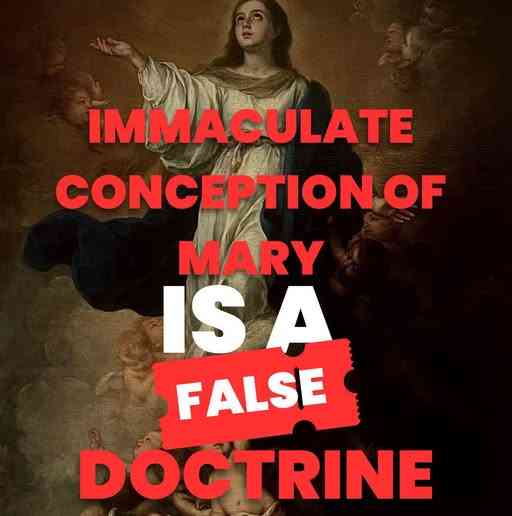
Bishop Stephanus, Postillator, and Doctor of the Paris University in 1324, wrote (Super Ep. ad Rom. et ad Hebr.): “The union of a soul with a body after the sin of Adam, could not take place without Original Sin, except in Christ alone; yet, by the grace of sanctification, sin was taken away from the Virgin Mary while yet in the womb of her mother, and subsequently the corrupt desire to sin was extirpated.”
We perceive what a persistent war had been carried on for centuries on this subject. On one side holy men and learned doctors and a few good Popes striving to protect what was left of the primitive faith; and on the other side a number of cunning and depraved theologians and monks, headed by all the immoral, debased, and wicked Popes, who were labouring to introduce and spread the worship of Mary, as if she were a goddess, and of the saints as apotheosed heroes or demi-gods. The Dominican, Father John Adé (Badeus, iv. 641), in 1328 A.D. saw clearly whither his Church was drifting, when the doctrine of the Immaculate Conception was first enforced, and exclaimed: “En voulez-vous, donc, faire une Déesse.” Do you then want to make her your goddess? This they have since succeeded in doing, and they worship her accordingly. In Lisbon, for example, according to Professor Gibson (Scottish Protestant, vol. i. p. 464), the Italian Church has the following inscription, in large letters, on its façade: “To the Virgin Goddess of Loretto, the Italian race, devoted to her Divinity, have dedicated this temple.” It was in that very year, 1328, that the Archbishop of Canterbury, in the Council of London (Mansi, xxv. 829; Acta, cap. 2), decreed that the Feast of the Immaculate Conception should be solemnly observed throughout the kingdom.
Yet in 1329, Gerardus de Odonis de Castro Rodolphi, Patriarch of Antioch (Lib. De Figuris, cap. De Stella), wrote: “The Virgin was born with Original Sin, because she was conceived of the seed of Adam.” Again (5° Serm. de Nat. Dom.): “The Virgin was cleansed from Original Sin before her birth, in order that God and a sinless man might be born of her.”
But Galvaneus, or Gualfaneus Flamina, Mediolanensis, Ord. Præd., in 1330, gave this opinion: “The Feast of the Conception of the Virgin Mary should not be celebrated, because she was conceived in Original Sin.”
In the same year Adamus Goddamus or Woodhamiensis, Anglicus, Ord. Min., Professor Oxoniensis et Doctor Parisiensis, declared (III. Sent., Dist. 3): “If we are to believe what the saints have told us, we must hold that the blessed Virgin was conceived in Original Sin; and not a single saint can be found who asserted the contrary.” No! but a great number of wicked, corrupt, and most immoral Popes have asserted, and “infallibly” decreed the contrary!
Yet Landulphus Caracciolus, Neapolitanus, Ord. Min., Archiepiscopus Amalphitanus, in 1330, wrote (Postilla super Luc. i): “The blessed Virgin was born in sin, because she was generated by Adam’s seed.”
So also, in 1333, Richardus Radulphus, or Fitzralph, Archiepiscopus Armachanus, et Cancellarius Universitatis Oxoniensis, wrote (II. Sent., quest. 7, § 2): “The blessed Virgin was conceived in Original Sin, and was then freed from it before her birth, as all saints teach us.” No, Archbishop! the penultimate clause has been slipped in and accepted, like a bad sovereign between two halfpence. All saints do not teach us that Mary was freed from Original Sin before her birth.
A cloud of witnesses of the year 1340 now crowd on to the witness table: Bernardus Parentinus, Ord. Præd. (cap. Pronuntiandum), deposes that “The conception of the Virgin Mary should not be celebrated, because she was conceived in Original Sin, like all the rest of mankind, excepting only the Person of the Lord Jesus Christ.”
Robertus Melidunensis, Episc. Herefordiensis (Summa, lib. ii.) says: “The blessed Virgin Mary, and John the Baptist, were conceived in Original Sin; but they were subsequently sanctified by grace.”
So Philippus de Monte Calerio, seu de Janua, Ord. Min.: “The blessed Virgin Mary was born in sin, because she was conceived of Adam’s seed.”
Joannes de Exfordia says exactly the same in his Summa (cap. De Conceptione; and cap. De Pecc. Orig.).
Richardus, Anglicus, who was the same, I think, as Richardus Rollus Hampole, Archbishop of Canterbury, an Augustinian, wrote (II. Sent., Dist. xxxi. quest. 1; and III. Sent., Dist. 3): “Not until after the Virgin Mary had been quickened, could she have been freed, by God’s grace, from the taint of Original Sin.”
The famous Joannes de Calderinis, Bononiensis, also wrote (Extra. De Feriis, cap. Conquestus): “The conception of the Virgin Mary should not be celebrated; because she was conceived in Original Sin; as S. Bernard wrote to the Canons of Lyons, rebuking them for celebrating that feast.”
Moreover, Bartholomeus de Pisis in his Summa (cap. De Feriis) wrote: “Although the Roman Church tolerates the custom of some Churches which celebrate the Feast of the Conception of the blessed Virgin; yet we are not thereby to understand that she was holy in her conception. It is not known at what time she was made holy; therefore, on the day of the Conception, we celebrate the Feast of her Sanctification, rather than a Feast of Conception… The blessed Virgin was conceived with Original Sin; but was subsequently made more holy than others are.”
In 1340 A.D., Paulus (Saluccius) de Perusio wrote (III. Sent., Dist. 3): “The blessed Virgin was conceived in Original Sin, because, as the Magister Sententiarum (Peter Lombard) says, she was afterwards purged and purified from it.” He then adduces twelve arguments in support of this position, and quotes S. Augustine, S. Bernard, Jerome, Anselm, Pope Leo, and the Canon Law as of the same mind with him.
In 1342, Pope Clement VI mounted the papal throne. Preaching on the text, “There shall be signs in the sun and moon,” he said: “It seems to me that there should not be any Feast of the Conception of the Virgin Mary. This I say, first, on the authority of S. Bernard, who wrote to the Canons of Lyons, rebuking them for celebrating such a feast. Secondly, because no feast is celebrated except in reverence for the holiness of the person whose feast is celebrated. But the conception of the Virgin was not holy, because she was conceived in Original Sin. That is plainly proved by the authority of a great many saints. Therefore it should not be celebrated by a feast. For I assert that this much is true and clearly proved: that the blessed Virgin had, in her conception, contracted Original Sin… Not to have sin, is the prerogative and peculiarity of Christ alone; therefore the blessed Virgin was tainted with Original Sin, for some short time, at least; being soon afterwards sanctified.”
Baldwin, Bishop of Paderborn, nevertheless, in the year 1343, introduced the Feast of the Immaculate Conception of Mary into his diocese.
But Angelus (Acciajolo) de Bononia, Episc. Florentinus in 1345, wrote (III. Sent., Dist. 3): “The blessed Virgin was in Original Sin, not only at the first moment of her conception, but also for some time after; although she had been baptized in the meanwhile, as many of the saints have testified. For since Christ is the Head of the whole Church, it is proper that all mankind should be redeemed by Him. But if the blessed Virgin was without Original Sin, she was not redeemed by Christ; which is clearly a falsehood.”
Nevertheless, Robert Holcot, an Englishman, and Doctor of the University of Paris, in the same year, took up the prevalent opinion of his day (lib. Sapientiæ, cap. xiv. lect. clx.): “The blessed Virgin was sanctified in the womb of her mother, because she was cleansed from Original Sin; and the lust of sinning was so restrained in her, that she never fell into any actual sin. In her second sanctification, when she was conceiving the Son of God, the lust of sinning was entirely removed, and she was confirmed in all goodness, so that she was thenceforth unable to commit any sin.”
He added concerning his own Church (lib. Sap., Lectio clxxxiii.): “The priests of this time are like the priests of Baal; they are the fallen and apostate angels; they are akin to the priests of Dagon; they are priests of Priapus, the foul god; they are angels of the bottomless pit.”
So also Richardus Armachanus, Archbishop of Armagh, in 1350 A.D. (Sent. III., Dist. 3): “The blessed Virgin, after her quickening, was cleansed from Original Sin, in her mother’s womb, by her first sanctification; and, when conceiving her Son, the lust of sin was entirely extirpated.”
But Durandellus, Doctor Parisiensis, Ord. Præd., the nephew of Durandus, wrote, in 1350 (III. Sent., Dist. 3): “The blessed Virgin had Original Sin. This is proved, first, because she was redeemed; and redemption presupposes a slavery to sin; just as restoration to health presupposes illness; and, secondly, because S. Augustine expressly asserts that she was captive to sin.”
In 1357, Gregorius de Arimino, an Augustinian, who was surnamed “Doctor subtilissimus,” wrote (III. Sent., Dist. 3, quest. 2): “It is more in accordance with Scripture and with the teaching of the saints, to say that the blessed Virgin was conceived in Original Sin. For Scripture says that all without exception, who descended from Adam in the natural manner, were conceived in Original Sin. Moreover, remission of sins, through the death of Christ, is necessary for every one thus descended from Adam.” So said also, I believe, Bernardus Cliveri, Episc. Darcucensis, in the sixth book of his Quodlibets.
THE REVELATIONS OF ST. BRIDGET AND ST. CATHERINE
Now we come to two saints of the Roman Church, both reputed to be prophetesses: Bridget of Sweden and Catherine of Siena. They were contemporaries, and flourished about 1360 A.D.
S. Brigitta (Revelat., lib. i. cap. 50) pretended to a revelation, in which she heard our Lord addressing His mother in these words: “Thou art blessed by Me, thy blessed Son; and therefore no prayer that thou shalt ever offer Me, shall be refused; and all who seek mercy through thee, accompanied by an intention to amend, shall certainly receive grace; because, as all heat proceeds from the sun, so does all mercy proceed from thee, My mother.” At the end of the fifth book of her pretended revelations, she declared that she had received the following from God: “From the root of Adam there came out the Branch or Virgin (Virga seu Virgo), and she was born of sinful parents, although she was conceived without sin, in order that My Son might be born of her without sin.”
Bridget did not perceive the logical consequences. If, in order that Jesus might be born without the stain of sin, it was necessary that His mother should have been conceived without sin; then it follows that Anna, Mary’s mother, must have been conceived without sin, in order that Mary should be born without the stain of sin; and so on, up to Eve herself.
Bridget further pretended to prophesy (lib. vi. cap. 49), in Mary’s name, and uttering her words: “It is the truth, that I was conceived without Original Sin, and was not with any sin.” Again (cap. 55) she claimed to be the mouthpiece of Mary: “know thou that the truth of my conception was not made known to all; because it pleased God that His friends, even, should have pious doubts concerning my conception.”
The Dominicans vehemently opposed these ridiculous revelations, and the absurd doctrine which they announced, just as S. Bernard had done two centuries before. Therefore it was that Bridget found it necessary to explain, by a revelation, why God had made the saints and most holy doctors of the Roman Church oppose the dogma: saying that God wished His friends to remain in doubt as to the truth. How at variance was such a revelation with the words of Christ: “He that doeth My will, shall know of My doctrine, etc.!” How different from what God Himself has told us: that He hides nothing from His servants the prophets; and that He hid nothing from Abraham!
The curious fact was, that S. Catherine of Siena also pretended to have received revelations from God; and that Catherine’s revelations contradicted Bridget’s. For S. Catherine prophesied strongly against the doctrine of the Immaculate Conception of Mary. But Pope Benedict XIV proclaimed the revelation of Bridget to be true and authentic.
Yet here arises another difficulty. In those authentic and true revelations, we find these words: “The Pope is a murderer of souls; he destroys the flock of Christ, and fleeces it. More savage is he than Judas, and more unjust than Pilate, and worse and more wicked than Lucifer. He has exchanged all the ten commandments of God for this single one of his own: give me money, money, money. The Pope, with his clergy, are the forerunners of Antichrist, rather than the servants of Christ. The Pope’s court on the earth plunders the heavenly court of Christ. The clergy never read the book of God, but are ever studying the book of the world. For them the wisdom of God is reputed to be but folly, and the salvation of souls a mere fable.”
She adds: “I once loved priests more than men and even angels; but now they disgust me more than all the Jews and Gentiles, and all the devils too… The ‘kiss of peace’ of those fornicating priests is the kiss of Judas when he betrayed our Lord” (See Jo. Wolfii, Lection. Memor., i. 670).
Those were awkward words for a saint and prophetess to have used! Cardinal Cajetan tried to escape from it by observing (De Concept. Virg., p. 140), that Bridget “was canonized during the great schism of the West, when there was no undoubted Pope”—that is, no Pope at all, in accordance with the maxim: “Papa dubius, Papa nullus.” The Jesuit Cardinal Bellarmine pleads (De Beat. Sanc., i., cap. 7, 8), that “the Pope’s canonisations are doubtful, and subject to error.” Perhaps that was the reason why Pius V, who bribed Ridolfi to assassinate Queen Elizabeth, was canonized.
But here again we get into a difficulty. “The Pope’s canonisations are subject to error”? Good! But Cardinal Manning, in his True Story of the Vatican Council, p. 89, positively asserts that the canonisation of saints comes under the head of “Faith and Morals,” in all which cases the Pope’s judgment is infallible, they say. Putting the two Cardinals together we get this result: the Pope’s infallibility is fallible and subject to error!
To make matters worse, Cardinal Newman, in the preface of 1887 to his Via Media, p. lxxxiv., says of canonisation: “The infallibility of the Church must certainly extend to this solemn and public act (canonisation); and that, because on so serious a matter, affecting the worship of the faithful, though relating to a fact, the Church, that is the Pope, must be infallible.” So then the canonisation of Bridget was infallible, and her revelations were authentic and true, and therefore it follows that the Pope is a “murderer,” and “more savage than Judas, and more unjust than Pilate;” and that “he has exchanged all God’s ten commandments for this one of his own: give me more money, money, money.”
Verily that throws some light upon the matter; for Moroni, the Pope’s chamberlain, a short time ago published a book called Le Capelle Pontificie, etc., in which he declares that the canonisation of S. Bernardine of Siena cost 25,000 ducats of gold; that of S. Bonaventura, 27,000 ducats; that of S. Francis of Sales, 31,900 scudi; and so forth. I wonder how much was given to him for the canonisation of Garnet, Campion, and all those 261 ruffians, rebels, and murderers this year? Or whether he canonised them merely because they were rebels?
But let us turn to Saint Catherine of Siena. In her Orationes xxii., ab ipsa in raptu et extasi ad Deum prolatæ; or, Twenty-two prayers offered by her to God while she was in a state of rapture and ecstasy—we read (Orat. xvi.):[1] “The Eternal Word was given to us by the hand of Mary; and of the substance of Mary, He put on Him our nature without the stain of Original Sin; and that was because that conception was caused, not by man, but by the inspiration of the Holy Spirit. But that was not so in the case of Mary; because she did not proceed from the human race by the operation of the Holy Spirit, but by the operation of man; and because all the human race was a putrid mass, her parents could not implant her soul in any but a putrid nature; nor could her soul be purged except by the grace of the Holy Spirit. But a body is not a susceptible subject of grace; only a rational or intellectual spirit can be a subject of grace; and therefore Mary could not be purged from the stain of that sin, except after that her soul had been infused into her body; and then it was done out of reverence to the Divine Treasure who was to repose in that vessel.”
Catherine clearly denied the doctrine of the Immaculate Conception, and she was a prophetess too, they say. In the decree canonising Catherine of Siena, Pope Pius II used these words (and be it remembered that it was not during the great schism of the West): “By the authority of our Lord Jesus Christ, and of blessed Peter and Paul His apostles, and by Our Own, we declare that Catherine of Siena was received into the heavenly Jerusalem, and was enriched with the crown of eternal glory… And we ordain and define that she is to be publicly and privately worshipped as a saint.”
Very well; before we fall down and worship her, although the decree be infallible, let us dip into the inspired prophecies of that saint. (Cap. 125) “Monks and nuns enter the religious state as angels; but soon they are nearly all worse than devils… They are soon turned into weapons of the devil, corrupting religion, both in their conversations among themselves in the monastery, and also when they go into the world and converse with secular persons.” (Cap. 132) “Secular persons are seduced by those blind leaders, who are ignorant idiots, presumptuous hypocrites, avaricious, simoniacal, given to luxury, full of envy.” (Cap. 124) “The prelates of the Church are like candles on candlesticks, meant to be of use in the surrounding darkness; but they do not understand the Holy Scriptures; they have no receptivity for Divine grace; but are full of uncleanness, ignorance, lust, inquisitiveness, and avarice.”
As extraordinary care and circumspection is always observed in the work of canonisation, we must presume that Pope Pius II had made himself acquainted with the revelations which Catherine of Siena pretended to have received. If they were fraudulent and false, the infallible Pope could not have declared her to be a saint. But if they were true, then they proved the iniquity of the Papacy. Catherine of Siena contradicted Bridget as to the Immaculate Conception; but the two would-be prophetesses agreed in one thing, which was that the Pope is the Son of Perdition, and Antichrist; while the Papacy is the Mystery of Iniquity and the Harlot of Babylon.
In 1367 the Order of Jesuates was established in Siena by S. Giovanni Colombino, and confirmed by Pope Urban V. It was a mendicant order. The Order of Jeromites was established in Spain and Italy; and an Order of S. Bridget was founded by Bridget herself, in 1363, at the Convent of Vadstena, and confirmed by Pope Urban V in 1370.
This Order of Bridget was common to both monks and nuns, who lived in the same convent! A very convenient arrangement considering the decree of the Pope “forbidding marriage.” The order was dedicated to the Virgin; and according to chapter 12 of the rules, the “Abbatissa, Caput et Domina esse debet; quia ipsa Virgo, cujus Abbatissa geret vicem in terris, ascendente Christo in cœlos, Caput et Regina extitit apostolorum et discipulorum Christi.” “The abbess must be head and queen, because the Virgin, in whose stead the abbess rules on earth, is the head and queen of Christ’s apostles and disciples, ever since Christ ascended to heaven.” Each convent of the order was bound to contain 60 sisters to 13 priests, 4 deacons, and 8 lay brothers; 60 nuns to 20 monks!
Pope Gregory XI mounted the infallible throne of Peter in 1370 A.D., and condemned, as heretical and false, the proposition (Directorium Inquisitorium, pars ii. quest. 10): “That the Virgin Mary, at the time when she conceived her Son, was so full of grace that she could not afterwards grow and increase in grace;” that is, he defined as a false heresy the notion of the Virgin Mary’s “plenitude of grace,” after the imaginary “second sanctification.”
In spite of his own infallible definition, Pope Gregory XI, in 1372, instituted the Feast of the Presentation of the Virgin Mary, for November 21. In 1380 the University of Paris, which had hitherto opposed the Feast of the Immaculate Conception, resolved that it should be observed by the whole French nation. Of course the dogma spread far and wide after this time, and the feast was more and more celebrated.
The effect was that the Dominicans, or Order of Preachers, thought it their duty to oppose it with increased energy, at Paris, in 1384; so much so that the university and the populace rose in the utmost fury against them. In 1387 the university passed a condemnation of any denial of the doctrine of the Immaculate Conception, as a heresy. The Dominicans, and especially Joannes de Montesono, appealed to the Pope; and in January, 1389, the Pope’s decision was given in favour of the university, thus declaring on his infallible authority that the doctrine of Mary’s Immaculate Conception was part of the faith of the Roman Church.
Footnote
1 The passage is wanting in the Cologne Edition of Saint Catherine’s works, 1553; but is cited in the Summa of S. Antoninus, Archbishop of Florence, Pars I. tit. viii. c. 2.
(To be continued.)
Related posts:

Paradise or Purgatory?
The Popes And The Bible

The Church of Rome Ignores the Challenge to Disprove She is the Great Whore of Revelation ...

The Two Babylons Chapter V. Section II — Relic Worship
The Bible, Critical Theory, and Critical Race Theory, Part 1

The Papacy And The Civil Power - Chapter XVIII. Resistance to Civil Power
A Disputation On Holy Scripture Against The Papists Question VI. Concerning The Perfection...
The Six-Pointed Star – Chapter 7. The True Messiah and the Menorah