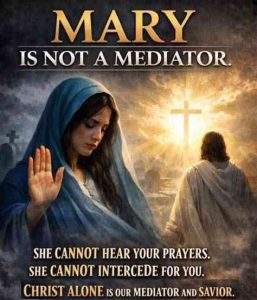
The Sower and the Virgin — Historical Retrospect — Sixth Period. 1572 A.D.
Continued from Historical Retrospect — Romance of Loreto.
HISTORICAL RETROSPECT.—SIXTH PERIOD. 1572 A.D.
LET us return to the course of our history of the development of mariolatry. In 1555, Pope Marcellus, who was Pope for only twenty-one days, found time to evince his opinion against the dogma of the Immaculate Conception. But Pope Paul IV., in the same year, rehearsed the bull of John XXII., “Sacratissimo uti culmine,” and so confirmed both the bull and the indulgences and privileges conferred by the Scapular.
In 1559, the Jesuit John Azorius (Iusti. moral, tom. I. lib. ix. cap. 10) thus declared the faith of his Church: “We not only honour the saints as men who excelled in virtue, wisdom, power, and every real dignity; but we also yield them that Divine worship and honour, which constitute an act of religion. Because that worship which is conceded to the most exemplary men does not amount to an act of religion.”
After the close of the Council of Trent, Pope Pius IV. promulgated his creed, which, with two additions (the Immaculate Conception and the Infallibility) is now professed by every Roman Catholic. One clause of that creed is as follows: “All and everything which the holy Council of Trent hath defined and declared, in the matter of Original Sin and Justification, I embrace and receive.”
The decree concerning Original Sin is comprised in an introduction, four long canons, and an appendix, which declares that Mary does not come under the law concerning it which was and is true of all human creatures.
Yet Cardinal Cajetan urged (Opusc., p. 141: Lugd., 1586), that: “At the period of the Council of Florence (1438), the Universal Church excepted Christ alone from the taint of Original Sin; which was not true, if the Virgin Mary is also to be excepted.” In other words, either the General Council of Florence, or the General Council of Trent, decreed a falsehood; and so did the two Popes who affirmed their respective decrees, in the full exercise of their Infallibility.
The doctrine of Justification is contained in an introduction, sixteen chapters, and thirty-three canons. When the subject was proposed in the council, Cardinal Pole, the only English prelate, urged the ancient doctrine of Justification by faith in Christ. But he was put down; and immediately left the assembly, never to return.
Cardinal Contarini maintained the same doctrine as Cardinal Pole, and wrote a treatise on “Justification.” This book was published at Lyons, in 1571, but was afterwards garbled and altered by some monks, and published under the Cardinal’s name. Cardinal Cajetan, it may be remembered, had propounded the same doctrine in his Commentary on the Epistle to the Romans.
The eighth article of the creed of Pius IV. teaches the worship of saints and the veneration of their relics. The Council of Trent, in its twenty-second session, on September 17th, 1562, asserted that the Roman Church “implores their patronage, and that they may deign to intercede for us in heaven.”
Our Lord declared that He is “the Way,” the only way, to heaven. Thus He forbad us to try to invent bye-ways for ourselves. Yet a modern Deborah might well sing of Rome (Jud. v. 6, 8), “The highway was unoccupied, and the travellers walked through bye-ways . . . they chose new gods.”
Our Lord’s second temptation was not to transfer worship from Jehovah to another god; but to yield an indirect worship to a creature, along with a worship of the true God also. But Our Lord replied in words taken from the Book of Deuteronomy: “Thou shalt worship the Lord thy God, and Him only shalt thou serve.”
Is it not derogatory to Christ, who has given us a direct access to the Father through His name, when we choose for ourselves bye-ways, and say that we will approach God through saints? Do we despise the way that God has provided? Do we deem it inadequate? or do we hold that He who died for us does not love us enough to listen to our prayers? We show contempt either for His power or for His goodness. Instead of “one Mediator, the man Christ Jesus,” we seek for ourselves a host of mediators who were merely men, and now are merely dust.
What makes it more wonderful that we should do this is the fact, as expressed by Cardinal Cajetan (in IIam. IIae, quest. lxxxviii. § 5): “We have no certain knowledge whether the saints can be aware of our prayers.”
On May 12th, 1566, Pope Pius V., by the bull “Superna dispensatione,” approved all the aforementioned bulls of former Popes, relating to mariolatry. Yet in the same year, Franciscus Dominicus, Episc. Astensis, asserted that the Virgin Mary was born in Original Sin, because she came of the seed of Adam.
By the bull “Ut laudes,” of September 18th, 1577, Pope Gregory XIII. commended, in the largest terms, the Scapular of the Carmelite fraternity, and affirmed that the bulls of John XXII., Alexander V., and Clement VII., were authentic.
But Otho Gualtperius, in 1590 (Oratio de doctrina Lutheri), after showing that very many of the doctrines and practices of the Roman Church—such as Meditations, the Suffrages of Saints, Patron Saints, the doctrine of Good Works, Guardian Angels, etc., etc.—have been adapted from Plato’s philosophy; asserted that the Popish prayer to Saints Cosma and Damian: “O medici piissimi! qui meritis clarissimi in celis refulgetis, a peste clade corporum preservetis,” etc., has been taken bodily from Plato’s address to Æsculapius.
So also the prayers of the rosary are merely pagan prayers, with the name of Mary instead of that of Trismegistus: “O virtutum vasculum, Regina Celorum, Christi Receptaculum, salus anxiorum, tutum Propugnaculum, Salvatrix languidorum, audi conquerentium preces famulorum, et pro nobis miseris Deum deprecare; nam quicquid petieris, vales impetrare,” etc.
In the year 1603, Pope Clement VIII. gave an indulgence of 700 years for every time that any person should kiss any measure of the Virgin Mary’s foot, accurately taken from the measure guaranteed by Pope John XXII., adding, that this indulgence is applicable to the souls in Purgatory.
Yet the fact that such a ridiculous means of gaining indulgences was granted, must not be taken as a proof that mariolatry had gained full possession of the Church of Rome.
For, two years after (1605), we find Franciscus Antonius a Treio, Bishop of Carthage, addressing Pope Paul V. in these words (Oration IV.): “Our most holy mother Church is now grievously tormented by the dispute of so many of the faithful concerning the holiness of conception of the Virgin Mary (by her mother Anne); yea, the Church is greatly burdened by all those quarrels of her most dear children; and therefore her principal prelates, and the princes of the whole world, with nearly all Christians, pray thy Beatitude to resolve their doubts, and altogether set at rest their disputes, by defining what they must believe.”
The next year, however (1606), Pope Paul V. merely confirmed all the previous bulls on the subject. This he did again in 1609; while the Congregation of Sacred Rites, under Pope Urban VIII., in 1628, reaffirmed all the indulgences and privileges of the Carmelites.
The disputes waxed warmer; and Pope Paul V., in 1617, found himself compelled to forbid the subject being discussed in public. In private the opposing factions made up in rancour for what they lost in publicity; and Gregory XV., in 1622, decreed that it should not be broached either in public or in private. Nor would this have been unnecessary if the Pope had desired to put a gag on the utterance of blasphemy.
This is a specimen thereof (Promptuarium discipuli, de miraculis B. M., Ex. xiv.: Mogunt, 1612). Mary is supposed to say: “The will of the Holy Trinity and my will are one; and the Holy Trinity, with ineffable favour, consents to everything that pleases me.” That is a parody on John x. 30: “I and My Father are one,” etc.
Again, in the Paradisus Sponsi et Sponse, or Paradise of Jesus and Mary, Husband and Wife, published in 1617, A.D., by the author of the Pancarpium Marianum, there is a plate of the Crucifixion, with Mary at the foot of the Cross, having a sword in her breast (p. 181), and the inscription: “Dilectus tuus Filius carnem tu vero animam immolasti; immo corpus et animam”: “Thy beloved Son did offer in sacrifice His flesh for us, but thou didst offer in sacrifice thy soul,—yea, both thy body and thy soul.”
Here is another specimen, not so blasphemous, perhaps, but more bombastic and ridiculous. Franciscus a Jesu-Maria, a Carmelite, wrote about 1650 (Comm. in Apoc., vol. ii. cap. xix.): “We honestly and sincerely profess that the glory and goodness of Mary is far greater than the glory of all the saints and angels put together.
Yea, it exceeds by as much as the whole circumference of the heavens exceeds the most minute point; as much as the brilliant effulgence of the mid-day sun excels the flickering of the smallest rushlight; as much as the whole ocean transcends the very smallest drop of water; as much as the whole earth is larger and more solid than the tiniest grain of dust.”
In the large cities of Spain, as well as in other countries, the controversy was carried on with a vehemence which resulted in much bloodshed. Philip III. and Philip IV., in order to put an end to the carnage, urged Pope Paul V. and Pope Gregory XV. and Pope Alexander VII. to declare the notion that Mary was conceived immaculate by Anne, to be a dogma of the Church and an article of the Roman Faith.
But the answer of Infallibility was, that such a doctrine had not been revealed in the Holy Scriptures, nor taught by the Apostles, nor suggested by any of the Fathers of the Church; nor had it been believed, nor preached, by the Church as an Article of Faith.
To Pope Alexander VII. belongs the questionable honour, attributed to him by Pope Pius IX., of having first made a dogmatic declaration concerning the Immaculate Conception, and to have established a solemn rite and festival in honour of it. Yet, in the year 1661, he forbad any one from stigmatising, as heresy, the denial of the Immaculate Conception of Mary. He therefore asserted that it was not a doctrine to be believed by the whole Church of Rome.
The Jesuits were however active in promoting mariolatry. The dogma of the Immaculate Conception they made peculiarly their own. Viegas the Jesuit, for example, in his Commentary on the Apocalypse (xii. com. 2, § 2, No. 6) wrote: “Just as a man dies when his breath is stopped, so when the patronage of the Virgin is taken away, the sinner cannot exist a moment longer.”
The Protestants on the other hand were strong in their indignation at the practice of mariolatry; while the Jansenists asserted that: “Praise offered to Mary, as Mary, is vain.” This proposition was condemned by Pope Alexander VIII., on Dec. 7th, 1690.
The Carmelites, by reason of the enormous privileges and indulgences which they believed themselves to enjoy, were as strenuous advocates as the Jesuits for mariolatry. Here is a specimen from a book on the subject, called Clavis aurea, written by Paulus-ab-omnibus-Sanctis, in 1669: “John XXII. had a singular devotion to the mother of God, and, on bended knees, prayed her to appear to him and grant him immunity against the attacks of all his enemies.”
John declared that she promised this, on condition that he would grant her Carmelite children the privilege that their souls, at death, if they died in the scapular, should go straight to heaven. “In the first year of his reign, or as some say, in his sixth year, he remembered the desire of the Virgin, and issued the bull at Avignon in 1317; or, as others say, in 1322, on the 3rd of March, which he said was the day on which, as he well remembered, the Virgin had appeared to him.”
It is remarkable that he should have remembered the day of the month so exactly, and yet have been so very uncertain as to the year of his reign, or the year of our Lord, on which he issued the bull—if indeed any bull was promulgated.
“That John XXII. was called Jacobus de Cusa (? Ossa), before his pontificate, a Frenchman by birth, and Bishop of Avignon. He had been created Cardinal Portuensis by Pope Clement V. He began to rule the Church in 1316, on the 7th of August, the Feast-day of S. Albert, a noted saint of the Order of Carmelites; and it was on this day that Daniel-a-Virgine-Maria, Provincial of the Carmelites in Flanders, said, in his Vinea Carmeli, that the Mother of God deigned to appear to him.” There seems then to have been a doubt even as to the day of the month on which the wonderful appearance took place.
Paulus-ab-omnibus-Sanctis continues: “The promise of the mother of God to liberate John from all his enemies, and to free all the brothers and associates of the Carmelite Order from hell, every Saturday, was confirmed in heaven by the Lord Jesus Christ, out of respect to His mother’s merits; but this fact is beyond human knowledge, and transcends the faculties of man.” If that is so, why did the writer take upon him to assert it? But all Romish doctors meddle with things that “are too high for them,” in oblivion of King David’s precept not to do so.
Further: “The empire and power of the virgin mother of God is not metaphorically and improperly, but truly and peculiarly her own, and due to her in all the severity of justice; because that empire and power is the same as the empire and power of the Son, . . . For the power and empire which belongs to the Son by nature and in virtue of His merits, flows to the most holy Virgin by her right as a mother. . . . But as all the government and powers which, by nature, belong to the Son, have been transferred to His mother, by the natural law which excludes civil law; there is no doubt that the power of sanctifying souls, and preserving them from the pains of hell, has necessarily been transferred to the most holy Virgin, in virtue of her maternal and natural rights.
This is that spiritual empire of which we have before spoken. . .Wherefore, we may fully trust to the promise made by the Virgin, that whoever dies while wearing the scapular, will not suffer the pains of hell.
For since the most holy Virgin is truly and really Queen, and, by a parent’s right, has an empire over all souls; therefore, in virtue of that imperial power, she can immediately require such helps and benefits of Divine grace as should perfect the salvation of those who are clothed in the sacred garb of the Virgin. . . .
We must here pay attention to the ground on which the power and empire of the most holy Virgin is asserted: namely, because He, who was born of the Virgin, is King of the whole earth; and therefore, by her maternal right, the most holy Virgin must necessarily have vindicated to herself that kingdom, not improperly and metaphorically, but properly and really.
For, as we have said, the kingdom and empire of the Son must, of necessity and by natural law, have been transferred to the mother; not by analogy or rule of congruity, but as a property, and as hers by natural right.”
“Exceedingly good senseless!” as Sir Toby said, “and very illogical!”
Two points have, however, to be remarked: (1) That Mary is there made the mother of God; and not merely the mother of Christ “as touching His manhood;” and (2) That Mary is spoken of as superior to and above Him, commanding Him to do what she wishes.
That error is symbolized by the Romanists, and inculcated into the minds of the ignorant, by representing the Virgin as an adult woman crowned, and holding in her arms an infant, also crowned. Such a representation is, moreover, a servile copy of the mother and wife of Horus, and other pagan representations.
Pope Clement XI. was completely under Jesuit influence; and, in 1708, he made the Immaculate Conception a feast, de precepto, for the whole Church.
HISTORICAL RETROSPECT.—LIGUORI.
NOW we come to Saint Alphonsus Liguori, who flourished in 1730. His Glories of Mary is a theological work by a doctor and saint of the Roman Church; and therefore all Romanists are bound to accept all that he says, or renounce the Roman Church as not being the true Church.
Moreover, the Congregation of Rites, in 1803, after an examination, for twenty years, of Liguori’s works, decreed that “in all the writings of S. Alphonsus Liguori, there is not a single word that can justly be found fault with.”
The edition of 1852 received the imprimatur of Cardinal Wiseman, who wrote that he approved of it and “cordially recommended it to the faithful.”
Another edition was published in 1868, and it was “heartily commended” by Cardinal Manning.
“At the very commencement, Liguori quotes approvingly from Bonaventura’s Psalter of Mary. He then pretends that he takes the following from Anselm: “S. Anselm, to increase our confidence, adds, that, when we have recourse to the Divine Mother, not only may we be sure of her protection, but often we shall be heard more quickly, and be thus preserved, if we have recourse to Mary, and call on her holy name, than we shall be if we call on the name of Jesus.”
That passage, as Liguori must have known, and as the divines of the Congregation of Rites must have known, is from a treatise which is a notorious forgery, and not by Anselm at all.
Liguori also quotes S. Bernard as saying: “At the name of Mary, every knee shall bow;” and he places beside it a false reference to one of Bernard’s Sermons on the Annunciation. Yet the passage is not to be found either there or anywhere else in the writings of Bernard.
He also quotes the martyr Ignatius as saying that without the help and favour of Mary, no one can be saved.
He further alleges that Chrysostom had vouched for the authenticity of the passage. The passage is not in the works of Ignatius, nor could he have uttered it, as it is inconsistent with the tenor of all his writings. Chrysostom never alluded to such a passage. This Liguori must have known, and the Congregation of Rites must have known, and yet they never appended a warning note to the writings of Liguori, to which they gave their most unqualified approval.
Similarly, Cardinal Wiseman was very fond of quoting spurious works as genuine; as for example the Christus Patiens, falsely attributed to Gregory Nazianzen, but rejected as spurious by Cardinal Baronius, Du Pin, Labbé, Bellarmine, Natalis Alexander, and many other Romanist writers. The Benedictines, who edited Gregory’s works, assert that the Christus Patiens was written at least five hundred years after Gregory’s death.
So also Cyprian has been quoted as a witness in favour of the Immaculate Conception of Mary. Yet the quotation is from a treatise by Arnoldus Bonavallensis in the twelfth century, and not by Cyprian at all. The Benedictines added it to their edition of Cyprian’s works, but printed it in small type to show its unauthenticity.
But, as the Roman Church has recommended Liguori’s works as a true exponent of the Roman faith, let us see what he teaches:—
(P. 4) “It is the will of God that all graces should come to us by the hand of Mary.”
(P. 5) “To reverence the Queen of Angels is to gain eternal life.”
(P. 8) “All graces are dispensed by Mary; and all who are saved, are saved only by means of this Divine Mother.”
(P. 14) “The Eternal Father gave the office of Judge and Avenger to the Son; and that of showing mercy, and relieving the necessitous, to the Mother.”
(P. 16) “We believe that she opens the abyss of God’s mercy to whomsoever she will, when she wills, and in the way she wills; so that there is no sinner, however great a sinner, who is lost if Mary protects him.”
(P. 19) “Let us always fly to the feet of this most sweet Queen, if we would be certain of salvation.”
(P. 21) “I am thine, O Mary; save me.”
(P. 34) “We can say of Mary that she so loved the world that she gave her only begotten Son to die for us,—when she granted Him permission to deliver Himself up to death.” He repeats this towards the end of the book.
(P. 43) “Thou hast all power to change hearts; take mine, and change it.”
(P. 53) “Neither on earth, nor in heaven, can I find any one who has more compassion for the miserable, and who is better able to assist me, than thou canst, O Mary.”
(P. 57) She is “the only hope for sinners; for by her help alone can we hope for the remission of sins.”
(P. 60) “Thou, Mary, art proclaimed and called by the whole Church, and by all the faithful: The Refuge of sinners.”
(P. 67) “He falls, and is lost, who has not recourse to Mary.”
(P. 84) “Hail, O certain salvation of Christians, and salvation of the world.”
(P. 85) “God has placed the whole price of Redemption in the hands of Mary, that she may dispense it as she will.” “Thou, O Mary, art the propitiation for the whole world.”
(Pp. 90, 95) “Our only city of refuge”; “the only Advocate for sinners”; “the only hope of sinners.” And later: “O our Lady! in heaven we have but one Advocate, and that is thyself.”
(P. 98) “It is true, O Lord, that at that time (the old dispensation) there was no one to raise up sinners, and to withhold Thy wrath; for Mary was not yet born. Before Mary, there was no one who could thus dare to restrain the arm of God. But now, if God is angry with a sinner, and Mary takes him under her protection, she withholds the avenging arm of her Son, and saves him.”
(P. 105) “I worship thy holy heart; through thee do I hope for salvation.”
(P. 112) “We often obtain more promptly what we ask for, by having recourse to Mary, and calling on her holy name, than we obtain it if we call on the name of Jesus”; and “Many things, which we ask of God, are not granted; they are asked of Mary and obtained.”
(P. 116) “To thee does it belong to save whomsoever thou willest; and whomsoever thou choosest to save, will be saved. . . . O salvation of those who call upon thee.” And afterwards: “Our salvation is in her hands. . . . He who is under the protection of Mary will be saved; he who is not, will be lost.”
(P. 128) “Mary was made the mediatrix of our salvation.”
(P. 129) “The intercession of Mary is ever necessary to salvation.”
(P. 132) “In Mary we shall find life and eternal salvation.”
(P. 136) “All gifts, all virtues, and all graces are dispensed by Mary, to whomsoever, whensoever, and howsoever she pleases.”
(P. 141) “All men, past, present, and to come, should look upon Mary as the means and negotiator of the salvation of all ages.”
(P. 143) “The way of salvation is open to no one, otherwise than through Mary.” “No one is saved, except through thee.”
(P. 144) “Our salvation is in the hands of Mary; our salvation depends upon thee.”
(P. 145) “There is no one, O most holy Mary, who can know God, except through thee.”
(P. 175) “She is the whole ground of my hope.”
(P. 197) “It is impossible for any sinner to be saved without the help and favour of the most blessed Virgin.”
(P. 248) “O immaculate Virgin! we are under thy protection; and therefore we have recourse to thee alone; and we beseech thee to prevent thy beloved Son, who is irritated by our sins, from abandoning us to the power of the devil.”
(P. 249) “Through thee we have been reconciled to God.” “Thou art the salvation of the whole world.”
(P. 251) “Thou art omnipotent to save sinners.”
(P. 330) “Let us, therefore, go with boldness to the throne of grace, that we may obtain mercy, and find grace to help in time of need. The throne of grace is the blessed Virgin Mary. If then we wish for graces, let us go to the throne of grace, which is Mary.”
(P. 344) “There is no one saved, but by thee; no one who receives a gift of God, but through thee.”
(P. 570) “Moreover, as she is the Universal Advocate of all men, it is fitting that all who are saved, should obtain salvation by her means.”
(P. 479) “Jesus Himself said: Were it not for the prayers of my mother, there would be no hope of mercy.”
What an outrageous falsehood! Our Lord Jesus never said anything of the kind. It will be observed from the foregoing extracts, that Liguori denied that Jesus is our only Saviour, Advocate, Mediator, and Intercessor. Liguori has put Mary in His place and denied Him; and the Roman Church has endorsed the opinions of Liguori.
Now (1 John ii. 22, 23) “He is Antichrist that denieth the Father and the Son. Whosoever denieth the Son, the same hath not the Father.” The Roman Church has denied the Son; and is therefore, Antichrist.
Moreover Liguori forgat his Bible, if he ever read it. What contradictions we find there to the teaching of Liguori!
(1 John iv. 14) “The Father hath sent the Son to be the Saviour of the world.”
(1 John ii. 1) “If any man sin, we have an Advocate with the Father, Jesus Christ the righteous.”
(1 Tim. ii. 5) “For there is one God, and one Mediator between God and man, the Man Christ Jesus.”
(Isa. xliii. 11) “I am the Lord; and there is no Saviour besides Me.”
(Acts iv. 12) “Nor is there salvation in any other; for there is none other name under heaven given among men, whereby we must be saved.”
(John x. 9) “By Me, if any man enter in, he shall be saved.”
(Matt. xxviii. 18) “And Jesus said unto them: All power is given unto Me in heaven and in earth.”
After asserting that the Virgin Mary “is Queen of mercy, as Jesus is the King of justice,” Liguori (p. 200, in Duffy’s Ed., Dublin, i. 337) rehearses the following myth: “In the Franciscan chronicles it is related that Brother Leo once saw a red ladder, on the summit of which was Jesus Christ; and a white one, on the top of which was his most holy mother; and he saw some who tried to ascend the red ladder, and they mounted a few steps, and fell; they tried again, and again fell. They were then advised to go and try the white ladder; and by that one they easily ascended, for our blessed Lady stretched out her hand and helped them, and so they got safely to heaven.”
Is not that a denial that Jesus Christ is our Saviour? Is it not a substitution of Mary for Him? Yet Liguori uses this silly and blasphemous vision of some inebriate, shaveling Capucin as a proof that salvation is by the Virgin Mary, and cannot be attained through Jesus.
He imagines that he thereby demonstrates that (p. 538) “she is the sinner’s ladder; she is my greatest confidence; she is the whole ground of my hope.” Having put her in the place of Jesus, this authorized teacher of the Roman Church proceeds to make her almighty: “queen, mother, and wife of the King; to her belong dominion and power over all creatures.”
Again (p. 155): “God has placed the whole Church not only under the patronage, but even under the dominion of Mary.”
(P. 214) “This Mary herself confirms in the Book of Proverbs, saying: By me kings reign and princes decree justice.”
Again (p. 569): “Mary commands in heaven”; and (p. 476): “Behold the power of the Virgin Mother! she smote and took captive the heart of God”; and (p. 155): “At the command of Mary, all things obey; even God (Imperio Virginis omnia famulantur, etiam Deus).”
And (p. 154): “All power is given to thee, Mary, in heaven and on earth; and nothing is impossible to thee”; and (p. 214): “By her own right she possesses the kingdom of her Son.”
Nor has Liguori been discarded in after years; on the contrary, his teaching has borne fruit on the Popes, and been extended.
Thus Pope Pius VIII., by the decree of April 28th, 1807, granted 300 days’ indulgence for every ejaculation of the following words:
“Jesus, Mary, Joseph! I offer you my heart and soul!”
“Jesus, Mary, Joseph! assist me in my last agony!”
“Jesus, Mary, Joseph! may I breathe forth my soul unto you in peace!”
So on August 15th, 1832, Pope Gregory XVI. issued an encyclical, in which he declared that “the Virgin Mary is our greatest hope; yea, the entire ground of our hope.” That, indeed, is what every priest declares in saying his Breviary (Sept. 9): “Tu es spes unica peccatorum”: “Thou art the only hope for sinners.”
That is a distinct denial of the Father and the Son. Those words, supposed infallible, therefore infallibly mark out Antichrist.
Further, Pope Gregory, in 1840, granted an indulgence of 100 years every time the following ejaculation is made:
“O, immaculate queen of heaven and of angels, I adore you.
It is you who have delivered me from hell.
It is you from whom I look for all my salvation.”
That is mariolatry, not Christianity.
We have Mary, for adoration, on one side; and Christ, our only salvation, on the other. Which do we each choose? The necessity for choosing the one or the other was put before us by the dream of the two ladders.
The Romanists have declared their choice in the Office of the Virgin Mary: “Precibus et meritis B. Marie semper Virginis, et omnium Sanctorum,” etc. They look for salvation not to the merits and intercession of Christ Jesus, but to “the prayers and merits of blessed Mary ever Virgin, and to those of all the saints.”
It continues: “Nos cum prole pia benedicat Virgo Maria.”
They look for blessing, with their whole Church, from the Virgin Mary.
Further: “O Mary, mother of grace, do thou protect us from Satan, and receive our souls in the hour of death.”
Throughout the Offices she is addressed as the intercessor and mediatrix for men, and is called “the happy gate of heaven,” as if no one can enter heaven except by her.
In the same Offices an omnipotence is ascribed to her, by calling her “Queen of heaven,”—Regina Celi; adding: “In thee we trust, on thee we place our hope; do thou defend us to all eternity.”
Further: “O happy mother! who dost atone for our sins!”—nostra pians scelera.
Then she is told to prove herself to be a mother, by commanding her Son. Is not that sufficient to prove that the Romanists (Rom. i. 25) still “worship the creature rather than the Creator”?
There is a sodality (brotherhood), administered by the Jesuits, called “The Society of the Blessed Virgin.” The rules ordain that every member should daily pray “to God, TO THE BLESSED VIRGIN MARY, to your guardian angel, to your patron saint,” etc.; and while the word “God” is printed in ordinary type, “the B. V. Mary” is printed in large capitals. Every member is bidden to remember daily that he “is the child of MARY,”—not a child of God. There, again, the word “Mary” is printed in large capitals, so that we shall make no mistake as to the exclusion of God.
The decree of March 6th, 1776 (!), wonderful to relate, gave enormous indulgences to the members of this society, as if it were to take the place of the Jesuit Society, which the Pope had just pretended to abolish.
One of their prayers, Saluto te humillimé, runs thus: “Behold! I throw myself at thy feet, O refuge of the miserable! O mediatrix between God and men! and I humbly pray thee, and I pray thy maternal bosom, by the love thou bearest,” etc.
The prayer Memorare runs thus: “Remember, O most gracious Virgin Mary, that never was it known that any one who fled to thy protection, implored thy help, and sought thine intercession, was left unaided. Inspired with this confidence, I fly to thee, O Virgin of virgins, O my mother! To thee I come, before thee I stand, a sorrowing sinner; praying thee to adopt me as a son of thine for ever, and to take on thyself the care of my eternal salvation,” etc.
To this prayer there was granted, by Pope Pius IX., in 1846, an indulgence of 300 days for each time it is said, and also a plenary indulgence for each month in which it is said daily.
In 1849, Pope Pius IX. addressed, from Gaéta, an encyclical to all bishops, inviting them to state how far the dogmatic definition of the Immaculate Conception would meet their wishes, and the wishes of the congregations under their charge. That is to say, the dogma had not yet been “revealed by God,” as Pope Pius asserted in the bull “Ineffabilis Deus,” of Dec. 8th, 1854.
Yet he vouched for the following statement: In the eighteenth century, a monk, of the name of Leonard, pretended to have seen the Virgin, and heard her say to him that the definition of the dogma of her Immaculate Conception would for ever put an end to wars, heresies, and schisms.
Pope Pius IX. was persuaded by the Jesuits to credit the story; and he himself then fancied he had a similar vision while at Gaéta, and to have been told, by the Virgin, that he would never return to Rome until he had vowed to proclaim the dogma (Chiniquy, 573).
This he fulfilled on Dec. 8th, 1854, by a bull which declared that she enjoyed the exclusive prerogative of our Divine Saviour; which asserted that Mary was without sin; which denied (Rom. iii. 22, 23) that “all have sinned and come short of the glory of God,” and “that there is not one righteous, no, not one.”
That bull not only proclaimed that Mary was conceived immaculate, but ordered “the Immaculate Conception to be worshipped in the public worship and veneration of the Church.” Then it alluded to the Psalterium of Bonaventure: “The very words which the Divine Scriptures use regarding the uncreated wisdom, and by which they represent His eternal origin, those very words the Church has been accustomed to transfer to the Virgin and to express her origin, both in the ecclesiastical offices, and in its holy liturgy.”
Further, Pope Pius declared: “God, who from the beginning, and before ages, chose and ordained a mother for His only begotten Son; He loved her above all creatures, and in her alone was well-pleased, and endowed her with the fulness of all heavenly gifts, far above all angelic spirits. . . . She is the most safe refuge in all danger; the most powerful mediatrix and conciliatrix in the whole world . . . who hath destroyed all heresies, and delivered us from many threatening dangers, and, by her most powerful patronage, causes that the sinful may obtain pardon; the sick, healing; the afflicted, consolation; and all who are in error, relief from spiritual blindness.”
That passage is unparalleled by the number of falsehoods crammed into it, in order to transfer to a creature that which belongs absolutely and finally to our Lord. That “definition” and proclamation of the Immaculate Conception of Mary, by her mother Anne, was made against the opinions of Popes, saints, doctors, and fathers of the Roman Church; and, of course, against the Holy Scriptures. It was made in obedience to the alleged vision of some unknown monk; and the vision promised that the proclamation of the dogma would “put an end to wars, heresies, and schisms.”
Let us see whether the vision was true.
The proclamation was made in 1854.
Was there not a great war in 1859, when the Pope lost the Romagna?
Did not Garibaldi war against the Pope in 1860, and Italy was unified?
Did not the Jesuits, especially those in London, stir up the Secession war in the United States, in order to weaken and humble a great Protestant power?
And did they not get up that Mexican business to support the Southern States against the North?
Was not the Danish war promoted by them, in 1864, in order that Romish Austria might seize the hegemony of Germany, to the humiliation and weakening of Protestant Prussia?
Was not a similar scheme in preparation in 1866, when Bismarck took time by the forelock, and got the hegemony for Prussia?
Did not the Jesuits, and the Empress Eugénie, urge the French to humiliate Prussia in 1870, and destroy her as a Protestant power?
Then wars have not ceased with the proclamation of the dogma, and the vision was false.
But perhaps heresies and schisms have come to an end? That is to say, heresies against the Roman Church, and schisms from it. Is Protestantism out of date?
So the foolish aristocracy and still more foolish Prime Ministers of England comfort themselves by saying, but “surely they swear falsely.” Yes, it is as false as the despatch of April 1st, 1878.
Are heresies and schisms at an end?
Perhaps English lands and English bishops are advancing rapidly, on their ritualistic line, towards Romanism, and thereby preparing most assuredly, in the near future, the disestablishment and disendowment of the English Church,—a Church which will have Romanist enemies on one side, and Protestant enemies on the other, and no real friends, except the receivers of money inside.
But have heresies and schisms come to an end? Why, then, does the Pope complain of being “a prisoner in the Vatican?” Why did the Jesuits write a furious onslaught on the Pope for making friends with Germany?
Why have the Jesuits fomented, and why do they still foment the Nationalist conspiracy in Ireland, against Protestant England, if indeed England’s Government be now Protestant?
Verily Friar Leonard and Pope Pius IX. were false prophets.
Before passing on, let us recall to mind a few of the passages of Holy Scripture which contradict the bull of December 8th, 1854.
(Col. ii. 9) “In Him (Christ) dwelleth all the fulness of the Godhead bodily.”
(1 Pet. i. 19) “We are redeemed with the precious blood of Christ, as of a lamb without blemish and without spot” (i.e. a Passover lamb).
(1 Tim. ii. 5) “There is one God and one Mediator between God and men, the Man Christ Jesus, who gave Himself a ransom for all.”
(2 Cor. v. 21) “For He (God the Father) hath made Him (Jesus Christ) to be sin for us, who knew no sin, that we might be made the righteousness of God in Him.”
(Heb. iv. 15, vii. 26) “For we have not an High Priest who cannot be touched with the feeling of our infirmities—an High Priest who is holy, harmless, undefiled, separate from sinners.”
(1 Pet. ii. 22) “Who did no sin, neither was guile found in His mouth.”
(1 John iii. 5) “And ye know that He was manifested to take away our sins; and in Him was no sin.”
(2 Cor. v. 18) “God hath reconciled us to Himself, by Jesus Christ, and hath committed unto us (apostles) the word of reconciliation.”
(Col. i. 21, 22) “And you that were sometime alienated, and enemies in your mind by wicked works, yet now hath He reconciled in the body of His flesh, through death.”
(2 Thess. ii. 16, 17) “Our Lord Jesus Christ Himself, and God, even our Father, hath loved us, and hath given us everlasting consolation and good hope.”
Wherefore our Lord’s blessed words remain and echo in the hearts of all sinners who turn to Him (Matt. xi. 28): “Come unto Me, all ye that labour and are heavy laden, and I will give you rest.”
There is a strong antidote to the whole theory of mariolatry!
There is the strong contradiction to the truth of the Pope’s bulls!
There is the curse for those who have preached “another gospel.”
There are two more points which it is well to mention. The worship of the Virgin began, as we have seen, in the eleventh century; a new worship, that of Joseph, took its rise in the eighteenth.
Here are two prayers, as examples, from the Raccolta:—
“Benign Joseph, our guide!—protect us and the holy Church.”
“I pray and beseech thee (Joseph) by these two dear pledges, Jesus and Mary, that, being preserved from all uncleanness, I may, with spotless mind and chaste body, ever most chastely serve Jesus and Mary. Amen.”
The other point is this: that the Roman divines now seem not to care that their congregations should pray to those whom they regard as the greater saints, so much as to lesser and more doubtful saints.
There is no indulgenced prayer to John, whom Jesus loved, nor to any of the apostles, except Peter and Paul, nor to Stephen, the first martyr. But there are indulgenced prayers to Aloysius Gonzaga, Stanislas Kostka, Nicolas di Bari, etc.
It seems as if the “greater saints” are “trop prés de l’Ennemi,” and they prefer those that are as far from God as possible.
It is true that the major part of their worship is to the Virgin Mary.
But first, what account do the Scriptures give of Mary? I have answered that question in the first part of this work.
Secondly, their worship of Mary is so idolatrous that it does the devil’s work as well as worshipping those doubtful saints.
I conclude with this one example from the Indulgenced Votive Mass in the Raccolta of prayers:—
“I acknowledge thee, and I venerate thee, most Holy Virgin, Queen of Heaven, Lady and Ruler of the Universe, as Daughter of the Eternal Father, Mother of His beloved Son, and the most loving Spouse (wife) of the Holy Spirit. Kneeling at the feet of thy great majesty, with all humility, I pray thee,” etc.
I have now, at the beginning of the seventh period, completed the task which I set before myself. I have exposed the nature of the mariolatry of Rome, or rather that part of the idolatry which consists in the worship of Dæmones, or apotheosized heroes. I have shown that every postulate on which it has been founded is distinctly denied in the Holy Scriptures. I have proved that the apostolic Church did not hold it, and that the immediate successors of the apostles expressly abjured it. I then passed in review a long procession of witnesses, consisting of Popes supposed to be infallible, saints, doctors, and divines of the Roman Church, who have all deliberately declared against it.
I have also pointed out that those who supported it were the worst, the most immoral, the most debased of men, who were merely imitating the pagan worship of Rome; and that the arguments, if arguments they may be called, by which they defended their wicked and senseless idolatry, were the most fantastic, absurd, baseless, and irrational assumptions; as well as outrageous misquotations and misinterpretations of Scripture, mixed up with fables as impossible as the Tales of Jack the Giant Killer, and more ridiculous than the Adventures of Baron Münchausen.
I now leave the case in the hands of my readers, and await with confidence their verdict. Of course, if they find for the prosecution, declaring against the worship of Mary, the worship of saints also falls to the ground.
Moreover, as the worship of Mary and the worship of the Conception of Mary have been defined by Popes, when these fall, the doctrine of the infallibility of Popes is denied, and the whole of the papal system, of which that is the basis and foundation, is destroyed in a general cataclysm.
Download the entire book, The Sower And The Virgin by Lord Robert Montagu in a single PDF file of 1.3 megabytes which is only 6% of the file size of the 22.8 megabyte file from where I got the text.
Related posts:

Young Catholic priest Charles Chiniquy stands up to the Bishop for his convictions against...

Babylon Mystery Religion Chapter Eight The Relics of Romanism
Japanese-Vatican Entente By J.J. Murphy
Popery: Its Character And Its Crimes – Part II. Popery A Moral Pestilence. Conclusion. Wha...

Lectures on Romanism By Joseph F. Berg – Lecture II. Transubstantiation.
Papal Theonomy and America Today - Medieval Theocracy
"What is the Roman Catholic Church-State?" - By Darryl Eberhart

The Ultimate Conspiracy - Dave Hunt and the Jesuit Attempt to Hijack the Christian Faith