
Babylon Mystery Religion Chapter Twenty-One The Mystery of the Mixture
Continued from Chapter Twenty The Winter Festival
CHAPTER TWENTY-ONE
The Mystery of the Mixture
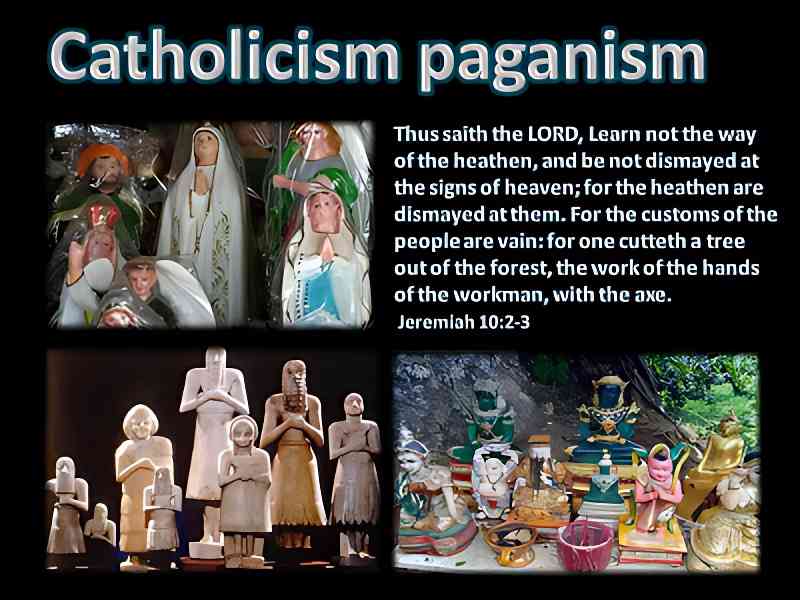
We have seen—by scores of examples—that a mixture of paganism and Christianity produced the Roman Catholic Church. The pagans worshiped and prayed to a mother goddess, so the fallen church adopted mother-worship under the name of Mary. The pagans had gods and goddesses associated with various days, occupations, and events in life. This system was adopted and the “gods” were called “saints.” The pagans used statues or idols of their pagan deities in their worship, so the fallen church did also, simply calling them by different names. From ancient times, crosses in various forms were regarded in superstitious ways. Some of these ideas were adopted and associated with the cross of Christ. The cross as an image was outwardly honored, but the true “finished” sacrifice of the cross became obscured by the rituals of the Mass with its transubstantiation, mystery drama, and prayers for the dead!
Repetitious prayers, rosaries, and relics were all adopted from paganism and given a surface appearance of Christianity. The pagan office and title of Pontifex Maximus was applied to the bishop of Rome. He became known as the pope, the Father of fathers, even though Jesus said to call no man father! In literally hundreds of ways, pagan rites were merged into Christianity at Rome.
Catholic scholars recognize that their church developed from a mixture of paganism and Christianity. But from their point of view, these things were triumphs for Christianity, because the church was able to Christianize pagan practices. The Catholic Encyclopedia makes these statements: “We need not shrink from admitting that candles, like incense and lustral water, were commonly employed in pagan worship and in the rites paid to the dead. But the Church from a very early period took them into her service, just as she adopted many other things…like music, lights, perfumes, ablutions, floral decorations, canopies, fans, screens, bells, vestments, etc., which were not identified with any idolatrous cult in particular; they were common to almost all cults.”1 “Water, oil, light, incense, singing, procession, prostration, decoration of altars, vestments of priests, are naturally at the service of universal religious instinct…Even pagan feasts may be ‘baptized’: certainly our processions of 25 April are the Robigalia; the Rogation days may replace the Ambarvalia; the date of Christmas Day may be due to the same instinct which placed on 25 December the Natalis Invicti of the solar cult.”2
The use of statues, and customs such as bowing before an image, are explained in Catholic theology as having developed from the old emperor worship! “The etiquette of the Byzantine court gradually evolved elaborate forms of respect, not only for the person of Caesar but even for his statues and symbols. Philostorgius…says that in the fourth century the Christian Roman citizens in the East offered gifts, incense, even prayers (!) to the statues of the emperor (Hist. eccl. II, 17). It would be natural that people who bowed to, kissed, incensed the imperial eagles and images of Caesar (with no suspicion of anything like idolatry)…should give the same signs to the cross, the images of Christ, and the altar… The first Christians were accustomed to see statues of emperors, of pagan gods and heroes, as well as pagan wall-paintings. So they made paintings of their religion, and, as soon as they could afford them, statues of their Lord and of their heroes.”3 It should be noticed that no claim for any scriptural command is even suggested for these things. It is clearly stated that these customs developed from paganism.
Sometimes various wall-paintings of the early centuries, such as those in the Roman catacombs, are referred to as though they represented the beliefs of the original Christians. We do not believe this is true, for there is clear evidence of a mixture. While these paintings included scenes of Christ feeding the multitudes with the loaves and fishes, Jonah and the whale, or the sacrifice of Isaac, other paintings were unmistakably pagan portrayals. Some feel this “mixture” was a disguise used to avoid persecution, but nevertheless, it cannot be denied that the roots of mixture were present. Says The Catholic Encyclopedia: “The Good Shepherd carrying the sheep on his shoulders occurs frequently, and this preference may well be due to its resemblance to the pagan figures of Hermes Kriophoros or Aristaeus, which at this period were much in vogue…Even the fable of Orpheus was borrowed pictorially and referred to Christ. Similarly the story of Eros and Psyche was revived and Christianized, serving to remind the believer of the resurrection of the body…The group of the Twelve Apostles probably attracted the less attention because the twelve Dii Majores were often also grouped together. Again the figure of the Orans (q. v.), the woman with arms uplifted in prayer, was quite familiar to classical antiquity…Similarly the fish symbol, representing Christ, the anchor of hope, the palm of victory, were all sufficiently familiar as emblems among pagans to excite no particular attention.”4
In the Old Testament, the apostasy into which the Israelites repeatedly fell was that of mixture. Usually they did not totally reject the worship of the true God, but mixed heathen rites with it! This was the case even when they worshiped the golden calf (Exodus 32). We all realize that such worship was false, heathenish, and an abomination in the sight of God. Yet—and this is the point we would make—it was claimed that this was a “feast unto the Lord” (verse 5)—a feast to Jehovah (or more correctly) Yahweh, the true God! They sat down to eat and drink and rose up to play. They practiced rites in which they made themselves naked (verse 25), perhaps similar to those which were carried out by naked Babylonian priests.5
During the forty years in the wilderness, the Israelites carried the tabernacle of God. However, some of them were not content with this, so they added something. They made unto themselves a Babylonian tabernacle that was carried also! “But ye have borne the tabernacle of your Moloch and Chiun, your images” (Amos 5:26; Acts 7:42, 43). These were but other names for the sun-god Baal and the mother goddess Astarte. Because of this mixture, their songs of worship, sacrifices, and offerings were rejected by God.
At another period, the Israelites performed secret rites, built high places, used divination, caused their children to pass through the fire, and worshiped the sun, moon, and stars (2 Kings 17:9–17). As a result, they were driven from their land. The king of Assyria brought men from various nations, including Babylon, to inhabit the land from which the Israelites had been taken. These also practiced heathenish rituals and God sent lions among them. Recognizing such as the judgment of God, they sent for a man of God to teach them how to fear the Lord. “Howbeit every nation made gods of their own” (verses 29–31), attempting to worship these gods and the Lord also—a mixture. “So”—in this way—“they feared the Lord, and made unto themselves of the lowest of them priests…they feared the Lord, and served their own gods” (verse 32).
Mixture was also apparent in the days of the judges when a Levite priest who claimed to speak the word of the Lord served in a “house of gods” and was called by the title “father” (Judges 17:3, 13; 18:6). At the time of Ezekiel, an idol had been placed right at the entrance of the Jerusalem temple. Priests offered incense to false gods which were pictured upon the walls. Women wept for Tammuz and men worshiped the sun at dawn from the temple area (Ezekiel 8). Some even sacrificed their children and “when they had slain their children to their idols”, God said, “then they came the same day into my sanctuary” (Ezekiel 23:38, 39).
Jeremiah’s message was directed to people who claimed to “worship the Lord” (Jer. 7:2), but who had mixed in paganistic rites. “Behold”, God said, “ye trust in lying words that cannot profit. Ye…burn incense unto Baal, and walk after other gods…make cakes to the queen of heaven…and come and stand before me in this house” (verses 8–18).
Considering these numerous Biblical examples, it is clear that God is not pleased with worship that is a mixture. As Samuel preached, “If ye do return unto the Lord with all your hearts, then put away the strange gods and Ashtaroth (the pagan mother worship) from among you, and prepare your hearts unto the Lord, and serve him only: and he will deliver you” (1 Samuel 7:3).
We should remember that Satan does not appear as a monster with horns, a long tail, and a pitchfork. Instead, he appears as an angel of light (2 Cor. 11:14). As Jesus warned about “wolves in sheep’s clothing” (Matt. 7:15), so in numerous instances the paganism that was disguised in the outer garments of Christianity became a mixture that has deceived millions. It was like removing the warning label from a bottle of poison and substituting a peppermint candy label in its place. The contents are deadly just the same. No matter how much we may dress it up on the outside, paganism is deadly. True worship must be “in spirit and in truth” (John 4:24)—not pagan error.
Because of the clever ways that paganism was mixed with Christianity, the Babylonish influence became hidden—a mystery—“mystery Babylon.” But as a detective gathers clues and facts in order to solve a mystery, so in this book we have presented many Biblical and historical clues as evidence. Some of these clues may have seemed insignificant at first glance or when taken alone. But when the full picture is seen, they fit together and conclusively solve the mystery of Babylon—ancient and modern! Over the centuries God has called his people out of the bondage of Babylon. Still today his voice is saying, “Come out of her, my people, that ye be not partakers of her sins” (Rev. 18:4).
It is a delicate task to write concerning religious subjects on which very fine and sincere people have strong differences. One wants to speak frankly enough to make a point, yet also to maintain a proper balance so that in disagreeing he is not needlessly disagreeable. As with any book—certainly not excluding the Bible—it is inevitable that some misunderstanding or differences of opinion will result. Some may feel too much has been said, others not enough. Nevertheless, in the words of Pilate, “What I have written I have written.” If the Roman Catholic Church which claims to never change is gradually turning from practices which some of us consider heathenish, we can be glad for any progress along the path of truth. If this book has had any part in this trend, we can rejoice.
We believe the true Christian goal is not religion based on mixture, but a return to the original, simple, powerful, and spiritual faith that was once delivered to the saints. No longer entangling ourselves in a maze of rituals or powerless traditions, we can find the “simplicity that is in Christ”, rejoicing in the “liberty wherewith Christ has made us free” from “bondage” (2 Cor. 11:3; Gal. 5:1).
Salvation is not dependent on a human priest, Mary, the saints, or the pope. Jesus said, “I am the way, the truth, and the life: no man cometh unto the Father, but by me” (John 14:6). “Neither is there salvation in any other: for there is none other name under heaven given among men, whereby we must be saved” (Acts 4:12). Let us look to JESUS who is the author and finisher of our faith, the Apostle and High Priest of our profession, the Lamb of God, the Captain of our Salvation, the Bread from Heaven, the Water of Life, the Good Shepherd, the Prince of Peace, the King of kings and Lord of lords!
NOTES
CHAPTER ONE
1, Clarke, Clarke’s Commentary, vol. 1, p. 86.
2. The Jewish Encyclopedia, vol. 9, p. 309.
3. Josephus, Antiquities of the Jews, Bk. 1, 4:2, 3.
4. Hislop, The Two Babylons.
5. Ibid., p. 12.
6. Bailey, The Legacy of Rome, p. 245.
CHAPTER TWO
1. Encyclopedia of Religions, vol. 2, p. 398.
2. Gross, The Heathen Religion, p. 60.
3. Hislop, The Two Babylons, p. 20.
4. Ibid.
5. Bach, Strange Sects and Curious Cults, p. 12.
6. Frazer, The Golden Bough, vol. 1, p. 356.
7. Encyclopedia Britannica, vol. 14, p. 309.
8. The Catholic Encyclopedia, vol. 15, p. 459, art. “Virgin Mary.”
9. Ibid., p. 460.
10. Fausset’s Bible Encyclopedia, p. 484.
11. Hislop, The Two Babylons, p. 20.
12. Harper’s Bible Dictionary, p. 47.
13. Smith, Man and His Gods, p. 216.
14. Kenrick, Egypt, vol. 1, p. 425. Blavatsky, Isis Unveiled, p. 49.
15, Weigall, The Paganism in Our Christianity, p. 129.
CHAPTER THREE
1. Boettner, Roman Catholicism, p. 147.
2. Hislop, The Two Babylons, p. 158.
3. The Catholic Encyclopedia, vol. 7, p. 674 art. “Immaculate conception.”
4, Ibid., p. 675.
5. Official Baltimore Catechism, no. 2 (Lesson 11),
6. Doane, Bible Myths, p. 357.
7. Encyclopedia Britannica, Vol. 14, p. 999, art. “Mary.”
8. Ibid., vol. 2, p. 632, art. “Assumption, Feast of.”
9. The Catholic Encyclopedia, vol. 13, p. 185, art. “Rosary.”
10. Seymour, The Cross in Tradition, History, and Art, p. 21.
11. Encyclopedia of Religions, vol. 3,pp. 203-205.
12. Hislop, The Two Babylons, pp. 187-188.
13. The Catholic Encyclopedia, vol. 7, p. 111, art. “Hail Mary.”
CHAPTER FOUR
1. The Catholic Encyclopedia, vol. 4, p. 653, 655, art. “Prayers for the dead.”
2. Ibid., vol, 8, p. 70, art. “Intercession.”
3. Ibid.
4. Hays, In the Beginnings, p. 65.
5. Encyclopedia of Religions, vol. 2, p. 78.
6. Williams, The Historians’ History of the World, vol. 1, p. 518.
7. Dobbins, Story of the World’s Worship, p. 621.
8. Durant, The Story of Civilization: Caesar and Christ, pp. 61-63.
9. The Catholic Encyclopedia, vol. 4, p. 178, art. “Communion of Saints,”
10. Ibid., vol, 9, pp. 130, 131, art. “Legends.”
11. Urlin, Festivals, Holy Days, and Saints’ Days, p.26.
12. The Catholic Encyclopedia, vol, 2, p. 44, art. “Athens.”
13. Hasting’s Encyclopedia of Religion and Ethics, art. “Images and Idols.”
14. The Catholic Encyclopedia, vol. 7, p. 636, art. “Idolatry.”
15. Ibid., p. 620, art. “Iconoclasm.”
16. Inman, Ancient Pagan and Modern Christian Symbolism, p. 35.
CHAPTER FIVE
1. Encyclopedia of Religions, vol. 3, p. 264.
2. Ibid., vol. 3, p. 33; Inman, Ancient Pagan and Modern Christian Symbolism, p. 99.
3. Scofield Reference Bible, p. 847.
4. Encyclopedia of Religions, vol. 3, p. 33.
5. Harper’s Bible Dictionary, p. 500.
6. Pignatorre, Ancient Monuments of Rome, p. 175.
7. Ibid., p. 177.
8. Hasting’s Encyclopedia of Religion and Ethics, art. “Phallicism.”
9. Champdor, Ancient Cities and Temples, p. 22.
10. Hislop, The Two Babylons, p. 307.
11. Cirlot, A Dictionary of Symbols, p. 326.
12. Bury, The Cambridge Ancient History—Egypt and Babylonia, vol. 1, p. 533.
13. The Catholic Encyclopedia, vol. 2, p. 185, art. “Babylonia.”
14. Dobbins, The Story of the World’s Worship, p. 14.
15. Brown, Sex Worship and Symbolism of Primitive Races, p. 38.
16. Eichler, The Customs of Mankind, p. 55.
CHAPTER SIX
1. Harper’s Book of Facts.
2. Fausset’s Bible Encyclopedia, p. 145.
3. Seymour, The Cross in Tradition, History, and Art, p. 157.
4. Vine, An Expository Dictionary of New Testament Words, p. 256.
5. Seymour, The Cross in Tradition, History, and Art, pp. 22, 26.
6. Ibid., p.13.
7. Ibid., pp. 10, 12.
8. Ibid., p. 9.
9. Prescott’s Conquest of Mexico, vol. 1, p. 242 (quoted by Hislop, p. 199)
10. The Catholic Encyclopedia. vol. 10, p. 253, art. “Mexico.”
11. Seymour, The Cross in Tradition, History, and Art, pp. 22, 26.
12. Hislop, The Two Babylons, p. 198.
13. Encyclopedia of Religions, vol. 1, pp. 386, 494.
14. Hislop, The Two Babylons, p. 198.
15. The Catholic Encyclopedia, vol. 4, p. 517, art. “Cross.”
16. Seymour, The Cross in Tradition, History, and Art, p. 64,
17. The Pentateuch Examined, vol, 6, p. 113.
18. The Catholic Encyclopedia, vol. 4, p. 518, art. “Cross.”
19. Encyclopedia of Religions, vol. 1, p. 494.
20. Vine, An Expository Dictionary of New Testament Words, p. 256.
CHAPTER SEVEN
1. Smith, Man and His Gods, p.220.
2. Durant, The Story of Civilization: Caesar and Christ, p. 66.
3. The Catholic Encyclopedia. vol. 4, p. 300, art. “Constantine.”
4. Ibid.
5. Durant, The Story of Civilization: Caesar and Christ pp. 655, 656.
6. Ibid., p. 654.
7. The Catholic Encyclopedia, vol. 4, pp. 299, 300, art. “Constantine”, etc.
8. Ibid., vol. 4, p. 523, art. “Cross.”
9. Encyclopedia of Religions, vol. 1, p. 494.
10. Fausset’s Bible Encyclopedia, p. 145.
CHAPTER EIGHT
1. The Catholic Encyclopedia, vol. 4, p. 524, art. “Cross.”
2. Calvin’s Tracts, vol. 1, pp. 296-304.
3. Wilder, The Other Side of Rome, p. 54.
4. Ibid., p. 53.
5. The Catholic Encyclopedia, vol. 13, p. 454, art. “Santa Casa di Loreto.”
6. Ibid., vol, 12, p. 734, art. “Relics.”
7. Cotterill, Medieval Italy, p. 71.
8. Ibid., p. 391.
9. The Catholic Encyclopedia, vol. 2, p. 661, art. “Boniface IV.”
10. Ibid., vol.12, p. 737, art. “Relics.”
11. Durant, The Story of Civilization: The Reformation, p. 339.
12. Hislop, The Two Babylons, p. 179.
13. The Catholic Encyclopedia, vol, 12, p. 734, art. “Relics.”
14, Boettner, Roman Catholicism,p. 290.
15. The Catholic Encyclopedia, vol. 12, p. 737, art. “Relics.”
16. Ibid., p. 738.
CHAPTER NINE
1. Durant, The Story of Civilization: The Age of Faith, p. 753.
2. Ibid., p. 766.
3. The Catholic Encyclopedia, vol. 7, p. 783, art. “Indulgences.””
4. Ibid., p. 784.
5. Ibid., pp. 786, 787.
6. Durant, The Story of Civilization: The Reformation, p. 23.
7. Ibid., p.735.
8. Encyclopedia of Religions, vol. 2, p. 159.
9. Smith, Man and His Gods, p. 127.
10. Encyclopedia Britannica, vol. 22, p. 660.
11. Hislop, The Two Babylons, p. 167.
12. Fausset’s Bible Encyclopedia, p. 481.
13. Strong’s Exhaustive Concordance of the Bible, No.8612.
CHAPTER ELEVEN
1. Parkhurst’s Hebrew Lexicon, p. 602 (quoted by Hislop, p. 208).
2. Hislop, The Two Babylons, p. 210.
3. Ibid.,
4. Strong’s Exhaustive Concordance of the Bible, no. 6363.
5. The Catholic Encyclopedia, vol. 7. p. 699, art. “Impostors.”
6. Hislop, The Two Babylons, p. 207.
7. Smith, Man and His Gods, p. 129.
8. Encyclopedia of Religions, vol. 2, p. 311, art. “Janus.”
9. Ibid., p. 545.
10. The Catholic Encyclopedia, vol. 10, p. 403, art. “Mithraism.”
11. Durant, The Story of Civilization: The Age of Faith, p. 745.
12. Inman, Ancient Pagan and Modern Christian Symbolism, pp. 63, 64.
13. Strong’s Exhaustive Concordance of the Bible, no. 1709 and 1712.
14. Encyclopedia of Religions, vol. 1, p.502, art. “Dagon.”
15. Inman, Ancient Pagan and Modern Christian Symbolism, p. 21.
16. Layard, Babylon and Nineveh, p. 343.
17, Hislop, The Two Babylons, P. 216.
18. The Catholic Encyclopedia, Vol, 3, p. 554, art. “Chair of Peter.”
19. Ibid., vol, 2, p. 185, art. “Babylonia.”
20.Hasting’s Encyclopedia of Religion and Ethics, art, ‘Images and Idols.”
21. Hislop, The Two Babylons, P. 214.
22. Encyclopedia Britannica, vol. 22, p. 81, art. “Pope.”
23. Aradi, The Popes—The History of How They are Chosen, Elected, and Crowned, p. 108.
CHAPTER TWELVE
1. Chiniquy, The Priest, the Woman, and the Confessional, P. 138.
2. Cotterill, Medieval Italy, P. 331.
3. Halley, Halley’s Bible Handbook, p. 174.
4, The Catholic Encyclopedia, Vol. 8, pp. 425, art. “John X, Pope.”
5. Chiniquy, The Priest, the Woman, and the Confessional, p. 138.
6. The Catholic Encyclopedia, vol. 8, p. 426, art. “John XI.”
7. Ibid., p. 427, art. “John XII.”
8. Liber Pontificalis, vol, 2, p. 246.
9. The Catholic Encyclopedia, Vol, 2, p. 661, 662, art. “Boniface VII.”
10. Halley, Halley’s Bible Handbook, P. 775.
11. Ibid.
12. The Catholic Encyclopedia, vol, 2, pp. 668, 668, art. “Boniface VIII.”
13. Ibid. , p. 670.
14. History of the Church Councils, Bk. 40, art. 697.
15. The Catholic Encyclopedia. vol. 4, p. 435, art. “Councils.”
16. Halley, Halley’s Bible Handbook, p. 178.
17. Chiniquy, The Priest, the Woman, and the Confessional, p. 139.
18. Durant, The Story of Civilization: The Reformation, p. 10.
19. Sacrorum Conciliorium, vol. 27, p. 663.
20. Durant, The Story of Civilization: The Reformation, p. 10.
21. Halley, Halley’s Bible Handbook, p. 779.
22. Durant, The Story of Civilization: The Reformation, p. 13.
23. Halley, Halley’s Bible Handbook, p. 779.
24. Ibid.
25. The Catholic Encyclopedia, vol. 8, p. 19, art. “Innocent VIII.”
26. D’Aubigne, History of the Reformation, p.11.
27. Chiniquy, The Priest, the Woman, and the Confessional, p. 139.
28. Diarium, vol. 3, p. 167.
29. Life July 5, 1963.
30. The Catholic Encyclopedia, vol. 9, pp. 162, 163, art. “Leo X.”
31. Durant, The Story of Civilization: The Reformation, p. 344,
32. D’Aubigne, History of the Reformation, p. 59.
33. The Catholic Encyclopedia, vol. 8, p. 407, art. “Joan, Popess.””
34. Ibid., p. 408.
CHAPTER THIRTEEN
1. The Catholic Encyclopedia, vol. 7, p. 796, art. “Infallibility.”
2. Ibid., vol. 14, p. 316, art. “Strossmayer.”
3. Ibid., vol. 6, p. 141, art. “Formosus.”
4. Ibid.
CHAPTER FOURTEEN
1. The Catholic Encyclopedia, vol. 8, p. 34.
2. Smith, Man and His Gods, p. 286.
3. Ridpath’s History of the World, vol, 5, p. 304,
4. Fox’s Book of Martyrs, p. 103.
5. Ridpath’s History of the World, vol. 5, p. 297.
CHAPTER FIFTEEN
1. Ritter, This is the Catholic Church, booklet 50, p. 38.
2. Hislop, The Two Babylons, p. 210.
3. Ibid., p. 206.
4. Harper’s Dictionary of Classical Literature and Antiquities, p. 675.
5. Luther, To the German Nobility, p. 317.
6. Scofield, Scofield Reference Bible, p. 1332.
7. Cumont, The Mysteries of Mithra, p. 167.
8. The Catholic Encyclopedia, vol. 10, p. 403, art. “Mithraism.”
9. Ibid., p. 510, art. “Monsignor.”
CHAPTER SIXTEEN
1. Clarke’s Commentary, vol. 6, p. 601.
2. Hislop, The Two Babylons, p. 219.
3. Ibid., p. 220.
4. Ibid.
5. Durant, The Story of Civilization: The Reformation, p. 21.
6. D’Aubigne, History of the Reformation, p. 11.
7. Flick, The Decline of the Medieval Church, p. 295.
8. D’Aubigne, History of the Reformation, p.11.
9. The Catholic Encyclopedia, vol. 3, p. 483, art. “Celibacy.”
10. Ibid., pp. 483, 485.
11. Ibid., p. 481.
12. Ibid., p. 484.
18. Ibid., vol, 11, p. 625, art. “Penance.”
14. Ibid.
15. Saggs, The Greatness that was Babylon, p. 268.
16. Hislop, The Two Babylons, pp. 9, 10.
17. Fausset’s Bible Encyclopedia, p. 291, art. “High places.”
18. Clarke’s Commentary, vol. 2, p. 562.
19. The Catholic Encyclopedia, vol, 14, p. 779, art. “Tonsure.”
20. Ibid.
21. Hislop, The Two Babylons, p. 222.
CHAPTER SEVENTEEN
1. The Catholic Encyclopedia, vol. 4, p. 277, art. “Consecration.”
2. Durant, The Story of Civilization: The Reformation. p. 749,
3. Encyclopedia of Religions, vol. 2, p. 77.
4, The Catholic Encyclopedia, vol 14, p. 586, art. “Theology.”
5. Ibid., vol. 10, p. 6, art. “Mass, Sacrifice of.”
6. Ibid., p. 13.
7. Ibid., vol. 7, p. 346, art. “High Altar.”
8. The New Baltimore Catechism, no. 3, question 931.
9. The Catholic Encyclopedia, vol. 5, p. 581, art. “Eucharist.”
10. Ibid., vol. 4, p. 176, art. “Communion under both kinds.”
11. Ibid.
12. Durant, The Story of Civilization: The Reformation, p. 741.
13. The Catholic Encyclopedia, vol. 10, p. 404, art. “Mithraism.”
14. Encyclopedia of Religions, vol. 2, p. 76.
15. Prescott’s Conquest of Mexico, vol. 3.
16. Hislop, The Two Babylons, p. 232.
17. The Catholic Encyclopedia, vol. 7, p. 489, art. “Host.”
18. Ibid., p. 492.
19. Ibid., p. 491.
20. Hislop, The Two Babylons, p. 163.
21. Wilkinson, Egyptians, vol. 5, p. 353 (quoted by Hislop, p. 160).
22. Blavatsky, Isis Unveiled, p. 351.
23. Inman, Ancient Pagan and Modern Christian Symbolism, p. 34,
24. Dobbins, Story of the World’s Worship, p. 383.
25. Hislop, The Two Babylons, p. 162.
26. Lethaby, Architecture, Nature, and Magic, p. 29.
27. Ibid.
28. Nichols, The Growth of the Christian Church, p. 23.
29. Hislop, The Two Babylons, p. 164.
30. Scott, Romanism and the Gospel, p. 93.
31. Boettner, Roman Catholicism, p. 170.
CHAPTER EIGHTEEN
1. The Jewish Encyclopedia, vol. 4, p. 475, art. “Day.”
2. Eternity, June, 1958.
3. The Catholic Encyclopedia, Vol. 8, p. 378, art. “Jesus Christ.”
4. Pettingill, Bible Questions Answered, p. 182.
5. Dake’s Annotated Reference Bible, p.13.
6. Torrey, Difficulties and Alleged Errors and Contradictions in the Bible, pp. 104-109.
CHAPTER NINETEEN
1. Cirlot, A Dictionary of Symbols, p. 29.
2. Fausset’s Bible Encyclopedia, p. 232.
3. Encyclopedia of Religions, vol. 2, p. 120, art. “Friday.”
4. Ibid., vol. 2, p. 105, art. “Fish.”
5. Inman, Ancient Pagan and Modern Christian Symbolism, p. 55.
6. Encyclopedia of Religions, vol. 2, p. 105.
7. Hislop, The Two Babylons, p. 103.
8. Ibid., p. 109.
9. Ibid., p. 108.
10. Encyclopedia of Religions, vol. 2, p. 13.
11, Ibid., p. 12.
12. Bonwick, Egyptian Belief, p. 24.
13. Encyclopedia Britannica, art. “Easter.”
14. The Catholic Encyclopedia, vol. 5, p. 227, art. “Easter.”
15. Encyclopedia Britannica, art. “Easter.”
16. Fausset’s Bible Encyclopedia, p. 304.
17. Strong’s Exhaustive Concordance of the Bible, no. 1242.
18. Dobbins, The Story of the World’s Worship, p. 330.
19. Smith, Man and His Gods, p. 86.
20. Urlin, Festivals, Holy Days, and Saints’ Days, p. 89.
21. Encyclopedia Britannica, vol. 7. p. 859, art. “Easter.”
22. Hislop, The Two Babylons, pp. 104, 105.
23. The Catholic Encyclopedia, vol. 3, p. 484. art. “Celibacy.”
24. Ibid., vol. 11, p. 390, art. “Paganism.”
CHAPTER TWENTY
1. Clark’s Commentary, vol. 5, p. 370, “Luke.”
2. The Catholic Encyclopedia, vol. 3, p. 724, art. “Christmas.”
3. Ibid., p. 725.
4. The Encyclopedia Americana, vol. 6, p. 623.
5. Frazer, The Golden Bough, p. 471.
6. The Catholic Encyclopedia, vol. 3, p. 727, art. “Christmas.”
7. Ibid.
8. Walsh, Curiosities of Popular Customs, p. 242.
9. Bailey, The Legacy of Rome, p. 242.
10. Walsh, Curiosities of Popular Customs, p. 242.
11. Urlin, Festivals, Holy Days, and Saints’ Days, p. 222.
12. Ibid., p. 238.
13. The Catholic Encyclopedia, vol. 8, p. 491, art. “John the Baptist.”
14. Toland’s Druids, p. 107 (quoted by Hislop, p. 116).
15. Hislop, The Two Babylons, p. 114.
16. Fausset’s Bible Encyclopedia, p. 510.
17. Durant, The Story of Civilization: The Age of Faith, p. 746.
18. Urlin, Festivals, Holy Days, and Saints’ Days, pp. 27, 28.
19. The Catholic Encyclopedia, vol. 3, p. 246, art. “Candles.”
CHAPTER TWENTY-ONE
1. The Catholic Encyclopedia, vol. 3, p. 246, art. “Candles.”
2. Ibid., vol. 11, p. 90, art. “Paganism.”
3. Ibid., vol. 7, pp. 666-668, art. “Images.”
4. Ibid., vol. 14, p. 374, art. “Symbolism.”
5. Saggs, The Greatness that was Babylon, pp. 182, 354.
BIBLIOGRAPHY
Araki, Zsolt. The Popes—The History of How They are Chosen, Elected, and Crowned. London: Macmillan, 1956.
Artz, Frederick B. The Mind of the Middle Ages. New York: Knopf, 1959.
Babylon the Great Has Fallen. Watchtower Bible and Tract Society. New York, 1963.
Bach, Marcus. Strange Sects and Curious Cults. New York: Dodd, Mead, 1961.
Bailey, Cyril (editor). The Legacy of Rome. Oxford: The Clarendon Press, 1923.
Benson, George Willard. The Cross—Its History and Symbolism. Hacker, 1934.
Blavatsky, H. P. Isis Unveiled. London: Theosophical Publishing Co., 1923.
Boettner, Loraine. Roman Catholicism. Philadelphia: Presbyterian and Reformed Publishing Co., 1962.
Bonwick, James. Egyptian Belief and Modern Thought.
Bower, Archibald. History of the Popes. Philadelphia: Griffith and Simon, 1845.
Broderick, Robert C. Concise Catholic Dictionary. Milwaukee: The Bruce Publishing Co., 1944.
Brown, Lewis. This Believing World, New York: The Macmillan Co., 1930.
Brown, Sanger. Sex Worship and Symbolism of Primitive Races. 1916.
Bullinger, Ethelbert William. Number in Scripture. Grand Rapids: Kregel, 1967.
Bury, J. B. (editor). The Cambridge Ancient History—Egypt and Babylonia. New York: The Macmillan Co. 1924.
Busenbark, Ernest. Symbols, Sex, and the Stars in Popular Beliefs. New York: The Truth Seeker Co., 1949.
Calvin, John. Calvin’s Tracts.
Catholic Encyclopedia, The. New York, Robert Appleton Co., 1911.
Champdor, Albert. Ancient Cities and Temples—Babylon. New York: Putnam. 1958,
Chiniquy, Charles. Fifty Years in the Church of Rome. New York: Christ’s Mission, 1953 (first printed in 1885). —The Priest, the Woman, and the Confessional. Sea Cliff, New Jersey: Christ’s Mission n.d.
Cirlot, J. E. A Dictionary of Symbols, New York: Philosophical Library, 1962.
Clarke, Adam. Clarke’s Commentary. New York, Nashville: Abingdon Press. n.d.
Contenau, George. Everyday Life in Babylon and Assyria. London: E. Arnold, 1954.
Cotterill, H. B. Medieval Italy. New York: Frederick A. Stokes Co., 1915.
Cummings, Charles A. History of Architecture in Italy. Boston and New York: Houghton, Miffin and Co., 1901.
Cumont, Franz, The Mysteries of Mithra. New York: Dover Publications, 1956.
Dake, Finis Jennings. Dake’s Annotated Reference Bible. Atlanta: Dake Bible Sales, 1963.
D’Aubigne, J . H. Merle. History of the Reformation. New York: Putnam. 1872.
Doane, T. W. Bible Myths. J. W. Bouton, 1928.
Dobbins, F. S. Story of the World’s Worship.
Doeswyck, Peter J. Ecumenicalism and Romanism. Long Beach: Knights of Christ, 1961.
Durant, Will. The Story of Civilization. Caesar and Christ (vol. 3), The Age of Faith (vol. 4), The Renaissance (vol.5), The Reformation (vol. 6). New York: Simon and Schuster, 1944-1977,
Eichler, Lillian. The Customs of Mankind. Garden City 1924.
Encyclopedia Americana. Danbury, Connecticut: Grolier Inc.
Encyclopedia Britannica. New York: Henry G. Allen Co.
Fausset, A. R. Fausset’s Bible Encyclopedia. Grand Rapids: Zondervan. n. d.
Flick, Alexander C. The Decline of the Medieval Church. New York: Knopf. 1930.
Forlong, J. G. R. Encyclopedia of Religions. New Hyde Park, New York: University Books, 1964.
Foxe, John. Foxe’s Book of Martyrs (sixteenth century).
Frazer, James George. The Golden Bough. New York: Macmillan Co., 1935.
Gaster, Theodor H. Myth, Legend, and Custom in the Old Testament. New York: Harper and Row. 1969.
Goldberg, B. Z. The Sacred Fire. New York: Liveright. 1930.
Goldsmith, Elizabeth. Ancient Pagan Symbols. Gale, 1929.
Gross, J. B. The Heathen Religion.
Halley, Henry H. Halley’s Bible Handbook, 24th edition, copyright 1965 by Halley’s Bible Handbook, Inc. and used by permission of Zondervan Publishing House.
Hastings, James. Hasting’s Encyclopedia of Religion and Ethics. New York: Chas. Scribner’s Sons, 1928.
Hays, H. R. In the Beginnings, Early Man and His Gods. New York: Putnam, 1963.
Hefele, Karl Joseph. A History of the Councils of the Church. Edinburgh: T. T. Clark, 1883-96.
Hirn, Yrjo. The Sacred Shrine. London: Macmillan and Co., 1912.
Hislop, Alexander. The Two Babylons. New York: Loizeaux Brothers. 1959 (first published 1853).
Horan, Ellamay. Official Revised Baltimore Catechism (Number 2).
Inman, Thomas. Ancient Pagan and Modern Christian Symbolism. Bristol: 1874.
Ironside, H. A. Revelation. New York: Loizeaux, 1953.
Jewish Encyclopedia, New York: Funk and Wagnalls Co.
John, Eric (editor). The Popes—A Concise Biographical History. New York: Hawthorn Books, 1964.
Josephus, Flavius. Antiquities of the Jews. Philadelphia: John C. Winston Co., 1957 edition.
Layard, Austen Henry. Nineveh and Its Remains. New York: Putnam, 1849, –Nineveh and Babylon. New York: Harper and Brothers, 1853.
Lea, Henry Charles. History of Sacerdotal Celibacy. New York. The Macmillan Co., 1907.
Lethaby, W. R. Architecture, Nature, and Magic. London: Duckworth, 1956.
Luther, Martin. To the German Nobility.
Masson, Georgina. The Companion Guide to Rome. New York: Harper and Row. 1965.
McLoughlin, Emmett. Crime and Immorality in the Catholic Church, New York: Lyle Stuart, 1962.
Miller, Madeleine S. Harper’s Bible Dictionary. New York: Harper and Row, 1961.
Nichols, Robert Hastings. The Growth of the Christian Church. Philadelphia: The Westminster Press, 1941.
Peck, Harry Thursdon (editor). Harper’s Dictionary of Classical Literature and Antiquities. New York: Harper and Brothers. 1896.
Pettingill, W. L. Bible Questions Answered. Grand Rapids: Zondervan. n. d.
Pfeiffer, Harold A. A Catholic Picture Dictionary. Garden City, New York: Garden City Books, 1948.
Ridpath, John Clarke. Ridpath’s History of the World. Cincinnati: Jones Publishing Co., 1912.
Pignatorre, Theodore. Ancient Monuments of Rome. London: Trefoil, 1932.
Prescott, William H. History of the Conquest of Mexico. London, 1843.
Robinson, James Harvey. Earlier Ages.
Saggs, H. W. F. The Greatness that was Babylon. Mentor Books, 1968 edition.
Sansom, William. A Book of Christmas. New York: McGrawHill. 1968.
Schaff, Philip. History of the Christian Church. Grand Rapids: Eerdmans, 1960-62.
Scofield, C. I. Scofield Reference Bible. New York: Oxford University press, 1917.
Scott, C. Anderson. Romanism and the Gospel. Philadelphia: Westminister, 1946.
Seldes, George. The Vatican; Yesterday, Today, Tomorrow. London: Harper and Brothers. 1934.
Seymour, William Wood. The Cross in Tradition, History, and Art. New York: G. P. Putnam’s Sons, 1897.
Smith, Homer W. Man and His Gods. Boston: Little, Brown, and Co., 1953.
Strong, James. Strong’s Exhaustive Concordance of the Bible. New York, Nashville: Abingdon-Cokesbury Press, 1890.
Torrey, R. A. Difficulties and Alleged Errors and Contradictions in the Bible. 1909.
Tucker, Thomas G. Life in the Roman World. New York: Macmillan Co., 1911.
Urlin, Ethel L. Festivals, Holy Days, and Saints’ Days. London, 1915.
Vine, William Edwyn. An Expository Dictionary of New Testament Words, Westwood, New Jersey: Revell, 1940.
Walsh, Mary E. The Wine of Roman Babylon. Nashville: Southern Publishing Association, 1945.
Walsh, William S. Curiosities of Popular Customs. Philadelphia: Lippincott Co., 1897.
Weigall, Arthur. The Paganism in our Christianity. New York: Putnam’s Son, 1928.
Wells, H. G. The Outline of History. Garden City, New York: Garden City Publishing Co., 1920.
Wilder, John P. The Other Side of Rome. Grand Rapids: Zondervan, 1959.
Williams, Henry Smith (editor). The Historians’ History of the World. New York: The History Association, 1907.
Download the entire book Babylon Mystery Religion by Ralph Woodrow in PDF format.