
Is It Mary, Or The Lady Of The Jesuits? – Chapter VI. A Valiant Friend
Continued from Chapter V. The Escaped Nun.
A VALIANT FRIEND
is the Rev. John Thornberry of Fishergate. It was at his church where William Millett, one of the most consecrated and generous of laymen in England, presided. In one of the many replies of Rev. John Thornberry, we find these utterances which are, at least, suggestive:
“The starting-point was the superintendence of, or opening of, nunneries, which a cloud of dust raised by a mixed multitude has obscured. Dr. Fulton, in his lecture on this subject, made reference to celibacy, and referred to the brethren of our Lord by the flesh, and having proved this point from Matt. 13, said, ‘The Virgin Mary could not have been much of a virgin after that.’ The Ritualists and Romanists rose in arms as if Dr. Fulton had been guilty of the greatest sin. Take from Dr. Fulton’s application of that Scripture but two little words, ‘much of,’ and you have the sentence as thousands of devout and reverent men have used it, viz., ‘She could not have been a virgin after that.’
“I am not one of those who think that Dr. Fulton needs apologists. If anyone can prove to me that the sun needs to make an apology for shining and dispersing the darkness; that the fountain needs to apologize for sending forth its healing waters; or the rose for scattering its perfume, then, but not till then, can I see any need for an apology from the pen of any Protestant Bible-loving Christian for the great man, whom to know is to love, and to have gained a higher inspiration, and a more devout reverence for sacred persons and things. Dr. Fulton’s friends are, however, accused of uncharitableness and of stirring up strife. The same was said of Christ and of His Apostles.
“The devils said to Christ, ‘Art thou come to torment us?’ Men said of Christ’s Apostles, ‘These men who have turned the world upside down have come hither also.’ And again: ‘These men do exceedingly trouble our city.’ But, sir, is there not a cause? With most men I dislike controversy. I should like if the sky might never be darkened by storm or cloud, that the rose might bloom without a thorn, that the lamb might always sleep in the mouth of the cannon, and that the hosts might never be led to battle. Nevertheless, when I believe that there are 200 millions of my fellow-travellers to eternity sunk in abominable idolatry, that they are taught to put Mary instead of the Lord Jesus Christ, the Mass instead of the sacrifice once for all made on Calvary, Purgatory instead of the atoning blood of Jesus, the sinful priest in the confessional instead of the Great High Priest on the Throne of Mercy, I feel I should be a base time-serving man if I did not do all that lies in my power to lead poor infatuated women and men into the light and liberty of the Gospel.
“In order to support my charges, I should like to give a few extracts from bona-fide Roman Catholic books of devotion, coming to us as they do with the highest sanction of the representatives of the Pope in England.
“The first quotations are from The Glories of Mary, written by a canonized saint, Alphonsus Liguori, of whose teaching ‘the Sacred College of Cardinals’ have decreed that ‘There was nothing in his writings worthy of censure or of blame,’ and the present Cardinal Manning says, in the fly-leaf of the edition from which I quote, ‘We heartily commend this translation of the Glories of Mary to all the disciples of her Divine Son.—Henry E., Archbishop of Westminster,’ August 11th, 1868. Published by Burns, Oates, and Co., 63 Paternoster Row.
‘O Mary, we poor sinners know no surer refuge than thee, for thou art our only hope, and on thee we rely for salvation,’ p. 96.
‘Mary, she seizes the sword of Divine justice with her own hands to prevent it from falling upon sinners,’ p. 98.
‘St. Bridget heard Jesus Christ address His mother and say, that she might be ready to obtain the grace of God for the devil, if only he would seek her aid,’ p. 100.
‘We often obtain more promptly what we ask by calling on the name of Mary than by invoking that of Jesus,’ p. 112.
At p. 117: ‘Mary, it is stated, bruised the serpent’s head.’
‘God has intrusted the heart of Jesus into the hands of Mary,’ p. 118.
‘Such is His (God’s) will that we should have all by Mary,’ p. 129.
‘Whoever desires Jesus must go to Mary,’ p. 142.
‘Inasmuch as He (Jesus) was Her Son, He was truly obliged to obey her.’ ‘Even God was subject to her will,’ p. 153.
‘All those who are not thy servants, O Mary, shall perish,’ p. 196.
‘It is impossible for any sinner to be saved without the help of Mary—those who are not saved by the intercession of Mary [shall perish],’ p. 197.
‘All graces that have been bestowed on men all came by Mary,’ p. 134.
‘Mary does not ask, but commands God,’ p. 238. On page 658 Mary is invoked to save the reader’s soul ‘through her merits.’
“But, my lord, there are a great many more grievous evils in your diocese of which you have said nothing. May I call your attention to two of them? Within the past few days I bought at the High Church Depository in Bread-street, Brighton, and under the auspices of S. Magdalene Church in that street, two little books, called Absolution and How to Obtain It, in which there are the most filthy and polluting questions, which I have to put under lock and key lest my children should see them. These books, of my own knowledge, are put by many of your clergy into the hands of little girls and boys, and this has been going on for at least nine years. But no letter has been sent to your lordship to condemn the diabolical outrage on innocence and purity thus carried on by many of the High Church clergy in Brighton, and which led me to abandon the church in which I was brought up, and for which I long entertained a high esteem.
“The second thing is the practice of your clergy of the High Church school of teaching people to pray to the Virgin Mary, facilities for which are sold at the above-named Depository. There are two girls in Abinger-road, Southern Cross, who were for some time in one of Mr. Wagner’s homes in Brighton, who told me they were taught the following prayer while in the school: ‘We fly to thy patronage! Oh, holy Mother of God, despise not our petitions in our necessities, but deliver us from all evil, oh, holy and blessed Virgin.’ Their mother, a poor widow, told me that she took them away, and would rather earn their bread at the wash-tub than have them taught such error.
“And now, my lord, I again ask for proof of your serious charges against me and my people.
“I am your lordship’s obedient servant,
(Signed) John Thornberry,
“Minister of the Congregational Church, Fishergate.”
THE RIGHT HON. LORD ROBERT MONTAGU
comes to the defence of the truth with the following plain sentiments concerning the character and faith of Mary. “Dr. Durnford, Bishop of Chichester, vs. Dr. Fulton, of New York, on ‘The Perpetual Virginity of Mary,’” is the title of his defence.
He says: “A considerable amount of error seems to prevail in the Church of England concerning the Virgin Mary; and the practice, followed by many clergymen, of using prayers to the Virgin Mary, has received a quasi sanction from Dr. Durnford, Bishop of Chichester, in his letter concerning a lecture by Dr. Fulton, of New York. Dr. Fulton was accused of saying ‘that the Virgin Mary was not much of a virgin.’ The Bishop declared that Dr. Fulton by those words ‘openly assailed a fundamental doctrine of the Christian faith. . . . In attacking, and I must say, vilifying the Virgin Mary, he did, in fact, attack the incarnation of our Lord Jesus Christ as the Holy Scripture presents it, … Dr. Fulton spoke in terms which contradict the very letter of Scripture, and not by inference only, but directly impugned the vital doctrine of the Incarnation.’
“The expression ‘not much of a virgin’ could not have meant that Mary was never a virgin, and must therefore have denoted that she was not forever a virgin. So the Rev. W. T. McCormick stated: ‘I never heard a word spoken by Dr. Fulton in disparagement of the Virgin Mary, although he did express an opinion against the teaching of the church of Rome as to her perpetual virginity.’ As appeal has been made by the Bishop to the Holy Scriptures, let us abide by that appeal.
“Mary was a virgin until the nativity, but not afterwards. Joseph was really the husband of Mary; but Jesus was conceived ‘before they came together’; and he (Joseph) knew her not until she had brought forth her first-born son.” That is an intimation that she brought forth other sons. The opposition is clearly put by John: Jesus was the first-born, or eldest son of Mary, but the only-begotten son of God. Therefore Mary had other children also. This is expressly stated by the Holy Scriptures.
“The Scriptures to which you appealed have, I think, pronounced against you. So do the older divines of the Roman Church. Alvarez Pelagius, Papal Legate and Penitentiary, wrote that ‘James the Less’ was made the first Bishop of Jerusalem, because he was ‘brother to the Lord Jesus after the flesh.’ This he had learned from the ancient fathers, as you may see if you will consult Cyril of Jerusalem, who flourished about 370 A.D.: ‘Afterwards Christ was seen by His brother James, the first bishop of the parish (paroečia).’ You, who are the disciple of such a great bishop, may well believe him when he says he saw the risen Jesus stand before him. Or will you say that He appeared to His brother James because of James’s faith [or devotion] towards Him? Well, but after all He was seen of Paul, who was an enemy to Him.”
“Pope Nicholas I, in 858, issued a decree which is also embodied in the Canon Law, and is therefore part of the faith of the Roman Church! It distinctly states and proves that Mary was married to Joseph, and did not remain a virgin. The Canon Law also embodies passages from St. Augustine, to the same effect; from Pope Alexander III (in 1159); from Pope Innocent III (1215); from Pope Innocent IV (in 1243) in his Apparatus Mirificus; from Ricardus, De Media Villa (in 1280); while Hugo, Thomas of Aquino [Aquinas], and Artesanus, declared that it would have been a grievous sin if Mary had been betrothed or espoused, and remained a virgin. The Great Abbas Panormitanus, Archbishop of Palermo, asserts the same. So does Angelus de Clavasio, as late as 1480 A.D.”
It follows from this evidence that up to the end of the fifteenth century it was no part of the belief of the Roman Church, nor of any other Church, that Mary continued to be a virgin.
THE ALLEGED HOLINESS OF MARY
“Now let us investigate the alleged holiness of Mary. Matthew wrote that ‘Jesus said unto them: A prophet is not without honor, except in his own country, and in his own house.’ And He did not many mighty works there, because of their unbelief”—because of the unbelief of those in His own house or family. For John plainly tells us that “neither did His brethren believe in Him.”
“Now let us look for the traces of holiness in Mary’s personal history. Mary heard that her Son was ‘the Saviour, which is Christ the Lord’; and the angel had promised that He should ‘be called the Son of the Highest.’ Yet, all that Mary did is described in these words: ‘But Mary kept all these things, and pondered them in her heart.’ To ponder denotes a balancing of arguments or probabilities; a weighing of pros and cons, or of opposing doubts. When Simeon prophesied to Mary that her Son would be ‘a Light to lighten the Gentiles, and the Glory of Thy people Israel,’ Mary and Joseph ‘marvelled’ at these words ‘which were spoken of Him.’ Marvelling implies doubt, or a want of knowledge and certainty. Twelve years after, Mary and Joseph ‘understood not the saying which He spake unto them,’ when He called God His Father; but ‘His Mother kept all these sayings in her heart’; or stored them up in her memory. Twenty years after we are told that Mary’s other sons did not believe in Him. This fact at once recalls to our minds the Psalm which our Lord applied to Himself as a prophecy which was fulfilled in Him. In that Psalm we find our Lord saying: ‘I am become a stranger unto my brethren, and an alien unto my mother’s children, for the zeal of thine house hath eaten me up.’”
I will return to this point after a consideration of an expression in Simeon’s prophecy: Christ shall be “a sign which shall be spoken against, yea, a sword shall pierce through thine own soul also, that the thoughts of many hearts may be revealed.” What was meant by the sword? Something related to speaking against Christ; and something that had to do with a general belief or opinion—“the thoughts of many hearts.” There is little doubt, I think, that it denotes a poignant remorse, a most bitter repentance, a piercing memory of opportunities lost and hard thoughts indulged. Mary had not believed in her Son throughout His life, and therefore she had not understood His sayings; and when He was at the point of death she was cut to the heart by remorse and grief and bitter repentance.
These words may appear harsh and shocking. Why so? Because they are so unaccustomed, so strange, in these days. They embodied the common opinion in former days. Tertullian wrote, for example:—“The brothers of the Lord did not believe on Him. His mother, in like manner, is proved not to have adhered to Him; whereas the other Maries and Marthas were often in His company. By this fact their unbelief was to be at last made manifest.” Again:—“Whilst Christ was preaching, was it without justice that he uttered those words to strike at the unbelief of his mother and brothers, who stood without.”
So also Origen:—“What! do we suppose that when the Apostles were offended or scandalised, the Mother of our Lord was free from feeling offence? This was what Simeon prophesied, saying: ‘And through thine own soul the pointed sword of unbelief shall pierce, and thou shalt be struck with the sharp edge of doubt.’” Basil thus paraphrased the same passage:—“Yet, after all, there shall arise a certain wondering, even in thine own soul.” “Even thee, also, who has been instructed from above in the things of the Lord, some doubts shall darken.”
When S. Hilary was asked by a brother Bishop the meaning of the text, he replied:—“The sword which pierced her soul was disbelief, which smote her at the time of Christ’s passion.” Chrysostom, mentioning the miracle at Cana in Galilee, says: “Not even did all the Apostles know Him as He ought to have been known. Not even His mother nor His brothers knew Him.” Again:—“Why do I speak of many, whereas not even the Virgin who conceived Him, knew the ineffable mystery; not even His brothers believed on Him.” Further:—“Now we see the foolish arrogance, both of her and of them.”
At the beginning of that prophecy of Simeon, he “blessed them”; he blessed Mary and Joseph; and so we know that Simeon was better than both; for “Without all contradiction the less is blessed of the better.”
But how was it that Mary had yielded to the fashionable opinion—“the thoughts of many hearts”—and disbelieved? The Jews held universally that the Messiah was to come as a great King and triumphant Conqueror, who was to bear down all opposition, and reign in wealth and glory. Therefore it was that, when Herod heard the rumour of His birth, “he was troubled, and all Jerusalem with him.” Herod had fully accepted that opinion; all Jerusalem also held it; and they concluded that their power was to be borne down, and the throne to be seized by the Divine Victor. This worldly notion was “the veil that was on their hearts”; it was “the thought of many hearts;”—the carnal, the worldly thought that the Son of God must be wealthier and have more worldly prosperity and glory than anyone else. The regenerate thought is that the Son of God must be humbler, more kind, more just, more suffering, and yet more trustful than anyone else. That carnal notion was the fatal veil on their hearts.
So thought His disciples: “Lord! wilt thou at this time restore the kingdom to Israel?” But Jesus taught otherwise. He tore the veil. “My kingdom is not of this world.” No worldly wealth, no worldly power, no worldly glory, no visible triumphs have I. My kingdom “cometh not with observation.” It is not a visible society. It is too poor, humble, persecuted, spat upon, too worthless (from a carnal point of view) for observation. If my kingdom were the worldly thing you suppose, “then would my servants fight”; but my servants do not fight, they do not “strive nor cry”; and therefore it is not of this world. My kingdom is not increased by fighting and contention. Its confines are not extended by worldly means; but by spiritual means, which your carnal minds cannot see—by mildness, by gentleness, by humility, by poorness of spirit, by mercy, by examples of righteousness, by persecution, by obloquy. It is the devil’s kingdom which is increased by persecutions, and crusades, and dungeons, and Smithfield fires, and grand prelates, and proud words of Papal infallibilities.
Mary, His mother, and His brothers and sisters, expected to find, in our Lord, a wealthy, powerful, triumphant conqueror; a dazzling monarch; and perhaps it was such a thought that Mary connected with the words: “He hath showed strength with His arm; He hath scattered the proud in the imagination of their hearts; He hath put down the mighty from their seats; and exalted them of low degree.” When Mary, and His brothers and sisters saw that Jesus was humble, meek, unambitious, unresisting, and utterly poor in spirit; when they saw that, for thirty years, He was contented with working as a carpenter; and then, for three and a half years, as contented with being a poor itinerant Missionary; and all the time: “As a root out of a dry ground, He hath no form nor comeliness; and when we see Him there is no beauty that we should desire Him; He is despised and rejected of men, a man of sorrows and acquainted with grief; and we hid, as it were, our faces from Him; He was despised, and we (also) esteemed Him not”;—when Mary and His brothers and sisters saw all that, they were grievously disappointed in Him. But when He foretold His death, they naturally were filled with the indignation of disappointment, and retorted: “We have heard, out of the law, that Christ abideth forever; and how sayest thou: The Son of Man must be lifted up? Who is this Son of Man?” Alas! they had not seen, in the Prophets, what Paul read there: “Though he were a Son, yet learned he obedience by the things which he suffered; and, being made perfect, he became the author of eternal salvation unto all them that obey him.” The Jews were, indeed, as obstinate in dwelling on Christ’s reign and ignoring His sufferings, as we are in dwelling on His sufferings, and ignoring His present reign.
On the same Sabbath day when our Lord narrated the parable of the Sower—that is to say, the Sabbath before the waiving of the first fruits—we read that while Jesus was preaching, His mother and brethren came to the building and would not enter; but sent in to tell Him to come out to them. They did not come to hear His preaching; they cared not to push into the crowded building where He was preaching, but they ordered Him out by the mouth of a messenger who could push in. What did the Lord say? “My mother and my brethren are those disciples which hear the word of God and do it.” That is to say, my mother and my brethren do not hear the word of God nor do it.
Christ’s “zeal had eaten Him up,” no doubt. But why did His family come and order Him out? Mark informs us: “When His kinsmen heard of it they went out to lay hold on Him, for they said, He is beside Himself.” They thought Him mad—a dangerous lunatic who should be placed under restraint. Therefore the lawyers “and the scribes which came down from Jerusalem, said: He hath Beelzebub,” which was their way of mentioning a dangerous madman. So also the people said: “Thou hast a devil,”—thou art possessed, thou art mad. Then it was that His mother and His brethren came to seize Him, or entrap Him, and place Him in confinement; while some of the people also “sought to take Him; but no man laid hands on Him,” because His hour was not yet come. Truly said our Lord, when He went to his own village, “A Prophet is not without honour except in his own country, and among his own kin, and in his own house.”
Saint Luke narrates that Jesus was proceeding on a missionary tour “throughout every city and village, preaching and showing the glad tidings of the Kingdom of God.” How was he accompanied? By his twelve disciples and by “certain women who had been healed of evil spirits and infirmities—Mary called Magdalene, out of whom went seven devils, and Joanna, the wife of Chuza Herod’s steward, and Susanna, and many others, which ministered unto Him of their substance.” His mother is not mentioned. Had he, then, not healed her of evil spirits? No; she thought Him mad, and tried to shut Him up.
These same women, afterwards, when “His hour had come,” namely, those “which followed Jesus from Galilee, ministering unto Him”—Mary Magdalene, “Mary, mother of James the Less, and of Joses and Salome,” and the wife of Zebedee, mother of John and James—“stood afar off.” But Mary His mother is not mentioned at all, unless she was mother of “James the Less, and of Joses and Salome.” These women all “stood afar off” during the supreme moment of His suffering.
Then we see Mary His mother, His aunt, and the two other Maries, standing “by the Cross,” He being evidently at the point of death. Was it then that His mother was pierced to the heart by the sword of remorse? Jesus “saw His Mother.” She had, at last, approached; she at length had drawn near, both bodily and spiritually, and she was bowed down with remorse at the opportunities she had lost, and with sorrow at her Son’s impending death, her heart overflowing with grief, and her eyes with tears. Yes! there she stood by “the accursed tree” to which He was hanging. Cyril of Alexandria tells us that Mary, during Christ’s suffering on the cross, failed, from doubt and remorse; and that our Lord committed her to John to be instructed; and that Jesus magnanimously forgot her disbelief, and gave way to love and compassion, when He said: “Woman! behold thy son.”
How much tenderness was involved in those words! He said, as it were: “Mother! thou hast all along refused to hear me; until now thou hast disbelieved, and even despised me; thou wouldst even have imprisoned me as a madman. Now I go to My Father, and thou wilt see me no more until my second advent to earth; but there is my beloved disciple! Learn to love him for My sake, and your love to him I will account as love to me!”
The Lord Jesus was then buried. Who were the mourners who went to the sepulchre? Mary Magdalene, Mary mother of James the Less and of Salome. Was His Mother not there? or was she the mother of James the Less?
The prophet foretold Him in those words: “He is despised and rejected of men, a man of sorrows and acquainted with grief, and we hid as it were our faces from Him; He was despised and we esteemed Him not. Surely He hath borne our griefs and carried our sorrows; we did esteem Him stricken [in anger], smitten of God and afflicted (as if God had cast Him off for His sins). But he was wounded for our transgressions, He was bruised for our iniquities; the chastisement of our peace was upon Him, and with His stripes we are healed: . . . The Lord hath laid upon Him the iniquity of us all. He was oppressed and He was afflicted, yet He opened not his mouth. . . . He was taken from prison and from judgment, and who shall declare His generation? for He was cut off out of the land of the living; for the transgression of My people was He stricken. And He made His grave with the wicked (crucified malefactor) and with the rich (Joseph of Arimathea) in His death, because He had done no violence, neither was any deceit in His mouth.” Surely the prophet foretold that He was to bear every kind of grief that any one of us has to bear, and carry every species of sorrow which any of us has to mourn. But if His relations had believed in Him, and had shown Him kindness; if His mother had, in love, blessed God for her Son, and trusted in that Son in filial affection; then there would have been one sorrow which He had not felt—a sorrow which breaks the heart of many of us. There would have been one bitter affliction in which He had not sympathised. Can we suppose that defect to have been there?
After His resurrection He manifested Himself ten times. First, He appeared to Mary Magdalene. Then to the wife of Cleophas—to those, namely, who had ministered unto Him. Did He show Himself to His mother?
Previous to His ascension, while walking to Emmaus, He “expounded in all the Scriptures the things concerning Himself.” He does not seem to have mentioned His mother.
When the disciples asked Him to teach them to pray, He never inculcated a single phrase to His mother, nor a single ejaculation to any saint.
The eleven were present to witness His ascension. His last moments on earth were watched by them, but not by His mother.
When the Holy Ghost was poured out at Pentecost we learn that His mother was there. “When the day of Pentecost was fully come, they were all, with one accord, in one place.” “All,” that is, the eleven apostles, and Mary the mother of Jesus, and others to the number of one hundred and twenty. She joined the rest in prayer; and then she altogether drops out of sight.
NOT A MEDIATOR
Certainly the Scripture never intimates that we should ask Mary to intercede for us. Quite the contrary. At the feast in the Galilean Cana He said: “Woman! what hast thou to do with Me? Mine hour (the hour of My death) is not yet come”; and, until that hour shall have come, thou wilt not believe in Me. What right, then, hast thou to interfere with Me, by making requests for others? I know their real wants, better than thou canst know them.
But, if not Mary, then a fortiori, “there is none other name under heaven, given among men, whereby we must be saved.” He said to us: “Come unto Me, all ye that labour and are heavy laden, and I will give you rest. Take My yoke upon you, and learn of Me; for I am meek and lowly in heart; and ye shall find rest unto your souls. For My yoke is easy, and My burden is light.” When did He say: “Go to my mother to be saved.” Never. Augustine wrote thus: “When the Lord said, ‘Woman! what have I to do with thee? Mine hour is not yet come,’ He gave us to understand that, as being God, He had no mother.” Ambrose laid down a far-reaching principle: “We are brought into the presence of kings by lords and officers; because a king is, after all, a man, and knows not to whom he may safely entrust his realm. But, in order to come to God, from Whom nothing is hidden, and Who knows the merits of all men, we need no middle man—only a devout mind. For wheresoever such a one speaks to God, God will answer him.”
Epiphanius, writing against the Collyridian heretics, whose error was Mariolatry, said: “Christ said to His mother: Woman, what have I to do with thee! Mine hour is not yet come. Lest any one should think that the Virgin was of a greater excellence than others, He called her ‘Woman,’ as if prophesying the future species of sects and heresies which were to arise on earth; lest persons, admiring too much that holy woman, should slip into this heresy of the Collyridians, and its deliriums. For, indeed, their whole doctrine is a mockery, and an old wife’s tale, and, to speak nothing but the working of a heresy.”
Paul “kept back nothing that was profitable,” and “declared all the counsel of God”; and summing it all up in “repentance toward God, and faith toward our Lord Jesus Christ.” But not a word did he say about Mary, or any other saint.
Jesus proved His infinite love to sinners, by suffering for them on the accursed tree; did Mary do so? The dying thief turned to Jesus, whom he had just been reviling, and said: “Lord remember me when thou comest into Thy kingdom.” Did Jesus reply: “Ask Mary to pacify Me, who am justly angry with you?”
Do we read that Mary ever interceded for any one? Or did any sinner have cause to fear going straight to Jesus? Never, never! If Jesus’ power is infinite, and His wisdom infinite, and His goodness and love infinite, what need can there be of any other infinite love to spur on His will, of infinite power to work out His purpose! Christ is the eternal, Unchangeable God. Therefore He abhors such a notion of praying to any but Himself: “I am the Lord; that is My name; and My glory will I not give to another, neither my praise to graven images.” He is ever angry with those who “worship and serve the creature more than the Creator.” He still commands: “Thou shalt worship the Lord thy God; and Him only shalt thou serve.” He warns us that “No man cometh unto the Father but by me.” “If ye shall ask anything in my name, I will do it.” “For there is one God, and one Mediator between God and men, the man Christ Jesus.”
When the Roman Catholics worship Mary, the Mother of Jesus, as her “Advocate,” “Intercessor,” “Mediatrix,” we reply that Christ “is able to save them to the uttermost that come unto God by Him, seeing He ever liveth to make intercession for them; so that we do not want any other intercessor besides Christ Jesus and His Holy Spirit.” Wherefore “my prayer shall be unto the God of my life.” “O Thou that hearest prayer, unto Thee shall all flesh come (to pray).” “Then hear Thou in heaven thy dwelling place, and forgive, and do and give to every man according to his ways, whose heart thou knowest; for Thou, even Thou only, knowest the hearts of all the children of men.”
It will be seen that the Bishop of Chichester trains with the Romish Priesthood, and contends for the perpetual Virginity of the Virgin. Let him know that he is against the New Testament, and is opposed by those who desire to glorify Jesus Christ as the one Being who can say truly, “He that believeth on me hath everlasting life,” John 6:47. The story told concerning the Irish servant girl, and the words spoken by her in describing the wife of Joseph, have sent and are sending their echoes all over the world. The Romish trend among the Ritualists toward the worship of the Virgin Mary is revealed, and thinking people are being brought face to face with the Word of God. By that I stand or fall. I can do no other than seek to exalt and lift up Jesus Christ, and destroy the image worship seen in Mariolatry.
This I did everywhere in England, as I had opportunity to speak. Mr. Robert Scott of The Christian asked that the story of “Our Irish Katy” be written out as a tract. His request is now complied with. He declared, as I everywhere sought to proclaim, that to place Mary in the stead of Christ, is to throw away the offer of salvation made through Christ, and accept the aid of one powerless to save. Any pandering to Mariolatry is a rejection of Christ. The Bishop of Chichester says, “I maintain that Dr. Fulton has entirely failed to comprehend the character of our Lord’s Mother as revealed in Holy Writ, a character beautiful in her submission to God’s will, her thoughtfulness, humility and self-abnegation.” Admit it, and what of it? Salvation does not depend upon comprehending the character of Mary, no more than it does upon comprehending the character of Mary Magdalene or of Mary the wife of Cleophas.
“THE RELIGION OF MARY”
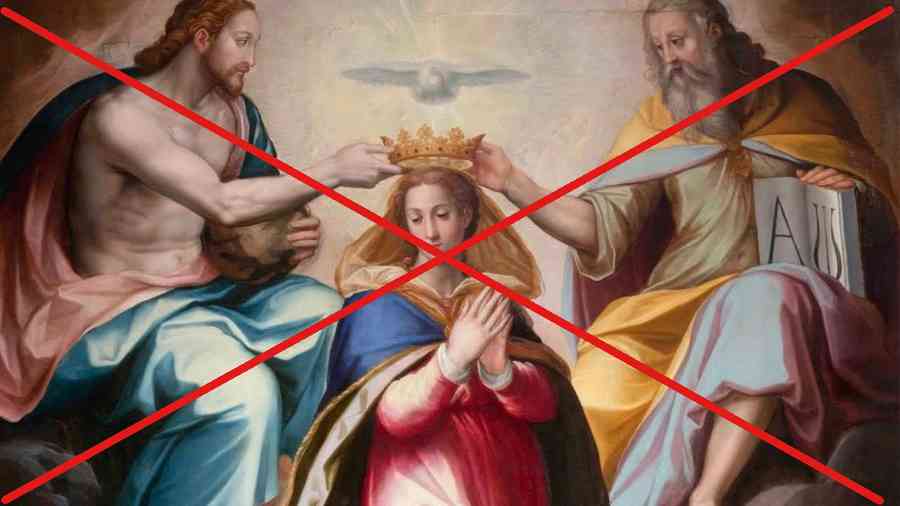
Instead of the religion of Christ, this is the characteristic of the religion of Rome. In almost all the devotional books of the Roman Catholic Church, the mother of God is crowned, sceptered, and enthroned as the Queen of Heaven. “I can never,” said the Rev. M. Herbert Seymour, in his Evenings with the Romanists, p. 254, “forget the shock I received when I first saw in their churches in Italy, the Virgin Mary crowned as Queen of Heaven, seated on the same throne with Jesus crowned King of Heaven. They were the God-man and God-woman enthroned alike. There was nothing to distinguish the one above the other.”
The origin of this idolatry has its roots in ancient mythology. Astarte of the Assyrians, Ashtoreth of the Sidonians, and Bowaney of the Hindoos, held the place that Mary occupies in the Church of Rome. Greece had Venus, and Rome her Juno. The Diana of the Ephesians was a female, from whose body in every part, there seemed to be issuing all the various animals of creation symbolizing the conception and creation of all things. The Egyptians on the one hand and the Etruscans on the other had their Isis, the same symbol, a female divinity whom they regarded as “the mother of the gods.” Jeremiah describes the Jews who had rebelled against God as making cakes to “the Queen of Heaven” (Jer. 7:18; 44:17), the title given to Juno in the Scandinavian theology. Rome has adopted this element of heathenism, this product of the carnal heart. In all its essential elements the Roman Etruscan, the Roman Church, the Pagan Rome, and the Papal Rome are in accord—Romanists are idolators.
Continued in Chapter VII. Mariolatry Encourages Sinners.