Rome’s Vietnam War? How Australia Was Conned
ROME’S VIETNAM WAR?
How Australia Was Conned
by Patrick O’Neill
Introduction
Australia’s involvement in the Vietnam War is normally explained in the familiar vocabulary of the Cold War: communist expansion in Asia, the defence of South Vietnam, ANZUS, SEATO, concern over Indonesia, the security of Southeast Asia, and the desire of successive Australian governments to demonstrate the reliability of the American alliance.
There is considerable truth in that explanation. However, it is not the whole story. The conventional account tends to treat Australia’s commitment as the product principally of governments, diplomats, defence establishments and strategic calculations. Much less attention is given to the political, religious and social networks operating alongside the formal machinery of government: networks that had been constructed over decades, possessed their own publications and organisations, trained political activists, influenced labour organisations, mobilised voters and maintained relationships across national boundaries.
The argument is that, from the 1930s through the Cold War, an extensive Roman Catholic anticommunist political milieu developed internationally, involving clergy, lay organisations, political activists, labour organisers, journalists, intellectuals, military figures and political leaders. In the United States this milieu intersected with foreign-policy and intelligence circles. In Australia, B. A. Santamaria, the so-called Catholic Social Studies Movement, the National Civic Council, the Democratic Labor Party and associated organisations created an unusually disciplined anti-communist parapolitical infrastructure.
The historical question is whether the political environment that produced Australia’s intervention was shaped by a transnational network in which Roman Catholic anticommunism, American foreign policy, intelligence activity, military strategy and Australian political mobilisation overlapped.
The evidence makes that question impossible to dismiss.
1. The Religious Dimension of Vietnam
Avro Manhattan’s Vietnam: Why Did We Go? argued that American intervention in Vietnam could not be understood simply as a secular Cold War operation. Manhattan placed particular emphasis upon the religious and political importance of Roman Catholic networks in the rise of Ngo Dinh Diem. Although Manhattan was a polemical writer, and his claims must therefore be tested against independent evidence : When that test is applied, the foundations of his argument survive remarkably well. The most important evidence comes from an unexpected source: the United States intelligence establishment itself.
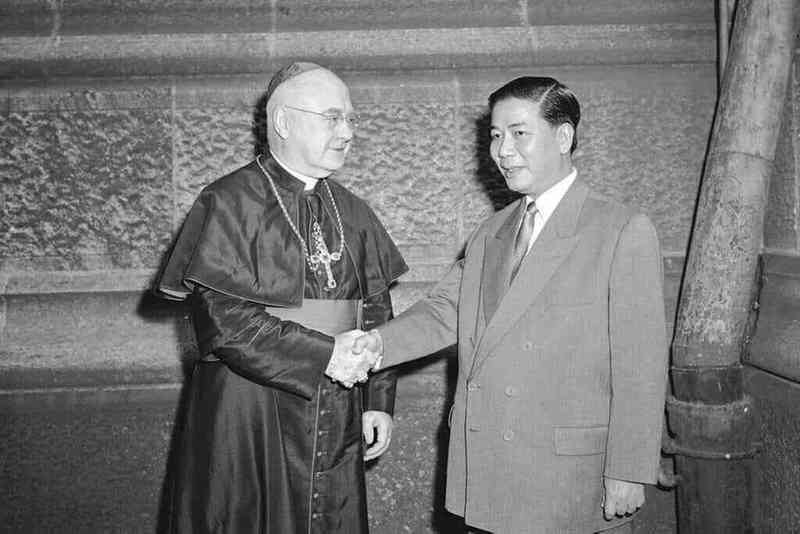
The CIA’s historical study CIA and the House of Ngo: Covert Action in South Vietnam, 1954–63 records that Diem’s religion helped win the favour of prominent American figures including Francis Cardinal Spellman, Senator Mike Mansfield and Senator John F. Kennedy. It further records that Diem’s residence in the United States provided him with a platform for vigorous lobbying and helped make him an early candidate when Washington began looking for an indigenous leader for Vietnam.
The significance is obvious. Diem was not merely an abstract strategic asset selected by Washington because of an impersonal geopolitical calculation. His religious identity, political connections and American contacts were part of the process by which he acquired influential patrons.
This does not establish the entire thesis by itself. It does, however, establish the importance of the religious and personal networks that the conventional account tends to push into the background.
2. The Roman Catholic Anti-Communist Infrastructure
The international Roman Catholic world possessed something that secular political organisations often lacked: a pre-existing transnational institutional infrastructure.
Schools, universities, missions, publishing houses, religious orders, labour organisations, lay movements, social organisations and political associations created channels through which ideas and personnel could move across national boundaries.
The Jesuits, the so-called Society of Jesus, were particularly significant in this respect.
Peter McDonough’s Men Astutely Trained, an academic history, examines Jesuit engagement with American political and social life through subjects including social principles and political tactics, labour schools, social order and social reform, political change, corporatism, journalism and internationalism.
3. Cardinal Spellman: Church Power and American Politics
Francis Cardinal Spellman occupies an important place in this story. Spellman was not simply a religious figure concerned with ecclesiastical affairs. He was an internationally connected political actor whose influence extended into American foreign policy and anti-communist politics.
A CIA-held 1984 Associated Press review of John Cooney’s The American Pope described Spellman as a powerful political figure and referred to his relationships with the FBI and CIA. The FBI’s archival holdings concerning Spellman likewise demonstrate the extent to which American authorities monitored his political activity and his position on Vietnam. The significance of Spellman becomes even clearer when the Guatemala and Vietnam stories are placed beside one another.
In Vietnam, Spellman was an important supporter of Diem. In Guatemala, a former CIA officer later described how Spellman’s ecclesiastical influence was incorporated into an American psychological-warfare operation. These are not isolated facts; they form a pattern.
4. E. Howard Hunt and the Intelligence Value of Clergy
The Guatemala operation provides one of the most revealing pieces of evidence in this study. E. Howard Hunt was a CIA officer who participated in Operation PBSUCCESS, the 1954 covert operation against the government of Jacobo Árbenz.
In his later interview concerning the operation, Hunt described the importance of priests because they could communicate with populations far beyond the major urban centres. He described the use of ecclesiastical channels in psychological warfare and discussed his contact with Cardinal Spellman in New York.
This is important because it is not a modern commentator theorising about what intelligence agencies might have done. It is testimony from a man who was actually involved in covert operations. Hunt described the value of the Roman clergy precisely in terms of communications, access and influence: priests possessed channels into communities that an intelligence officer could not easily penetrate.
The Guatemala documentation independently confirms the wider psychological-warfare programme and the exploitation of organised Roman Catholic social and Church of Rome structures.
The implication is substantial. The Church of Rome’s institutional reach could function as a political and communications infrastructure of considerable value to an intelligence organisation, in this case the CIA.
Hunt went further in his assessment of Jesuit capabilities, famously describing the Jesuits as “the greatest intelligence service in the world”. That statement is historically important. A former CIA officer who had worked inside covert operations was explicitly drawing attention to the intelligence capabilities he associated with Jesuit organisation. That deserves considerably more attention than it has generally received.
5. Guatemala: A Demonstrated CIA–Roman Church Intersection
Guatemala is therefore not merely an interesting parallel. It is a documented case of interaction between American intelligence, Roman Catholic ecclesiastical influence and psychological warfare.
The CIA’s historical documentation describes the psychological-war component of PBSUCCESS and the exploitation of political, media, radio and other organised channels.
Hunt’s own account describes the approach to Spellman and the subsequent involvement of the Guatemalan clergy.
The resulting chain is remarkably clear:
CIA operation → Cardinal Spellman → Guatemalan ecclesiastical hierarchy → clergy → population-level communication.
Whatever larger conclusions one draws from it, this is not speculation. It demonstrates that the political and communications reach of Roman Catholic institutions could be incorporated into American covert operations.
Once that fact is established, the question of Roman Catholic intelligence capability can no longer reasonably be dismissed as fantasy or “conspiracy theory”.
6. From Washington to Australia
The same period witnessed the construction of a formidable anti-communist political infrastructure in Australia. Its central figure was B. A. Santamaria.
Santamaria’s importance is not a matter of retrospective conspiracy literature. The Australian Dictionary of Biography describes his development from [Roman] “Catholic Action” organiser into the strategist and ideologue of the Movement, his role in anti-communist trade-union organisation, the training of cadres, the creation of front organisations and his relationships with Roman Church figures, politicians and business leaders.
The Movement was deliberately organised with secrecy in mind. By the 1940s it was using disciplined political organisation and parish networks to contest communist influence in Australian unions. The Roman bishops authorised and funded the Movement in 1945, and Santamaria subsequently reorganised it as the National Civic Council after the Vatican ordered the Movement to cease functioning publicly as a Church of Rome-affiliated political organisation in 1957.
That history is crucial. The eventual NCC was formally a lay organisation, but its origins were deeply embedded in the Roman Catholic political and ecclesiastical world. And Santamaria himself was explicit about his political ambitions.
7. Santamaria’s Own Words
On 11 December 1952, Santamaria wrote to Archbishop Daniel Mannix outlining the political possibilities that had emerged from the Movement’s work in the labour movement. He wrote that the Social Studies Movement should, within five or six years, be able to “completely transform the leadership of the Labor Movement” and introduce large numbers of people into Federal and State politics capable of implementing a “Christian” social programme.
This is a remarkably revealing document. The Movement was not simply attempting to prevent communists from winning union positions: It was consciously developing a political strategy capable of moving from the unions into parliamentary politics.
Santamaria recognised that union delegates moved into Labor Party conferences, executive positions and parliamentary careers. Political influence gained through industrial organisation could therefore become political influence at the governmental level.
8. The Movement, the NCC and the DLP
The historical record of the Movement’s development is complex, and it is important not to reduce Santamaria to the caricature of an omnipotent “mastermind”.
The Movement developed disciplined cadres, industrial groups, publications and political networks. It operated within a broader anti-communist environment involving Roman Catholic bishops, lay activists, trade unionists, business interests and political figures.
After the 1955–57 Labor split, the Democratic Labor Party emerged as the principal parliamentary expression of the anti-communist breakaway. The NCC remained outside formal party structures, but continued to exercise political influence. The Australian Dictionary of Biography records that Santamaria remained the Movement’s strategist and ideologue, monitored international communist developments, acted as an intermediary with Roman Church figures and selected politicians and business leaders, and later continued to operate through the NCC.
The NCC’s existence therefore matters not because it secretly controlled Australia : It matters because Australia already possessed an organised, disciplined anti-communist political romanist constituency before the escalation of the Vietnam War. That Roman-Church-state constituency did not have to invent its political machinery in 1965: It was already embedded in the Australian religo-political malaise.
9. Vietnam Enters the Australian Political Battlefield
In 1991, Val Noone published “Melbourne Catholics and the 1965 Increase in Australian Military Intervention in Vietnam” in the Journal of Religious History. The article runs to 26 pages and directly examines the relationship between Melbourne Roman Catholics and the increase in Australian military intervention in 1965.
This is significant because it establishes that the religious dimension of the Australian Vietnam decision is not an invention of the present essay: It has already been the subject of specialised historical scholarship.
The question therefore deserves to be asked directly:
What did Australia’s organised anti-communist Roman Catholic political milieu do when Vietnam became the central Cold War issue of the 1960s?
The answer is revealing. The Romanist network already possessed newspapers, speakers, political organisations, university contacts, labour connections, anti-communist campaigners and an established ideological framework in which communism was interpreted as an existential threat to “Christendom” [what Martin Luther referred to as Popedom]. The Vietnam War fitted naturally into that worldview, as a 20th century Crusade.
10. The Australian Defence and Intelligence Connection
The Roman Catholic political network also intersected with the military world. Frank Mount’s Wrestling with Asia provides important participant testimony concerning the Pacific Institute and its attempt to develop an international anti-communist network in Southeast Asia.
Mount’s account should be read critically, particularly where he assigns large historical importance to his own organisation; but as participant testimony it is highly significant.
Ted Serong provides another important connection. Serong became one of Australia’s leading counter-insurgency specialists and developed close relationships with American military and intelligence personnel. His papers held by the Australian War Memorial provide documentary evidence concerning his work in South Vietnam, counter-insurgency training and his relationships with American counterparts.
This places the Australian story in a much wider environment. Mobilised political romanism, Roman Catholic anti-communism, military counter-insurgency theory and American [CIA] intelligence activity were not operating in completely separate compartments: They intersected.
11. The Diem Model
The significance of Ngo Dinh Diem now becomes clearer. Diem represented a model of political romanism in the guise anti-communist nationalism that could appeal simultaneously to:
- • “American” strategic planners;
• Roman Catholic political networks;
• Jesuit educated anti-communist intellectuals;
• Agenda driven military strategists;
• political romanist activists concerned with the containment of communism in Asia.
The CIA’s own historical study confirms that Diem’s Roman Catholic identity helped him secure the support of Spellman, Kennedy and Mansfield and that his American residence gave him an important lobbying platform. The Vatican religious and strategic dimensions therefore intersected in a single political figure. That is precisely the intersection which a purely secular account tends to obscure.
12. The Australian Political Environment
As previously noted, by the time Australia increased its military intervention in Vietnam, the country already possessed an organised and deeply embedded Roman Catholic anti-communist political infrastructure. Santamaria’s Movement had operated for decades. The NCC had inherited its organisational machinery. The DLP had parliamentary representation. Roman anticommunist publications had an established readership. The universities contained organised “anti-communist” activists. Trade unions had already been fought over through the Movement’s industrial campaigns. And a generation of Papal Dominion inspired political activists had been trained to interpret international affairs through the lens of paranoia about communist expansionism and the defence of “Christian” civilisation.
One does not need to invent a secret command structure to recognise the political significance of that environment.A political movement does not need to control a government in order to influence the assumptions within which government policy is debated. That is how political influence ordinarily works.
13. What the Conventional Account Leaves Out
The conventional explanation of Australian intervention remains important. Menzies’ government genuinely believed that communist expansion posed a strategic danger. Indonesia, Malaysia, the United States alliance, ANZUS, and SEATO all mattered. Australian defence planners had genuine strategic concerns. None of this disappears.
But neither does the religious and political infrastructure described above disappear simply because strategic considerations were real. The two histories can exist simultaneously. Indeed, the more pertinent question is how they interacted.
A strategic threat does not automatically produce a particular political response. Political organisations interpret threats, and they identify enemies. They define moral obligations, mobilise supporters, and provide language through which governments can justify policy. They also create political constituencies willing to defend those policies.
That is precisely what the anti-communist movement in Australia had spent decades learning to do.
14. The Question of Jesuit Intelligence
The Jesuit question deserves particular attention because it has too often been reduced to caricature. There are two equally unsatisfactory extremes. One is to assert that the Jesuits literally control every political calamity a nation faces, and the other is to pretend that this Society of Loyola ‘s international organisation, previous political machinations, agenda driven educational institutions, communications networks and strategic relationships with governments are historically irrelevant. For example, it is no coincidence that Georgetown University is situated in Washington DC.
Neither position is adequate. The evidence establishes something much more interesting.
Jesuit organisation had extensive international reach.
Jesuits operated educational and social institutions across national boundaries.
Jesuit writers and organisations developed agenda driven approaches to social and political questions.
Roman Catholic clergy possessed communications channels reaching communities inaccessible to conventional intelligence officers.
And a former CIA operative, E. Howard Hunt, explicitly identified the Jesuits with exceptional intelligence capabilities.
The appropriate historical question is therefore not whether there was a second CIA headquartered in Rome.
It is:
How did existing Roman Catholic organisational capabilities and aspirations interact with the intelligence, political and strategic structures of the Cold War?
The Guatemala evidence demonstrates that such interaction occurred. The remaining question is how far that pattern extended. That is a legitimate historical research question, not an absurdity.
15. Rome, Political Organisation and the Art of Influence
The deeper significance of the evidence lies in the distinction between formal command and organised influence. A political network does not need to issue written orders to every participant. Influence can operate through:
- • recruitment;
• education;
• ideological formation;
• patronage;
• personal relationships;
• publications;
• social organisations;
• political pressure;
• electoral mobilisation;
• access to influential figures;
• intelligence relationships;
• and the creation of a common understanding of political reality.
The history of Santamaria’s Movement demonstrates the effectiveness of precisely such methods. His 1952 letter demonstrates the intention to move from industrial organisation into political influence. The later history of the NCC demonstrates the continuation of that organisational strategy in a formally lay structure. The international evidence demonstrates that similar Roman Catholic networks existed elsewhere. The intelligence record demonstrates that American agencies recognised the “usefulness” of Roman Catholic ecclesiastical channels.
The pieces fit together.
16. “Conspiracy” Is Not an Adequate Answer
The word “conspiracy” has frequently been used to end discussion rather than begin it; however, the historical method is simpler:
Identify the organisations.
Identify the people.
Identify the meetings.
Identify the correspondence.
Identify the funding.
Identify the institutional relationships.
Identify the intelligence contacts.
Identify the political campaigns.
Identify the publications.
Then establish what those people and organisations actually did.
The existence of secrecy is not evidence that everything concealed is true; although secrecy is also not evidence that nothing happened. The Movement itself was deliberately secretive, and intelligence organisations by definition operate secretly.
Political and ecclesiastical networks frequently operate through personal relationships rather than formal organisational charts. Consequently, demanding a single piece of paper bearing a complete organisational diagram is an unreasonable standard for investigating a network whose very effectiveness depended upon relationships, discretion and compartmentalisation.
17. The Evidence Is Cumulative
No single document carries the entire argument. The argument emerges from accumulation.
We have:
Diem’s Roman Catholic identity helping secure influential American patrons.
Spellman’s political influence in American anti-communism.
Spellman’s involvement in the Guatemalan episode described by Hunt.
CIA use of ecclesiastical communications in psychological warfare.
Hunt’s testimony regarding the operational value of priests.
Hunt’s extraordinary assessment of Jesuit intelligence capabilities.
Jesuit organisational and political activity documented by academic historians.
Santamaria’s deliberate construction of a Roman Catholic based anti-communist political organisation.
Santamaria’s own statement of his intention to transform Labor leadership.
The Movement’s links with Roman bishops, labour organisations, politicians and business interests.
The creation and political activity of the NCC and DLP.
Noone’s specific historical examination of Melbourne Roman Catholics and the 1965 increase in Australian intervention in Vietnam.
Mount’s testimony concerning the Pacific Institute and Southeast Asian anti-communism.
Serong’s documented position within Australian counter-insurgency and American strategic networks.
Taken individually, each piece tells only part of the story. Taken together, they demand that the Roman Catholic religious and political dimension of Vietnam be taken seriously.
18. The Confessional Protestant Perspective
From a confessional Reformed Bible Protestant perspective, the historical question acquires another dimension.
Before recent times, much of the Reformed Protestant tradition has historically regarded the claims and political influence of the Church of Rome with particular seriousness. Within a Historicist reading of Christian history, the Roman ecclesiastical system is not regarded merely as another denomination competing for theological influence, but as a historically powerful institution whose religious and political dimensions have repeatedly intersected: the Papal Dominion. That theological conclusion should not be confused with the documentary evidence. The documentary evidence stands on its own.
The theological interpretation provides a framework through which the longer historical pattern can be understood. For the purposes of this essay, the relevant point is therefore not that every Roman Catholic institution or individual must be treated as part of one continuous conspiracy.
The point is that religion and political power have repeatedly interacted in the history of Rome, and that the Vietnam era provides another important case in which Vatican-linked ecclesiastical networks, “anti-communist” politics, intelligence activity and international strategy intersected.
19. How Australia Was Conned
The word “conned” is deliberately provocative. The deception lies in the simplification of the narrative for public consumption. Australians were presented with a strategic and moral proposition:
Communism was advancing.
South Vietnam had to be defended.
Australia had to stand with the United States.
The security of Southeast Asia depended upon resistance.
Therefore Australia had to fight.
Those propositions were presented as though they emerged naturally from strategic necessity. But political propositions do not emerge from nowhere; they are developed, communicated, repeated, organised and defended by people and institutions. For decades before Australia’s major escalation in Vietnam, an organised “anti-communist” political infrastructure had been developing within Australian sosociety.pts intellectual roots reached into the Church of Rome. Its organisations reached into the labour movement. Its political influence reached into Parliament. Its publications reached into public debate. Its activists entered universities. Its international connections reached into Southeast Asia. Its strategic world intersected with “American” anti-communism, and some of its personnel operated in the same broad counterinsurgency environment in which American intelligence and military organisations were active.
The question is therefore not whether Australia possessed strategic reasons for intervention:
It is who helped define those reasons, who interpreted them for the Australian public, who mobilised political support for them, and what larger international networks were already in place when the decision was made.
That is where the conventional story becomes inadequate.
Conclusion
Australia’s Vietnam commitment cannot responsibly be reduced to a single cause : The Cold War was real, Communist expansion was real, Indonesia’s confrontation with Malaysia was real, American pressure and alliance politics were real, and Australian strategic anxieties were real. However, the political environment in which those realities were interpreted was not neutral.
For decades, an organised Roman Catholic anti-communist movement had been constructing political influence in Australia. Internationally, Roman Catholic organisations possessed extensive social and communications networks. In the United States, those networks intersected with anti-communist political and intelligence structures.
In Guatemala, the CIA demonstrably made use of ecclesiastical channels in psychological warfare, and E. Howard Hunt personally described the operational importance of priests and his dealings with Cardinal Spellman.
In Vietnam, the CIA’s own history records the importance of Diem’s Roman Catholic identity and his relationships with Spellman and other influential Americans.
In Australia, Santamaria’s Movement developed an ideologically Roman Catholic anticommunist political machine, later reorganised as the NCC, while the DLP provided a parliamentary expression of the anti-communist break. Santamaria’s own correspondence reveals that the Movement’s ambitions extended beyond industrial politics into the transformation of Labor leadership and the implantation of a “Christian social programme” within Federal and State politics.
By 1965, therefore, Australia did not confront Vietnam from a political vacuum. It confronted Vietnam through a political culture that had been shaped by political romanism for decades.
A network of institutions, people, ideas, loyalties and relationships whose influence crossed the boundaries between Roman Catholicism, politics, intelligence and strategy.
That network deserves to be placed back into the history of Australia’s Vietnam War.
The conventional explanation tells us why Australian governments said they went to Vietnam. The evidence assembled here asks a deeper question:
Who helped construct the political world in which those reasons became compelling — and whose international interests were advanced when Australia accepted them?
That question remains open to further documentary investigation; but after the evidence considered here, it can no longer reasonably be dismissed.
SELECTED BIBLIOGRAPHY AND SOURCE TRAIL
Primary and Declassified Sources
1. Ahern, Thomas L., Jr. CIA and the House of Ngo: Covert Action in South Vietnam, 1954–63. CIA Center for the Study of Intelligence, 2000. Declassified. Especially pp. 9– 15.
2. Central Intelligence Agency. CIA and the House of Ngo: Covert Action in South Vietnam, 1954–63. CIA Reading Room, document C01268718. CIA historical study: CIA and the House of Ngo
3. Federal Bureau of Investigation. Cardinal Francis Spellman Files, FBI Vault, Parts 1– 5.
4. Hunt, E. Howard. Undercover: Memoirs of an American Secret Agent. Berkeley Publishing, 1974.
5. Hunt, E. Howard. Interview concerning Operation PBSUCCESS and Guatemala, A Coup Made in America, Turning Points of History, 1998. See also the National Security Archive interview material.
6. National Archives of Australia. Cabinet and defence records relating to Vietnam and National Service, including A1209 and A1838 series.
7. Australian War Memorial. Ted Serong Papers, PR91/096.
8. National Library of Australia. B. A. Santamaria Papers, MS 13492. Particularly the correspondence with Archbishop Daniel Mannix, including the letter of 11 December 1952.
Roman Catholic and Jesuit Political Organisation
9. McDonough, Peter. Men Astutely Trained: A History of the Jesuits in the American Century. Free Press, 1994.
10. Cooney, John. The American Pope: The Life and Times of Francis Cardinal Spellman. Times Books, 1984.
11. Alvarez, David J. Spies in the Vatican: American Espionage and Catholic Papal Diplomacy, 1939–1945. University Press of Kansas, 2002.
12. Graziano, Michael. Errand into the Wilderness of Mirrors: Religion and the History of the CIA. University of Chicago Press, 2021.
13. Cooke, Ronald. Mystery Confusion: A Study Embracing the United States, El Salvador, and the European Economic Community, Showing How Differently the Roman Catholic System Works to Try to Produce a Jesuit Vaticanomy. 1999.
14. Manhattan, Avro. Vietnam: Why Did We Go? The Religious Beginnings of an Unholy War. Chick Publications edition, 1984. Used as the principal early formulation of the religious thesis examined and tested by this essay.
Vietnam
15. Jacobs, Seth. America’s Miracle Man in Vietnam: Ngo Dinh Diem, Religion, Race, and U.S. Intervention in Southeast Asia. Duke University Press, 2004.
16. Chapman, Jessica M. Cauldron of Resistance: Ngo Dinh Diem, the United States, and 1950s Southern Vietnam. Cornell University Press, 2013.
17. Edwards, Peter. A Nation at War: Australian Politics, Society and Diplomacy During the Vietnam War 1965–1975. Allen & Unwin, 1997.
18. Karnow, Stanley. Vietnam: A History. Viking, 1983.
19. Logevall, Fredrik. Choosing War: The Lost Chance for Peace and the Escalation of War in Vietnam. University of California Press, 1999.
Australia
20. Duncan, Bruce. Crusade or Conspiracy? Catholics and the Anti-Communist Struggle in Australia. University of New South Wales Press, 2001. 21. Henderson, Gerard. Santamaria: A Most Unusual Man. Miegunyah Press, 2015.
22. Murray, Robert. “Santamaria, Bartholomew Augustine (Bob) (1915–1998).” Australian Dictionary of Biography, National Centre of Biography, Australian National University.
23. Mount, Frank. Wrestling with Asia: A Memoir. 2012.
24. Noone, Val. “Melbourne Catholics and the 1965 Increase in Australian Military Intervention in Vietnam.” Journal of Religious History, vol. 16, no. 4, 1991, pp. 456–481.
25. Santamaria, B. A. A Most Unusual Man and Collected Letters, together with the Santamaria Papers, National Library of Australia.
Download this article Rome’s Vietnam War in PDF format.
Related posts:

Vatican Control through Civil Law
Modern Jesuitism. The Order In The Papal States.—Internal Squabbles.
Papal Theonomy and America Today - Realism or Surrealism

The Mask of the New World Order, The Jesuits!
The Suppressed Truth about the Assassination of Abraham Lincoln Chapter 7 Assembling the C...
Views of the Russian Invasion of Ukraine by a Christian Missionary Who Lived in Ukraine

Do Catholics Possess Life Eternal?

The British Monarchy In Peril