
The Pornocracy of the Papacy – By Ronald Cooke
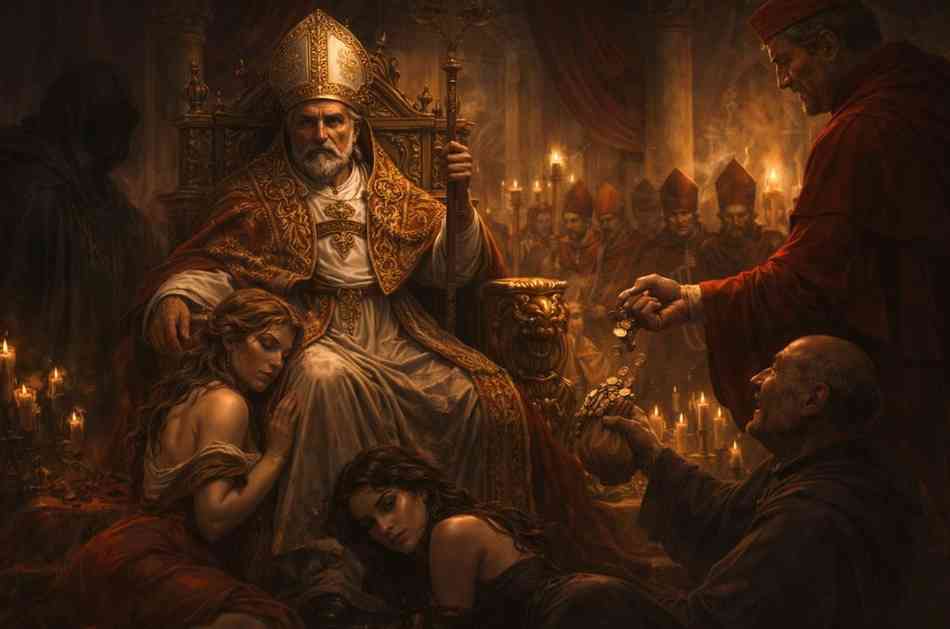
THE PORNOCRACY OF THE PAPACY
(AD 850-1200)
A PROTESTANT VIEW OF CHURCH HISTORY
Ronald Cooke
pornocracy
noun
- A government by prostitutes, or a government dominated by them.
- The period in the papacy known as The Rule of the Harlots, being about 30 or 60 years starting in 904 A.D.
(Definitions from Wiktionary.)
THE PAPAL DOMINION IS NOT CHRISTIANITY
Tract Four
A series of Tracts presenting a Protestant view of Church history, tracing the roots of the true Church from New Testament times right up to the present day. Showing how the apostasy developed in the Papal Dominion, and then looking at what has happened in the last two hundred years WITHIN evangelicalism in North America. Men who still claim to be Protestant Evangelicals now want to combine with the Papal Dominion to form the ecumenical—read Catholic—church, with the pope of Rome as the Universal Primate of this religious conglomerate. We will see, as history unfolds, that in the last two hundred years non-Catholics have sought to assist, and many are still working to assist in what Edward Elliott regarded as the theological suicide of Protestantism, in his battle with the Tractarians in England, in the latter half of the nineteenth century.
MethodEvangel Press Rector,AR
INTRODUCTION
As the Papacy grew, it sought more and more power, not just in the church but also in the state. As it became more embroiled in matters of the State and Empire, it was affected by the evils and wickedness of the State and Empire. This entanglement with State and Empire led the church into the Dark Ages.
Latourette wonders about the “Christianity” of these times. He writes about pursuing his rapid way through his condensed account of the conversion of Europe, and says that the question inevitably has again and again risen up to perplex him, as to “what extent, if at all, did these converts understand the gospel, and really commit themselves to it and know its power?”
He asks the question: was it true, as someone was later to put it, THAT EUROPE WAS INOCULATED WITH A MILD FORM OF CHRISTIANITY IN SUCH A FASHION THAT IT WAS IMMUNE TO THE REAL THING? We would say that many were inoculated with a mild form of religion that kept them from true Christianity.
The Papal Dominion has for centuries inoculated all those who follow its traditions and customs, and who follow the false teachings of an unscriptural priesthood and hierarchy, to real biblical Christianity. Even Latourette could see what millions of evangelicals and modern Reformed leaders cannot see in North America today: that the Papal Dominion is NOT Christianity, but a clever imitation of the real thing.
He does remark at the beginning of his chapter on the Pornocracy of the Papacy (which he euphemistically describes as the setting of the Great Recession) that one of the most palpable facts of history is that Christianity was seriously affected by the fatal sickness of the Roman Empire. The use of the word “fatal” by Latourette is surely significant, for the papal involvement with the Roman Empire proved to be its death sentence; ecclesiastically, theologically, and spiritually.
While Latourette writes about the inoculation by the Papal Dominion to real Christianity, he nevertheless seems to be impressed with the hierarchical structure and organization of the Papal Dominion, and of the popes of Rome. He is not alone; for other church historians are impressed with the same thing. Perhaps this is why the God of Heaven brought down the “great organization of the papacy” in the following centuries.
While the Celtic Church was evangelizing Europe, the Papal Dominion was seeking more and more political power and acquiring more and more places, lands, and wealth. When the Celtic Church sank down into idleness and stagnation; the Papal Dominion sank down into the Pornocracy from which it never recovered. It would later gain almost universal dictatorship after the Pornocracy, but this ecclesiastical dictatorship was not the Christian Church; it was the Papal Dominion at the height of its ANTI-Christian power and tyranny.
Ronald Cooke
4927 E.Lee Hwy.
Max Meadows,VA 24360
March 8,2015
THE DEVELOPMENT OF PAPAL POWER BEFORE THE PORNOCRACY
If the church had remained a scattered group of individual assemblies following the dictates of Scripture, it would never have fallen into such an evil as the Pornocracy, nor would it ever have grown into such an engine of horror and terror persecuting all Dissenters from it. Yet almost all the historians I read, with the exception of the old Protestant ones, refer to this evil, dictatorial, hierarchical, ecclesiastical, persecuting monstrosity as the Christian Church.
We saw in the early days of the church that churches did not submit to Roman authority. There were various synods and councils held in the first four centuries of the church, and these were not convolved by the authority of the Bishop of Rome. In fact, they were usually convened by Imperial decree, not by the leader of the church in Rome.
At none of these meetings did the bishop of Rome, or his legates, preside, nor was there any appeal to the bishop of Rome concerning controversial issues about dogma or authority. The first indication of conceding anything to the Bishop of Rome came at the Council of Sardica (AD 343). This issue involved the case of a bishop who was sentenced for some crime. The judges in that case were to apply to the bishop of Rome for a final decision in such a case. It was not a general concession to the authority of the Roman Bishop, but merely making him the court of final appeal in such a special criminal case.
Innocent I (402-417) endeavored to put more weight upon the decision at Sardica, claiming that the Bishop of Rome had the right to decide ALL the important ecclesiastical questions, demonstrating that even the early popes were looking for ways to increase their power over the whole Church.
The next bishop of Rome, Zosimus (AD 417-418), tried to claim that the “fathers” had conferred upon the Roman See the right to be the last court of appeal, and the decisive one in all controversies. This claim would continue to be made by later popes.
The first pope of Rome, in the sense in which the word “pope” is used today, was Leo I (440-461). He had a very dictatorial mindset and thought of the papacy as an ecclesiastical monarchy, with the Bishop of Rome as king. In fact, he thought of himself as the Vicar of Christ, and even, “God upon earth.” He sought by fair means and foul to transform the “church” into a Church-State ruling in both ecclesiastical and temporal affairs.
Leo is considered “the great” by Roman Catholic writers. He certainly sought to be great by extending the power of the papacy, but he was not successful. He faced considerable opposition within the “church” of that time. The greatest opposition came from the Bishop of Constantinople. He refused point blank to regard Leo as Bishop over the whole church. And to this day (2015), the Patriarch of the Eastern Church does not recognize the pope of Rome as head over all the national churches—Greek, Bulgar, Romanian, Russian, Armenian, Serbian, Hungarian, etc.—that make up present-day Eastern Orthodoxy.
The whole Eastern church resisted all his efforts to gain control over them. Not long after the death of Leo I, Felix II (483-492) tried to excommunicate the patriarch of Constantinople, which resulted in a schism in the Church. The Eastern Church separated completely from the Roman, and the schism lasted thirty years. This proved that the power which Leo had tried to claim was still far from being achieved. Historical facts such as these prove that at this early period of church history the germs for a papal dictatorship existed, but had very little real foundation in the affairs of the times. For centuries, emperors, councils, armed mobs, and murderers appointed popes and deposed popes. The popes claimed exorbitant powers, but it would be centuries before they achieved anything close to their claims.
Gregory I (5690-604) was the next powerful pope after Leo I. However, strangely enough, he protested against the adoption, by the patriarch of Constantinople, of the title “UNIVERSAL BISHOP.” He referred to such a claim as the claim of “the forerunner of Antichrist.” He believed he was the “servant of servants,” and anyone claiming to be the universal bishop over the whole church was someone who was antichristian and preparing the way for Antichrist. Yet, it would not be long until the popes of Rome were claiming to be not only universal bishop, but the ruler of the world. In fact, Leo I had already proclaimed he was God on earth!
McClintock and Strong note that, “Gregory was the first (churchman) who “discovered” Purgatory, and it was by means of apparitions and visions which he relates in his dialogues that he first discovered it; so that the Church of Rome is probably indebted to some old man or old woman for one of the most lucrative articles of her whole creed.”
Gregory tried hard to extend the authority of Rome over Europe. Newman says that, “He sent missionaries to Britain and Germany, where a free evangelical form of Christianity had long existed (through the efforts of the Celtic church) with a view to SUBJUGATING these Christians to the Roman See.” (emphasis added)
REFERENCES
1. McClintock and Strong, op. Cit., Vol. Ill, p. 999.
2. Ibid., p. 1000.
3. Newman, op. Cit., p. 406.
THE BLATANT AND BLASPHEMOUS PRETENSIONS OF THE PAPAL DOMINION
Prior to the Pornocracy
The rise to power of the Bishop of Rome was based on several facts, not least of these was the fact that Rome had for so long been the imperial city of the world. This great metropolis had held sway for centuries before the church was planted in Rome. The very power and authority of this city lent, to the church in the city, an air of authority, especially after the time of Constantine the Great. Cardinal Manning, that great ultramontane Romanist, shows how the Roman Catholic Church grew in power and extent in the fifth, sixth, and seventh centuries.
Manning wrote that, “the abandonment of Rome (by the Byzantine emperors) was the liberation of the Roman Pontiffs.” Historically, Protestants have agreed with such an assessment, but have pointed out that the Roman Pontiffs then were working to become the new CAESARS. Manning proceeds to note that, “The Pontiffs found themselves alone, the SOLE fountains of order, peace, law, and safety… No sovereign has ever reigned in Rome since.”
He was writing before 1870. After 1870, the pope no longer ruled in Rome. When we come to that era, we will see that the pope then was called by the world, “the prisoner in the Vatican.”
But of course, Manning wrote his work BEFORE 1870, so he blunders on in his praise of the absolute sovereign power of the papacy which it almost did achieve in the Middle Ages. He says, “A power had grown up in Rome, far more imperial over the reason and will of man than the iron despotism of the Roman Empire… This interior and supernatural power of direction and government over the actions and hearts of men flowed from one center, and was embodied in one person, the Bishop of Rome.” (This is why the older Protestant commentators viewed the papacy as the Antichrist.)
As pagan Rome became desolate, Papal Rome assumed the leadership of the whole ancient world. Manning here mentions not only the Church, but the CIVIL power that had also departed, and which the Church then took over. Manning admits that the popes of Rome stepped into the vacuum created by the emperor moving his seat to Constantinople. Papal Rome now tried to assume the role of the Emperor in the state, as well as the role of universal Bishop in the church.
Manning surely knew of the centuries of the Pornocracy of the papacy, when again the city of Rome, and the bishopric of Rome, were once again made desolate BY EMPERORS’ ARMIES, LOCAL MILITIAS, INDIVIDUAL MURDERERS AND ASSASSINS, AND ROAMING BANDS OF GANGSTERS AND RUFFIANS, AND THE WICKED POPES THEMSELVES, who turned the Papacy into a glorified brothel. There was NO order, peace, law, or safety in the city of Rome, only complete mayhem.
It must be noted that as early as AD 494, Gelasius, the bishop of Rome, who styled himself the Vicar of the blessed Peter, wrote in a letter to the emperor, “There are two authorities by which the world is governed—the Pontifical and the Royal, the sacerdotal order being that which has charge of the sacraments of life, and from it must be sought salvation. Hence in Divine things it becomes kings to bow the neck to priests, especially to the head of priests whom Christ’s own voice has set over the universal church.”
Here the foundation for subsequent complete papal supremacy was being laid, even when the Bishop of Rome had no real temporal power or authority.
Cunningham stated that the whole history of the rise and progress of the papal supremacy from its earliest dawnings unto its full establishment is certainly by far, “THE MOST EXTRAORDINARY INSTANCE OF SUCCESSFUL IMPOSTURE AND INIQUITY THE WORLD HAS SO FAR WITNESSED.”
Adding, that it was an object prosecuted for a “succession of ages with unwearied zeal, no scruples of conscience, no regard for truth or veracity, no respect for the laws of God or man were ever allowed to stand in the way of extending this usurped dominion over the church.”
He concluded this section of his theology by noting that every incident was most carefully improved for the promoting of papal supremacy, when, “one examines the claims with care and attention, one will see the utter baselessness of the ground on which the Papal supremacy rests, and the way in which this power has been secured and exercised, and the fact that it is full of dead men’s bones and all uncleanness…”
Manning was one of the main promoters of papal infallibility at Vatican Council I. He had lived to see the papacy reduced drastically in power from what it once was. Consequently, he worked hard, and surreptitiously, to make papal infallibility a recognized DOGMA of Romanism. We will look at this issue in a subsequent Tract.
REFERENCES
1. Guinness, H. Grattan, Light for the Last Days, Marshall, Morgan, & Scott, London, England, Reprint, p. 76.
2. Ibid., p. 78.
3. Loc. Cit.
4. McClintock and Strong, op. Cit., Vol. Ill, p. 765.
5. Cunningham, W., Historical Theology, Banner of Truth Trust, Edinburgh, Scotland, Reprint, 1994, p. 222.
6. Loc. Cit.
7. Loc. Cit.
THE PAPAL RELIGIOUS SYSTEM SINKING INTO SPIRITUAL DARKNESS BEFORE THE TIME OF THE PORNOCRACY
As the Papal Dominion lied, cheated, and forged its way across the pages of church history, and across the continent of Europe in the first millennium, it sought for greater and greater temporal power, at the same time as it fell further and further into complete spiritual darkness. The apostle Peter, in speaking of what false teachers in the church produced, said, “These are wells without water, clouds that are carried with a tempest, to whom the mist of darkness is reserved forever” (II Peter 2:17).
It is difficult to comprehend the spiritual darkness that was now descending upon the Papal Dominion at this time. According to one writer, “The eighth century was the most ignorant, the darkest, the most barbarous, that France had ever seen.”
Farrar notes that, “The Papal system had established a secure despotism over the minds of men. The source of all Christian truth was supposed to be furnished by Scripture and tradition; and the Church—by which was mainly meant the Pope—was held to be the infallible interpreter of both.”
As we shall see, many popes at this time were ignorant, ungodly men at best; and murderous and adulterous brutes at worst. The Bible was an unknown book to them. Baronius, the Roman Catholic writer, confessed that in the “church of the tenth century, there was no pilot to guide the helm, no captain to command the crew, at the moment of its greatest need.” Baronius here wrote euphemistically about what he calls “the church.” Yet, even he has to admit that the popes of that time were incapable of guiding even the Papal Dominion. Surely the wicked religious system which he calls the church lacked the real marks of Christ’s EKKLESIA. The Papal Dominion, at this time in history, was sinking to a lower level of wickedness than the paganism which surrounded it. So wicked indeed, that it has ever since been called, by both Roman Catholic and Protestant historians, THE PORNOCRACY OF THE PAPACY.
This period of gross wickedness stretched from the ninth century to the twelfth century. In these years the men who occupied the Papal Chair sank to depths of iniquity that far outstripped ordinary sinners. In this period, the final lights that still glimmered here and there in Europe, in what is still called “the Christian Church” by almost all church historians, were being put out by the Papal Dominion, and a gross darkness took their place. True theology, based upon biblical exegesis, was unknown in the papal chair and in the “church.” Superstitions and heathen customs, and pagan beliefs flourished in the Papacy. A mountain of forgeries, and claims built upon them, eclipsed the Scriptures in the false religious system that Rome had now become. The general public wallowed in biblical ignorance, and the clergy were just as ignorant. Indeed, it has been remarked that more freedom of thought existed in the eighth and ninth centuries than existed in the twelfth. Certainly, there was more gospel light, for men like Claudius of Turin, Gottschalk of Hautvillers, and Ratramnus of Corbie lived before the time of the Pornocracy of the Papacy. These men sought to teach the Bible amid the gathering spiritual darkness of Europe.
The older Protestant writers looked upon this era as the beginning of the manifestation of the Antichrist in the Papal Dominion. They saw the beginning of the rise of Mystery Babylon the Great within the context of Roman Catholicism, and this view, or something akin to it, was held by all Protestants up until the rise of the Tractarian Movement in the nineteenth century. Then evangelical Protestantism was blindsided by the aggressive Tractarian Movement in English Anglicanism. After that time, the euthanizing of evangelical Protestantism began, and is continuing in twenty-first-century America, even as we write. For anywhere that anyone writes upon the identity of Antichrist today, the Roman Catholic positions are set forth: Preterism and Futurism. One or the other of these two Jesuit views is now followed by almost all evangelical Protestants in North America today. These views have produced all the concessions that are now being made by evangelical Protestants to the claims of the Papal Dominion, and are paving the way for ultimate union with it.
REFERENCES
1. Farrar, op. Cit., p. 247.
2. Ibid., p. 246.
3. Stanley, Arthur, P., History of the Eastern Church, NY, NY, 1873, p. 69.
THE LAST LIGHTS GO OUT IN EUROPE AND THE PAPAL DOMINION DESCENDS INTO THE BLACKNESS AND COMPLETE DARKNESS OF THE PORNOCRACY
“From Martin II (882) to Christopher (903), never was the papacy more degraded than from 880-1000… Europe lapsed into a state of almost complete anarchy… The papacy lost almost all its power and prestige and came to be a bone of contention among rival factions. Pope Formosus (891-898)… was probably poisoned.
He was succeeded (after fifteen days during which Boniface VI began and ended his reign) by his mortal enemy Stephen VI, who had his body exhumed, tried, condemned, deposed, cut to pieces, and thrown in the Tiber. In about a year Stephen was imprisoned and strangled. Stephen’s successor, Marinus, reigned four months, and his successor three weeks… Leo V (903), having reigned two months, was murdered by his chaplain, who succeeded him. The murderer was murdered and succeeded by Sergius Ill, after eight months of pontifical glory… With Sergius was inaugurated what is known in history as the PORNOCRACY.”
—Albert H. Newman, Baptist Church historian. (Emphasis his)
“It is an unpleasant task for the historian to expose these shocking corruptions; but it is necessary for the understanding of the Reformation (under Hildebrand) that followed. The truth must be told, with its wholesome lessons of humiliation and encouragement. No system of doctrine or government can save the church from decline and decay. Human nature is capable of satanic wickedness. Anti-Christ steals into the very temple of God, and often wears priestly robes.”
—Philip Schaff, ecumenical church historian.
“Pope Stephen had his arch rival brought before him, after having his kneecaps broken so that he could not walk, his eyes carved out so that he could not see, then soundly whipped. Within a year, Pope Stephen will have used Duke Desiderius to get Christophorus and Gratiosus imprisoned, first their eyes put out, then their lives ended. He will then turn on Desiderius and by December will encompass his ruin and death.”
—Malachi Martin, modern Roman Catholic scholar and writer.
Although I majored in history at Asbury University, and took several courses in church history at Trinity College, Talbot Seminary, and Graduate school, I never heard of the Pornocracy of the Papacy. Now this could be from the fact that in history courses a limited amount of material can only be covered.
In any church history course the professor can only cover a limited amount of material. Depending upon the historical era chosen, he may deal with the reformation period. Or he may cover the first four centuries. In such cases the era of the Pornocracy would not be covered. Or the historian writing on the subject may not call it the Pornocracy of the Papacy. One writer I read later referred to this era as the times of confusion. Anyway, I never remember any professor I sat under discussing “the Pornocracy of the Papacy.” I know that I only became aware of it through reading the Roman Catholic writer, Malachi Martin. He described this era of church history in his book, The Decline and Fall of the Roman Church. Some historians start the Pornocracy with Pope Sergius Ill; Martin seems to start it earlier. He describes the ghastly episode connected to Pope Formosus I in starting his comments about the Pornocracy.
FORMOSUS I (AD 891-896)
Formosus reigned for five years and his pontificate was a troubled one. But it is what happened to him after his death that sounds almost incredible, even allowing for the times in which he lived. He, apparently, was one of the “warrior” popes who occupied the Papal Chair during the time of the Pornocracy. He tried to take the city of Spoleto by force at the head of an army, but died on the way. Some say he died of a stroke; others believed he was poisoned. He was buried in AD 896 in the city of Rome.
Malachi Martin, after his Introduction, divides his book into four main sections: the third section is called RIPENESS AND DECAY. It is divided into nine chapters, with the first few chapters dealing with the Pornocracy of the Papacy, with titles like: The Nymph who made Popes; The Mark of Cain; Lord of the World; and the Popes in Babylon. He describes Marozia—his Nymph—in greater detail than any Protestant writer I have read.
“Marozia’s career had begun when she was six years old. The big-eye opener for her had been in March 897. Agiltruda, the queen mother of Spoleto, took her by the hand to the Lateran Palace. They stood outside in the bright sunshine with a crowd of Romans. Inside, the reigning pope, Stephen VI (nicknamed “the Trembler” by his contemporaries because of his nervous disease), surrounded by his cardinals and bishops, conducted a trial. Agiltruda, a Lombard, with her luxuriant blond hair, blue eyes, impressive stature, and imperious voice, wanted everyone, including Marozia, to witness the degradation of her most foul enemy, a dead pope, a Corsican, Formosus by name. Pope Formosus had deprived Agiltruda’s son of his due honor by crowning instead a hated German, Arnulf, as Holy Roman Emperor in February of 896.
Agiltruda had led an army, seized Rome, and installed herself in Hadrian’s Mausoleum. But Emperor Arnulf had sent her packing home to Spoleto, breathing vengeance and hate. Pope Formosus had then set out at the head of his own army to capture Agiltruda’s beloved Spoleto. But he died of a stroke (or perhaps Agiltruda’s poison) on April 4, 896, and was buried in Rome as befitted a pope. The next pope, Boniface VI, was put on the throne by armed Roman citizens. Within fifteen days Agiltruda made sure Boniface was stone dead (after all, before becoming pope, he had been twice defrocked for unseemly behavior). She then put her own creature on throne as Pope Stephen VII. Everyone, including Agiltruda, knew that Stephen was insane and subject to violent paroxysms of black rage. He was therefore perfect for Agiltruda’s scheme.
The venom and malice of that scheme were monumental.Formosus had been dead and buried for over eleven months. On Agiltruda’s suggestion, Pope Stephen had the rotten corpse dug up and brought to the Lateran Palace, clothed in pontifical vestments, placed sitting on a papal throne, and then tried for capital crimes by Stephen and his cardinals and bishops. This was the famous Corpse Synod. Pope Stephen himself and a papal accuser cross-questioned the rotting corpse (a trembling eighteen- year-old deacon stood beside the corpse and answered for the voiceless Formosus). At the crucial confession, Cardinals Sergius, Benedict, Paschalis, Leo, John, and the others rushed on the corpse, ripped the pontifical vestments from it, tore off the first three fingers of the right hand (Formosus, like every pope, gave the papal blessing with those three fingers), and then dragged the corpse from the hall. Marozia was there as the cardinals and clergy dragged the corpse out of the palace and along the streets. The shouts of the crowd, the smell of putrefying flesh, the stones and the mud she and the others threw at the corpse did not let up at all. And then there was the dull splash as they threw the remains of Formosus into the river Tiber.”
This may be regarded as the start of the Pornocracy of the Papacy.
The sad truth is that this period known as the Pornocracy only deals with about three centuries. When, in fact, the entire history of the papacy has been one long Pornocracy, with only a few years here and there where some form of decency was present in the Papal Chair. Gross moral failures comprise only one aspect of evil. False teachings, practices, and ceremonies comprise a never-ending catalog of evil which never ceased in harming eternally all those deceived by such a false religious system.
In Marozia’s early years, the conditions in Rome were in the power of rich families like hers. Agiltruda was old and her days were numbered. Yet she did not leave the scene quietly by any means. She, with her army, seized the city of Rome again in AD 897. She put Pope Romanus on the throne, after Pope Stephen VII was first imprisoned, and then strangled. Then she did away with Pope Romanus after a few months and installed Pope Theodore II. This pope turned against Agiltruda, which was a fatal mistake on his part, so he only lasted for twenty days in the Papal Chair.
Marozia had learned valuable lessons from Agiltruda, and her family took over the reins of Rome as the House of Theophylact. When Pope Sergius III was put in the Papal Chair, Theophylact and his wife Theodora ruled Rome. They had two daughters, Marozia and Theodora. Martin states that, “Theodora was now powerful enough to become pope-maker. She put the mild and priestly Benedict IV on the throne, but he lived only three years and two months, dying in the summer of 903. Theodora’s next two popes were tragic: Leo V was pope only for July of 903, and then was imprisoned by Cardinal Christopher, who took his place. Then Christopher was imprisoned by Cardinal Sergius, who assassinated both Leo and Christopher in prison, together with all the other cardinals who opposed him. He had his enemies at the papal court strangled and himself declared Pope Sergius III. In engineering all this, Theophylact and Theodora had one aim: their daughter Marozia should be empress-queen of all the Romans.”
Latourette referred to the time of the Pornocracy of the Papacy as the Recession, and Schaff calls it the Degradation of the Papacy. Earle Cairns, who gave a series of lectures on church history when I was at Talbot Seminary, in his book, Christianity Through the Centuries, does not even mention ANYTHING AT ALL about this period except to sing the praises of the Papal Dominion. He starts out his chapter, covering that era, by stating that, “Although the Western Church was under the shadow of Otto’s Holy Roman Empire during the later part of the period between 800 and 1054, it EXPERIENCED AN INNER REVIVAL that gave it the strength to cope with imperial interference.”
A greater misrepresentation of what occurred during these centuries would indeed be difficult to find. For even Roman Catholic writers like Malachi Martin saw no such thing as an INNER REVIVAL during these particular centuries. He saw INNER DECAY in several chapters of his book. Not only that, but Philip Schaff also, while calling the period the Degradation of the Papacy, admits that others have called it “the Papal Pornocracy or Heterocracy.” He says that, “The tenth century is the darkest of the dark ages, a century of ignorance and superstition, anarchy, and crimes in church and state… The demoralization began in the state, reached the church, and culminated in the papacy.”
After admitting this, Schaff shows his ambivalence once again when he writes about the Providence of God, in the midst of the Degradation of the Papacy, saving it “for better times.” He claimed that the papacy, “Became the prey of avarice, violence, and intrigue, a veritable synagogue of Satan. It was dragged through the quagmire of the darkest crimes, and would have perished in utter disgrace had not Providence saved it for better times. Pope followed pope in rapid succession, and most of them ended their career in deposition, prison, and murder.”
This same writer then, not long after, plunges into his description of what he calls the Second Degradation of the Papacy. Obviously, the better times had not come. Roman Catholic writers go even further than Schaff, for Baronius not only sees better times providentially secured, he believed that the Pornocracy of the Papacy PROVES the DIVINE ORIGIN OF IT! Even at that, he saw no INNER REVIVAL at that time, but admitted the decay and the apostasy, but uses that very time of decay and apostasy as PROOF of the Divine Origin of the papacy. Arguing that, since the papacy fell into such degradation for such a time, and then RE-EMERGED again from it, that this shows the divine origin of it. He admits clearly the decay and apostasy, and lack of virtue in the Papacy, writing that, “For nearly 150 years, about fifty pontiffs, from John VIII until Leo IX, were found gravely wanting in sharing the virtuous nature of their ancestors, themselves Apostles of apostasy rather than Apostles of the Apostolic Succession.”
Contrary to Cairns, Dr. James L. Meagher, the Roman Catholic author of The Protestant Churches, which is a blistering attack upon ALL Protestant Churches, says plainly about this era of church history, “Church and State were then united, and Kings and civil rulers claimed the right of proposing candidates for vacant parishes and bishops’ thrones against the continued protests of the Popes. There was then a sad mixture of religion and politics and civil governments often enslaved the Church. Rulers appointed their bastard sons, friends and relatives to Church offices. Often with little religion and less morality, they neglected their work, and generations grew up without religious instruction. Sometimes priests and bishops were civil rulers and magistrates, and paid more attention to politics than to religion. After the XIII century the religious orders multiplied and became very wealthy. Whole families, stricken with the “Black Death” before they died out left their properties to the orders. Attracted by riches and easy lives, lazy worthless men became monks who did not follow the wise rules of their holy founders, and many abuses abounded. As they entered the religious life to save their own souls, they cared nothing for the people and lived on the revenues of their estates.”
This Roman Catholic writer did not see an INNER REVIVAL; he saw what almost every historian saw: a time of little religion and less morality, more attention to politics than to religion, bastard sons, friends and relatives appointed to Church offices, and many abuses abounding.
Even Schaff cannot avoid describing the utter wickedness of the men who claimed to be the successors of the Apostle Peter and the Vicars of Christ. These men, for a period of three hundred years demonstrated to all the world just how wicked religious men can be, while at the same time making such outrageous claims. One would think that the so-called educated and enlightened men of today could see through such claims, but it is quite obvious that over one billion cannot accomplish such a simple act. Nor can men, who are supposed to be evangelical and Reformed in their thinking, even do it. Truly the blindness and the unbelief that Paul writes about is still evident today, with regard to “His Holiness the Pope.”
Schaff wrote that, “Three bold and energetic women of the highest rank and lowest character, Theodora the elder, and her two daughters, Marozia and Theodora, filled the chair of St. Peter with their paramours and bastards… They turned the church of St. Peter into a den of robbers, and the residence of his successors into a harem.”
The Elder Theodora called herself Senatrix. She was the mistress of Adalbert of Tuscany, who died in AD 926. Then she became the mistress of Pope John X. (Yet the Roman Catholic writer, Eugenius Vulgarius, addressed her as that “virtuous and venerable matron.”) By one of the men that she consorted with, her daughter Marozia was born. She turned out to be the worst instigator of them all.
These women were strong minded and inveterate schemers, yet very ignorant. The daughters of the elder Theodora could neither read nor write, and signed their name with an X. With such women controlling the papal chair for so long, it is no wonder that for centuries it was believed that Pope John VIII was actually a woman.
While Schaff speaks of the evils of such women and their intrigues to turn the papacy into a den of robbers, he STILL manages to refer to St. Peter and his church? These papal monsters had nothing whatsoever to do with the church of Peter, and Peter has no connection whatsoever to the harem that these men presided over for centuries.
Mosheim wrote that between Pope Leo IV, who died in AD 855, and Benedict III, a woman concealed her sex and assumed the name of John. She has also been called Papess Joanna. The reign of a woman pope was not questioned for five centuries. According to some historians Papess Joanna was “elevated to the papal dignity as pope John VIII.” As late as the fifteenth century, the bust of Papess Joanna was placed beside the busts of other popes at Sienna, and nobody bothered to question this, or took any offence from it, at that time. Tradition has it that she was stoned to death by the people. During the Pornocracy of the Papacy many popes were strangled, poisoned, smothered, or murdered by the sword. So there were several ways to remove Popes during this era, and even long after this time. And if Papess Joanna was indeed stoned to death, it is further proof of her tenure on the papal Chair.
Whatever modern evangelicals like Dr. Earle Cairns may think, the older Reformed writers, and even the older Evangelical writers did not see either an INNER REVIVAL in the Western Empire; nor did they view the Papacy and the Papal Dominion as the Christian Church or Christianity. They all believed that the whole Papal System now reeked of Antichrist and Antichristianity. No doubt about it, multiplied millions of Evangelicals and Reformed, Baptists, Presbyterians, Methodists, Brethren, and Independents now NO LONGER TAKE THIS POSITION, but church history shows that the Dissenters before the Reformation, all the main Protestant Reformers, most of the Puritans and Puritan Separatists, and the Protestant denominations that followed them for centuries, all believed that the marks of Antichrist were being manifested in what is called the Pornocracy of the Papacy. The Dissenters of church history did NOT see the Papacy being SAVED by Providence for better times; nor did they see the Pornocracy as a proof of the Divine Origin of the papacy; nor did they see an INNER REVIVAL of the “church” at this time: they, ALL WITHOUT EXCEPTION, saw it as the Divine Proof that the Papal Dominion was Antichrist and Antichristianity. They believed that no dynasty of men, in the history of the world, has lasted so long; has been so evil; and yet AT THE SAME TIME, claimed to be the Vicar of Christ and Head of the Christian
21 Church on earth! They saw in the Papal Dominion, the Beast that WAS, and is NOT, and YET IS.
Earle E. Cairns was Chairman of the Department of History and Political Science at Wheaton College. His work on church history has been reprinted and revised, and had gone through no less than seventeen printings between 1954 and 1974, which is the date of the copy that I am using. No wonder evangelical education has become more and more Romanized, when Christian colleges, universities, and theological seminaries follow such teachings.
REFERENCES
1. Martin, Malachi, The Decline and Fall of the Roman Church, G. P. Putnam’s, NY, NY, 1983, pp. 119-120.
2. Ibid., p. 123.
3. Cairns, Earle E., Christianity Through the Centuries, Zondervan, Grand Rapids, MI, 1974, p.215.
4. Schaff, Philip, op. Cit., Vol. IV, p. 280.
5. Ibid., p. 283.
6. Turretin, Francis, Seventh Disputation, Protestant Reformed Publications, Forestville, CA, 1990, Reprint, p. 90.
7. Meagher, J. L., The Protestant Churches, Christian Press, NY, NY, 1914, p. 16.
8. Schaff, op. Cit., p. 284.
POPE SERGIUS III AND THE PORNOCRACY
Some historians believe that Pope Sergius III started off the Pornocracy of the papacy when he came with a group of Tuscan soldiers and deposed Pope Christopher, who had just deposed Leo V, and took possession of the papal chair, and according to Schaff, “soiled it with every vice.” After the short reign of two other popes (the short reign usually means murder, either from strangulation or poisoning), John X came to power. He was basically an Army general, and he led his army into battle as a “warrior pope,” and as the Vicar of Christ. He then was embroiled in a fierce contest for more power with Marozia and her husband, the Marquis Alberic I. Marozia was not about to surrender any of the power that she had gained. She instigated the seizure of the Castle of St. Angelo, had Pope John X cast into prison and smothered to death. She then had three of her choices become popes from AD 928 to AD 936.
Leo VI, Stephen VII, and John XI, who was her own bastard son, all were put into the Papal Chair through the power and intrigues of Marozia. In all these schemes, of course, enemies were made, and evil men and women were plotting to avenge what they believed were actions taken against them and their allies. Remember, this plotting, murdering, fighting, poisoning, and smothering were all connected to the Papal Chair; the supposedly HIGHEST place of honor and leadership in “Christendom,” occupied by those who were called the Vicar of Christ Himself. Only those completely spiritually blind could ever even imagine that such monsters were the personal representatives of Christ on earth.
Marozia’s husband, Alberic I, was murdered around AD 926. Marozia then married Guido, Margrave of Tuscany. He died shortly after? She then married King Hugo of Italy in AD 932. She had grandiose plans of becoming the Empress of the world. However, her own son Alberic II rebelled against her and drove Hugo out of Rome and put his mother into prison. Malachi Martin wrote that Otto III, the Emperor, came to see Marozia in prison.
According to Martin, he had only one reason for doing so, “To lay eyes on the woman who was the mother of a pope, whom she had conceived by another pope, and who was the aunt of a third pope, the grandmother of a fourth pope, and with the help of her own mother, creator of nine popes in eight years, of whom two had been strangled, one suffocated with a cushion (Pope John X) and four deposed and disposed of in circumstances that have never come to light.”
Martin goes into quite a bit of detail to cover the last days of Marozia. We will merely give the substance of what he wrote, “Marozia had been locked up for fifty-four years. She was to be allowed to confess her sins before being smothered in her cell. She is the pope’s prisoner. Gregory is not willing to do any more for her save allowing her to receive the last rites. The night after Otto’s visit, she is in her cell, in filthy rags with her face turned toward the wall. The bishop who is to give her the last rites is there in her cell, and another visitor is coming to her cell: the visitor called DEATH! “FOR THE WELL-BEING OF HOLY MOTHER CHURCH AND THE PEACE OF THE ROMAN PEOPLE.” So they decide. The sins of Pope John X\l are read to Marozia, for she had put the monster on the Papal Chair. The bishop finishes his reading quickly and gives Marozia absolution. Then he and Emperor Otto III go out into the courtyard. Later two men, cowled like monks, will enter the prison. One will carry the telltale red-velvet cushion. There is almost total silence as they come for her, except for the slight click of the key in the lock and the creak of the door. And it will all be over in a very short time. The cushion is firmly held over her nose and mouth until she stops breathing.”
This is the substance of what Malachi Martin wrote, and he closed off that chapter in his work with these words, “High up in his palace, Pope Gregory doubtless consoles himself with the thought that now the young German emperor will be a new Charlemagne for the church and will protect him, Peter’s successor. But Gregory will be poisoned two years from now, at the age of twenty-six. Otto himself will be dead in six years’ time, before he is twenty-two. And the leadership of the truth will pass into the hands of other popes who will continue on in the persuasion that the salvation of Jesus must be protected by warriors’ spears and cozened in wealth and magnificence.”
Pope John XII followed his predecessor to the papal chair in AD 955 and ruled in absolute wickedness for 8 years. Alberic died in AD 954, and his son Octavian, who was also the grandson of Marozia, was elected pope when he was 18 years old. He took the papal name as John XII. Schaff describes him in this way, “John XII disgraced the tiara for eight years (955-963). He was one of the most immoral and wicked popes ranking with Benedict IX, John XXXIII, and Alexander VI. He was charged by a Roman Synod, no one contradicting, with almost every crime of which depraved human nature is capable, and DEPOSED as a monster of iniquity. Among the charges of the Synod against him were that he appeared constantly armed with sword, lance, helmet, and breastplate, that he neglected matins and vespers, that he never signed himself with the sign of the cross, that he was fond of hunting, that he made a boy of ten years a bishop, and ordained a bishop or deacon ina stable, that he mutilated a priest, that he had set houses on fire, like Nero, that he committed homicide and adultery, had violated virgins and widows high and low, lived with his father’s mistress, converted the pontifical palace into a brothel, drank to the health of the devil, and invoked at the gambling table the help of Jupiter and Venus and other heathen demons! The Emperor Otho would not believe these enormities until they were proven, but the bishops replied that they were matters of public notoriety requiring no proof… He was later killed in an act of adultery by the enraged husband of his paramour.”
This may seem like a truly horrendous catalog of crime and wickedness, but Malachi Martin, the modern Roman Catholic writer, adds even more than the Protestant writer. He says that after being deposed by this synod and expelled from Rome and the Papal Chair, that he returned to Rome, “Evicted Pope Leo VIII, cut off the nose and tongue and two fingers of the Cardinal Deacon, flayed the skin off Bishop Otger, cut off the hands of Notary Azzo, and beheaded sixty three of Rome’s clergy and nobility.”
Schaff, with his usual ambivalence, still wanted to write about the REFORM of the papacy. “The reform of the papacy was merely temporary. It was followed by a second period of disgrace, which lasted till the middle of the eleventh century, but was interrupted by a few respectable popes and signs of a coming Reformation.”
And Schaff was not talking about the Protestant Reformation, he was speaking of what historians call the reform of the church under Hildebrand. Even at that he speaks only of a COMING reformation, for he begins on the next few pages to write about what he calls the SECOND DEGRADATION of the papacy. Before he gets that far, he desires to excuse the evils of the FIRST degradation and to continue to write about Reformation in the Papal Chair.
“No church or sect in Christendom ever sank so low as the Latin church in the tenth century. The papacy, like the old Roman god Janus, has two faces, one Christian, one antichristian, one friendly and benevolent, one fiendish and malignant. In this period, it shows almost exclusively the antichristian face. It is an unpleasant task for the historian to expose these shocking corruptions; but it is necessary for the understanding of the reformation that followed.”
The Christian Church is not a fiction like the two-faced Roman god Janus; it does not have two faces. The evil organization that has two faces is the Papal Dominion. Magnificent buildings have nothing to do with Christianity. The impressive ceremonies of a friendly and benevolent church are not Christianity. The Papal Dominion, even when it shows a so- called friendly face is not Christianity. Great crimes are malignant and fiendish; false doctrines and practices may be friendly and demonic. Neither harshness nor friendliness make the Papal Dominion Christian.
A Mr. Cecil, writing in the midst of The Tractarian Controversy, said that the Papal Dominion was the Devil’s masterpiece. Dr. John Robbins enlarges on that thought and completely shatters this description of Schaff:
“How many faces has the Roman Church? Look at her in this country, then look at her in Ireland. Look at her in England, Spain, Italy, and Latin America; you will find it very difficult to believe it is the same institution. She is able to change her color and her appearance and her form. She is, I say, all things to all men every where; she is everything; she is a whore.
The apostle has told us that it is one of the characteristics of the Devil himself that he can transform himself into an angel of light. So can this Church. There is no limit, there is no end to the various “guises” in which she can appear. Here in this country, she appears as highly intellectual and encourages her people to read the approved version of the Bible; in other countries she prohibits their doing so and is not only not intellectual but deliberately encourages superstition. Here she seems to be tolerant, ready to listen and to argue and to concede and to be friendly; in other countries she is utterly intolerant, vicious, and vile in her persecuting zeal, but still the same body, the same institution, the same people. This is surely the Devil’s masterpiece.”
Schaff and other church historians may call her the two-faced Christian Church, but she is the Devil’s masterpiece, not Christ’s Church. Millions are lost in this religious labyrinth, and evangelical Christians used to seek to minister the gospel to those lost souls; now they merely concede the theological field to the Papal Dominion and call all the evils and heresies that this Dominion practices: Christianity, even as most church historians also do.
REFERENCES
1. Martin, M., op. Cit., p. 119.
2. Ibid., pp. 120-127.
3. Ibid., p. 127.
4. Schaff, op. Cit., p. 287.
5. Martin, op. Cit., p. 106.
6. Schaff, op. Cit., p. 293.
7. Ibid., pp. 280-281.
8. Robbins, John, Against the World, 1978-1988, Trinity Foundation, Unicoi, TN, 1996, p. 176.
THE SECOND PORNOCRACY OF THE PAPACY (AD 973-AD 1200)
Malachi Martin recounts the evils of the second half of the Pornocracy. He did not divide it into two separate periods. He continues his account of the Pornocracy by stating that the events that the Greek travelers saw in Rome at this time, “nourished their contempt for all papal claims.” Adding, “They saw Pope Sylvester II murdered on May 17, 1003. Pope John XVII, who succeeded him, died of poisoning seven months later. Again, in 1009, Gregory of the Crescenti family was made pope by force of his family’s arms.”
Martin also gives a glimpse into the total immorality in which the Roman clergy were immersed at this juncture of history, “We still have documents of Byzantine ambassadors reporting on the four questions ritually put to every priest about to be consecrated as a bishop of the Roman Church: “Have you sodomized a boy? Have you fornicated with a nun? Have you committed adultery? Have you sodomized any four legged animal?” These questions accurately reflected the standard required of would-be bishops. St. Peter Damian wrote a famous book, the LIBER GOMORRHIANUS (Book of Gomorrah), graphically describing the venality, lechery, bestiality and homicidal fecklessness of his fellow Roman clerics.”
Here we see the sin of pedophilia is not something new in the Roman Catholic clergy. It has been there for centuries. Hidden in the United States, Canada, Ireland, and Germany, until the News Media finally became aware of it and showed the depth and extent of it in modern times; not just in the Dark Ages.
This was a dangerous time to be a pope, for intrigues and plots abounded, with popes being poisoned and strangled, or simply deposed by force of arms. If one takes the position of Schaff then he deals with what he calls the “second” degradation of the papacy. This second Pornocracy started after the death of the Emperor Otto and continued during the reign of his son Otto Il, and extended into the second millennium of church history.
The city of Rome at this time was filled with crime and immorality. The papal chair was looked upon as a prize to be won, and wealth to be gained, by wicked leaders who cared nothing for any religion, much less Christianity. Fighting took place all the time between the warring factions. Each sought to gain the upper hand and to gain the Papal Chair.
At the start of what some historians call the Second Period of the Pornocracy, the Roman “nobility,” under the leadership of Crescentius, the son of Pope John X and Theodora, gained the victory over the party loyal to the Emperor. Rome at this time was divided between the Imperialists, those who supported the Emperor; and the anti-Imperialists, those who supported the “nobility” in the city of Rome.
Crescentius led a rebellion against the pope who had been elected by the power of the Emperor, Pope Benedict VI, and he was murdered AD 974. Crescentius then, with his cabal, elected a new pope, Boniface VII, who, among those who care about the papal registry, is considered an antipope. Such was the state of riot, robbery, and murder in Rome at this time: this pope had to flee for his life to Constantinople.
After a few years in exile, he was able to get enough support in Rome to return. The first thing he did was have the pope, who had been installed by the power of the Emperor, murdered. This was Pope John XVI, who reigned until his murder in AD 985. Boniface VII did not last long. According to Schaff, he, “Maintained himself on the blood-stained throne by a lavish distribution of stolen money till he died probably by violence.”
He was called the HORRENDUM MONSTRUM—the Horrendous Monster, and a “bloody cruel pontiff” by Gerbert, who later became pope himself, as Sylvester II. During the time the emperor Otto III was still only a youth, the whole of Rome was a city of blood. Those who supported the Emperor battled the more popular Roman Faction, who hated the Imperialists. Alberic headed up the Imperialists, and the younger Crescentius, the grandson of Theodora, headed up the more popular Roman Faction. Bloodshed was a daily occurrence in the streets of Rome at this time. Issuing from their fortified castles, the two parties would fight whenever they met in the streets. They set up their own popes. Each would accuse the pope set up by his enemies as an antipope. Not only were popes killed, but they would be mutilated and paraded through the streets of Rome sometimes before being executed. Because of all the incest at that time among the nobility, the contending parties were all interrelated. The popes and antipopes at this time were all elected and controlled by the contending parties, and many times were in some way related to the contending parties.
Otto III, with his army, came to Rome to try to bring some kind of stability to the city and to the papacy at a time when crime, lust, and murder ruled the streets of Rome and the Papal Chair. The emperor put Bruno, his chaplain, on the papal throne as Gregory V in 996. The newly installed pope then consecrated Otho III as the new Emperor. When Gregory V came into the city of Rome under the protection of the Emperor’s army, he treated Crescentius with leniency, which was a crucial mistake. As soon as the German Army, under Otto III, left the city, Crescentius stirred up a rebellion, expelled the newly crowned pope Gregory V, and put Philagathus in as pope John XVI.
Gregory V, then realizing his mistake, convened a large Synod at Pavia and deposed the new pope in Rome. He also pronounced an anathema against both Crescentius and his pope. The Emperor then returned to Rome with his army, stormed the castle of St. Angelo, where Crescentius was residing, defeated his small band of soldiers, and had him beheaded.
Gregory V, then to show his Christian kindness, had pope John XVI (Philagathus) fearfully mutilated, then paraded through the streets of Rome on a donkey, with his face turned toward the tail, and with a wine-bladder on his head. (Remember, reader, that these popes are still considered the Vicars of Christ—Christ’s sole representative on earth—visible head of the church on earth, called His Holiness, by men like Malachi Martin, one billion Roman Catholics, and millions of non-Catholics in North America today.)
In AD 999, Gregory died a violent death of which there are no other details. Gerbert, the Archbishop of Rheims, became the next pope. He was the first French pope. According to some, “he sold his soul to the Devil for the papal tiara.” He took the Papal Chair as Sylvester II.
Sylvester II, while railing against other popes before he became pope, had grand schemes and grand dreams. He wanted the young emperor, Otto III, to combine all of Europe into one grand dominion; uniting the eastern and western parts of the Empire which had remained divided for so long. He then dreamed of becoming like Constantine the Great, the ruler of this great dominion. He, of course, wanted to rule it all from the Papal Chair. However, Otto Ill died of a fever, if he were not poisoned, in the year 1002.
According to several Italian writers, Otto Ill was poisoned. They say he was poisoned by Stephania, who was his mistress. She pretended to be his loving partner, but was secretly planning all along to avenge her murdered husband, Crescentius.
When pope Sylvester died the year after Otto Ill, it is believed that he also was poisoned. Some writers believe that Stephania, who apparently was his mistress also, administered the fatal dose. She was avenging the mutilation and murder of his papal predecessor, Philagathus—pope John XVI, who had been made pope by her husband, Crescentius.
The following years were marked by confusion and murder. The anti-imperial party regained some of its lost power, and John Crescentius, the son of the beheaded former ruler, took the reins of power in the city of Rome, under the title of Senator Patricus. He made Gregory VI pope, who is considered an antipope. While the Imperial party elected Benedict VIII, who managed to rule for twelve years, which was no small feat considering the times in which he ruled.
The Papal Chair had fallen so low at this time that it became hereditary among the crime- ridden families who were in control of it. Schaff claimed, “With Benedict VIII, the papal dignity became hereditary in the Tusculan family. He had bought it by open bribery. He was followed by his brother John XIX, a layman, who bought it likewise, and passed in one day through all the clerical degrees.”
That is, in one day, he went from priest, to bishop, to archbishop, to Cardinal, and then pope, demonstrating as nothing else will, the fiction of non-biblical hierarchical distinctions.
After his death in AD 1033, his nephew, Theophylact, a boy some say of twelve, and others make him fifteen, or possibly eighteen, took the Papal Chair as Benedict IX (1033-1045). This boy-pope equaled and surpassed even John XII in wickedness of every kind. Schaff describes him and his rule in these words: “He grew worse as he advanced in years. He ruled like a captain of bandits, committed murders and adulteries in open daylight, robbed pilgrims on the graves of the martyrs, and turned Rome into a den of thieves. These crimes went unpunished; for who could judge a pope? And his brother, Gregory, was Patrician of the city. At one time it is reported that he had the crazy notion of marrying his cousin and enthroning a woman in the chair of St. Peter; but the father of the intended bride refused unless he abdicated the papacy. Desiderius, who himself afterwards became pope Victor III, shrinks from describing the detestable life of this Benedict, who, he says, followed in the steps of Simon Magus rather than of Simon Peter, and proceeded in a career of rapine, murder, and every species of felony, until even the people of Rome became weary of his iniquities and expelled him from the city. Sylvester III was elected antipope (1044) but Benedict soon resumed the papacy with all his vices (the same year, 1044). Then sold it for one or two thousand pounds of silver to an arch-presbyter, John Gratian (1045), after he had emptied the treasury of every article of value, and ruling the bargain, he claimed the (papal chair) again, 1047, till he was finally expelled from Rome 1048.”
Before being finally expelled from Rome, Martin states that, “Theophylact (our former Benedict IX) had Clement II poisoned on October 9, 1047, and once more climbed back into the Papal throne as Benedict IX. He lasted exactly eight months and nine days—until the Emperor Henry returned to Rome… Henry put another of his German bishops on the throne, bishop of Brixin, as Pope Damasus Il, on July 17, 1048. But Theophylact’s poison acted again, and Damasus died twenty-three days after his elevation.”
It was during these evil times that those murderous bands of criminals started what are still called by some “the Christian Crusades.” In 1098, the first crusade went forth and they lasted for two centuries. When the early Crusaders relieved Antioch and Jerusalem from the hands of the Muslims, one of the first things the pope did was to replace all Greek churchmen with Latin churchmen. The Greeks retaliated by massacring every Latin they could find within the city limits of Constantinople. Malachi Martin then recounts what the Fourth Crusade in 1204 did.
“The Fourth Crusade was diverted and directed against Constantinople. These Crusaders, each with a red cross of Christ painted over his shoulder armor and on his shield, stormed the city, took it, went through the streets and houses and churches and palaces methodically raping, massacring, robbing, and burning. They installed a famous French Prostitute on the high altar of Hagia Sofia, where she sang ribald songs. In Rome, Pope Innocent Ill crossed himself in pious fear and spoke of God’s vengeance on recalcitrant heretics who refused to obey God’s vicar. One Byzantine historian, Niceta Choniates, wrote: “Even the Saracens (Muslims) are merciful and kind compared to these men who bear the cross of Christ on their shoulders.’
(We will look at the popes and Crusaders in more detail in another Tract.)
Obviously, something had to be done to try to stop the riot and massacres in Rome. It was left to the Emperor to oversee the task of trying to bring some stability to the city of Rome and to the Papal Dominion.
Emperor Henry III, on his way to Rome to be crowned, held a Synod at Sutri, about twenty- five miles from Rome, at which pope Gregory VI presided. Here the claims of the three men who were popes were considered. Benedict IX and Sylvester III were deposed. The first one resigned, and the other one was considered an intruder and dismissed. This left only Gregory VI. He had bought the office, but, believe it or not, he was considered the most legitimate pope of the three? Schaff says, “He acted as pope De Facto, and pronounced himself no pope De JURE.”
This fancy talk merely means that he acted as pope after the fact, but not according to the law. All this mumbo-jumbo was to try to show that the pope was above every human tribunal AND COULD BE JUDGED BY NO HUMAN BEING. “He was used by the synod for deposing his two rivals and then deposing himself. In that way the synod saved the principle that the pope was above every human tribunal and responsible to God alone.”
This fiction, that the pope of Rome could not be judged by any other human being, has nothing to back it up except the claims of former wicked popes. It is a complete pipe dream, and nothing demonstrates it more clearly than the farce that was conducted at this synod.
For all THREE popes, it turns out, were not popes at all. So there was not even a duly elected pope among the three who could even lay claim to such a fictional principle, had it been a true one. Even more to the point, Peter Damiani, who was present at this synod, says that Gregory VI was deposed by the synod. He did NOT depose himself. So it seems there was no pope then to keep the unbroken line of succession back to Peter, as the present pope claims.
The effort that Schaff says was made to save the situation will simply not stand up. It is no use saying that the Third pope in this case was regarded as pope De facto; not pope De Jure. For in plain English this is saying that the pope that was used to depose the other two was only pope after the fact and not according to the law. So he was an illegal pope; he simply did not meet the qualifications under Canon Law to be regarded as a duly elected pope in the unbroken line of succession. So if what Damiani says is true, then the unbroken line of succession was indeed broken; and the claim that the pope cannot be judged by a human tribunal was also repudiated.
To think that these monsters which have been described by both Roman Catholic writers and Protestant writers, as some of the worst men who ever lived, could think for one moment that they could not be judged by any human tribunal because they were responsible to God alone, is surely one of the greatest fictions ever invented by the popes of Rome. These men were not only grossly wicked, but they occupied a position in the Papal Dominion for centuries as Vicars of Christ, according to the papal claims. This is why the Dissenters of the times, and even men in the Papal Dominion, regarded them as antichrists.
Elliott states that Arnulf, the bishop of Orleans, made a BOLD declaration against the papacy and branded the men who were occupying the Papal Chair during the Pornocracy of the papacy as not only ignorant monsters but antichrists. Arnulf said, “Yet how would it fare with us, if it should happen that the man most deficient in all these virtues, one so abject as not to be worthy of the lowest place among the priesthood, should be chosen to fill the highest place of all? What would you say of such a one, when you see him sitting upon the throne glittering in purple and gold? MUST HE NOT BE THE ANTICHRIST, SITTING IN THE TEMPLE OF GOD, AND SHOWING HIMSELF AS GOD?” (emphasis added)
Gerbert of Rheims also “boldly attacked the Roman Antichrists who at that time were seated in the temple of God.” As various historians, both Roman Catholic and Protestant, have pointed out, the term Antichrist began to be used at this time in church history when describing some of the men who sat in the Papal Chair.
There is some doubt here among historians whether Crescentius was the son of Pope John X and the elder Theodora, or the younger Theodora, such was the state of morals among the popes and antipopes.
Hofler asserted that “every princely family in Italy in the tenth century was tainted with incestuous blood, and that it was difficult to distinguish between wives and sisters, mothers and daughters,” and apparently between male and female popes.
Peter Damiani was the Coadjutor of Hildebrand and one of the leading scholars at this time.
REFERENCES
1. Martin, op. Cit., p. 109.
2. Ibid., pp. 108-109.
3. Schaff, op. Cit., Vol. IV, p. 294.
4. Loc. Cit.
5. Loc. Cit.
6. Loc. Cit.
7. Ibid., p. 295.
8. Loc. Cit.
9. Loc. Cit.
10. Loc. Cit.
11. Loc. Cit.
12. Ibid., p. 297.
13. Ibid., p. 298.
14. Martin, op. Cit., p. 133.
15. Ibid., p. 134.
16. Schaff, op. Cit., Vol. IV, p. 301.
17. Loc. Cit.
18. Elliott, Edward, Horae Apocalypticae, Seeleys, London, 1850, Vol. Ill, p. 168.
19. Schaff, op. Cit., p. 780.
Related posts:

Revelation 6:12-17. The Sixth Seal

Paradise or Purgatory?

The Great Red Dragon; Or The Master Key to Popery

The Roman Catholic Agenda Embedded in the Manhattan Declaration
An Overview of the History of the Papacy - By Richard Bennett

Five Things to Watch for in 2024

The Papal System - VII. The Pope Claims to be Lord of Kings and Nations - Part 1
What The Pope Refuses To Believe
