
The Protestantism that Saved Europe – The Story of John Calvin
The Protestantism that Saved Europe.
The Story of John Calvin
PROTESTANT PUBLICATIONS
I can never forget the feelings with which, many years ago, I found myself in the romantic and historic city of Geneva, looking across the blue waters of Lake Leman to the wonderful Alps, culminating in their highest peak, Mount Blanc. A week before I had been in Rome, and had attended public worship under the dome of St. Peter’s, which claims to be the Mother Church of the world. That also had been an experience to remember, although, truth to tell—and it was Easter Sunday—the service itself had been far from impressive; it was the palatial pile, charged with such stupendous claims and such momentous happenings, that had moved the spirit. But now in Geneva was there not something sacramental in the breath of the purer and keener air, and the glimpse of the highest and whitest peak in Europe, something sacramental of Resurrection and Life? I thought so as I followed the Sabbath bell into the graceful nave and aisles of St. Peter’s, Geneva. This, too, is a magnificent Mother Church. The preacher who, attired in the simple ministerial uniform of the Reformed Church, the Geneva gown and bands, ascends the steps of the venerable pulpit that stands against one of the soaring Gothic columns, is in the direct succession of John Calvin, the theological and ecclesiastical master who, from this Cathedral and the adjoining College shaped, as no other man of his age, the religious and political destiny of Europe, making Geneva at once the Athens and the Rome of Reformed Christendom.
LUTHER AND CALVIN
During the recent war the remark was common in certain quarters that the action of Germany in bringing that disaster upon the world was an exposure and a condemnation of Protestantism. Those who passed this judgment showed themselves very partially acquainted with modern history. The Protestantism that has been most in evidence in the construction of the modern world hails not from Germany, but from France. We would yield all honor to Martin Luther, the mighty prophet of reawakened Christendom, but it was not he, but the Frenchman, John Calvin, who proved the great constructive genius of the Reformation movement. In principle, the two Reformers were essentially one, but it fell to Calvin to accomplish in the systematization of the Protestant doctrine and polity what Luther lacked in some measure the opportunity, and in some measure the special ability, to accomplish.
Notably after the Revolt of the Peasants, Luther, man of the people though he was by birth, distrusted the common man, shrank from a truly popular Church government which would have developed the character of the ordinary member and given the Church freedom to utter her voice on national questions, and—to his own regret, for he lived long enough to see some of the evil fruits of it—placed the Church largely under the management of the civil power. Had Germany been true to Luther’s pure Protestant principles, the war would have been impossible, but it was Luther’s mistake in allowing the Kaiser the jus episcopale (episcopal right), as supreme overseer of the Church, that made possible that Protestant Kaiserism, in some respects as deplorable as the Papacy, which had so much to do with the war.
What Calvin accomplished at Geneva as a legislator of Reformed Christendom ranks him with the greatest masterminds of history. The Englishman, John Wycliffe, had struck the vital sparks; the Czech, John Huss, had kindled the glowing coals; the German, Martin Luther, had wielded the flaming torch, and mustered the widespread forces; but to the Frenchman, John Calvin, fell the task of stating with fullest accuracy and depth the convictions of the forces assembled, and organizing them with a thoroughness and consistency which might face without flinching the utmost that even Rome could show.
FIGHTING PROTESTANTS
“The modern world,” declares the English historian John Richard Green, “is rooted in Calvinism.” “To omit Calvinism from the forces of Western evolution is to read history with one eye shut,” says Viscount Morley. “It is not till Calvin,” acknowledges the German Troeltsch, “that we can speak of Christian social reform and social construction, in so far as we mean the conscious united work of Christian society.” “Whatever was the cause,” says Froude, “the Calvinists were the only fighting Protestants. It was they whose faith gave them courage to stand up for the Reformation, and but for them the Reformation would have been crushed.” And Mark Pattison, a distinguished Anglican, testifies to the same effect: “The policy of Calvin was a vigorous effort to supply what the revolutionary movement wanted—a positive education of the individual soul. The power thus generated was too expansive to be confined to Geneva. It went forth into all countries. From every part of Protestant Europe eager hearts flocked thither to make head against the terrible repressive forces brought to bear by Spain, the Inquisition, and the Jesuits. Sparta against Persia was not such odds as Geneva against Spain. Calvinism saved Europe.”
To which general statement we may add the more detailed testimony of Professor Kuyper, Doctor of Divinity, and some time Prime Minister of Holland: “Just ask yourselves what would have become of Europe and America if in the sixteenth century the star of Calvinism had not suddenly risen on the horizon of Western Europe. In that case Spain would have crushed the Netherlands. In England and Scotland the Stuarts would have carried out their fatal plans. In Switzerland the spirit of half-heartedness would have won the day… The whole American continent would have remained subject to Spain… If the power of Spain had not been broken by the heroism of the Calvinistic spirit, the history of the Netherlands, of Europe, and of the world would have been as painfully sad and dark as now, thanks to Calvinism, it is bright and inspiring.”
But we must hasten to look at the life of this Christian lawgiver of imperial mold.
EARLY LIFE
John Calvin was born at Noyon, in Picardy, on the 10th of July, 1509. He was thus eight years old when Luther nailed his theses to the church gate at Wittenberg. The house in which he was born was still to be seen as the Hotel de France, until the recent war wiped it out. His father, Gerard Cauvin, was notary apostolic, procurator-fiscal of the county, clerk of the Church Court, diocesan secretary, and counselor of the clergy and nobility. The future Reformer was thus born into an ecclesiastical and aristocratic atmosphere. He was practically adopted by the Montmor family, one of the first in the country, and educated along with their children.
In 1521, at the age of 12, he received a benefice or bursary from the Cathedral Chapter, and two years later we find him at Paris with the young Montmors in the College de la Marche. From the College de la Marche he passed to the College Montaigne, also in Paris, where he may have sat on the same bench with Ignatius Loyola, destined to become the leader of the Counter-Reformation and the founder of the Society of Jesus. At the age of 18, his father obtained for him another benefice, and in order to draw the stipend he had to submit to the tonsure; but this was the nearest approach he made to the Romish priesthood. About this time, indeed, his father, who would seem to have been a man of independent spirit, quarreled with the bishop, and determined that his son should become a lawyer and not a priest.
PARIS
So the young man went to Orleans to study jurisprudence. At the same time, by studying day and night, he kept up his classical and theological studies, and attained such repute as a scholar that men did not hesitate to declare him the most distinguished student of his day. His preference was for theology, and the death of his father in 1531 left him free to follow his own inclination. In 1532 he abandoned the study of law and returned to Paris. It was in this year that Farel, a disciple of Lefèvre, the Paris professor of whom Beza says that he “chased barbarism from the most famous university of the world, and restored to the University of Paris the true logic of Aristotle and the Mathematics, in place of the sophistry which previously reigned there,”—it was in this year that Farel founded a secret church in Paris.
Hidden communications came afterwards to be formed between the houses of the evangelical community, so that members could go from one to another without being perceived. Under what circumstances Calvin came to identify himself with this community we cannot tell. Calvin was a man of a very different type from Luther. He was reticent about his religious experiences, while the bluff German was always ready to unbosom himself and tell every one about his doubts and fears. In the preface of his wonderful “Commentary on the Psalms,” Calvin withdraws the veil a little, telling us that God drew him to Himself by a “sudden conversion.” At any rate, his actions sufficiently proclaimed the great change: he renounced a brilliant career, gave up his ecclesiastical income, and identified himself, whatever the cost might be, with the small evangelical community of Paris, meeting with them regularly for the study of the Scriptures and for prayer.
This was in 1533, when he was 22 years old. Very soon exciting events took place. A controversy was in progress between the Romish and the Reformed theologians, in which the former went so far as to censure a book by Marguerite, Queen of Navarre, entitled “Mirror of the Sinful Soul.” King Henry of Navarre asked the University the reasons for this censure. The Rector of the University at this time, Nicolas Cop, a friend of Calvin’s, held a meeting of the four faculties, at which it was agreed to send a letter to the King disavowing what had been done. Then, on the first of November, All Saints’ Day, it fell to Cop to deliver a solemn discourse before the University in the Church of the Mathurians. This discourse, of which it is generally believed that Calvin was the author, was so thoroughly evangelical that it raised a perfect storm, and both Cop and Calvin had to flee the city. The Queen used her influence on Calvin’s behalf, and he returned to Paris, but only for a short time. In 1534 we find him at Poitiers celebrating the Lord’s Supper in a cave or grotto. And in 1535 he took up his residence in Basle.
BASLE
I can see the ripple of the pale green water of the Rhine as we looked down sheer upon it from a lofty window in a hotel whose foundations the river laved. To the right was an ancient bridge spanning the broad stream, and packed thickly all about us were the quaint buildings of the antique town. Here it was, at Basle, that Calvin gave to the world his monumental work, “The Institutes of the Christian Religion.” It is safe to say that no such work has ever, before or since, come from the pen of a young man of 26. Calvin at once approved himself the great constructive theologian of the Reformation, and took rank with Augustine, the greatest of the Fathers.
The work was dedicated to King Francis I of France. It is based on the Apostles’ Creed, and treats successively of God the Father, God the Son, God the Holy Ghost, and the Church. It shows that, when tested by the Apostles’ Creed, the Protestants are truer Catholics than the Romanists. It proves that evangelical theology is no new opinion, but the theology of the early creeds, made plain and divested of the superstitions and errors which medieval thinkers had borrowed from pagan practices and pagan philosophy. It is great not only as a theological, but as a literary masterpiece, and has been pronounced by French critics to be the first French book that can be called classical. The charm of its diction chimes with the lucidity and profundity of its thought and the wide range of its scholarship. As Luther had proved the maker of modern German, and as the 1611 translators of the Bible were to prove the makers of modern English, so Calvin proved the maker of modern French.
GENEVA
Calvin describes the dramatic circumstances under which he became a resident of Geneva. He had been at Ferrara, in Italy, as the guest of Renée de France, Duchess of Ferrara, who was favorable to the Reformation, and was making his way to Strasburg. “As the most direct route was shut up by the wars, I had resolved to pass quietly by Geneva, without staying longer than a single night in that city… Upon this Farel, who burned with an extraordinary zeal to advance the Gospel, immediately strained every nerve to detain me. And after having learned that my heart was set upon my devoting myself to private studies, for which I wished to keep myself free from other pursuits, and finding that he had gained nothing by entreaties, he proceeded to utter an imprecation that God would curse my retirement, and the tranquility of the studies which I sought, if I should withdraw and refuse assistance when the necessity was so urgent. By this imprecation I was so stricken with terror that I desisted from the journey I had undertaken.”
Little did the Councillors of Geneva dream what manner of man had come among them in the person of the reserved, frail young foreigner whom Farel introduced to them. They did not even ask his name! In their minutes he is referred to as “that Frenchman.” Very soon, however, his influence began to tell. In a memorandum presented to them in 1537, he lays down the main points of the Reformation he seeks. In every rightly ordered Church, he first maintains, the Holy Supper ought to be celebrated frequently, and well attended. To prevent unworthy communicants, the Lord has placed the discipline of excommunication within His Church, in order to maintain its purity.
This claim for the Church of the power of excommunication raised an outcry. The Magistrates, familiar only with the tyrannical discipline of the medieval Church, could not brook the idea. It was something new from the lips of a Protestant theologian. The looser people of the city were, of course, furious. Calvin was insulted in the streets. Bullies threatened to throw him into the Rhone. Ribald songs were sung by mobs outside his house, and shots fired to frighten him far into the night. But the Reformer would not flinch, although for the time being he was banished from the city. As no other Reformer, he was possessed by the conviction that the Holy Supper of the Lord was the centre of the religious life of the Church, the crown of her worship, and must not be profaned. Discipline was the nerve of the Church, and excommunication was the nerve of discipline.
STRASBURG
The scene now changes to Strasburg, where Martin Bucer was the leader of the Reformation. Here Calvin was appointed Minister of the French Church, and Lecturer in Divinity in the Academy or University. He became an intimate friend of Melanchthon, and entered into correspondence with Luther, in whose eyes likewise, we are told, he acquired great favor. Had he been less Luther’s junior in years and in the way of making his acquaintance sooner, the serious breach between Luther and Zwingli on the doctrine of the Lord’s Supper might have been avoided, for Calvin’s middle view would have formed a reasonable basis for the reconciliation of the two extremes. At Strasburg he married Idelette de Bure, a pious and cultivated lady. Three children were born to them, all of whom died young. She also predeceased Calvin, and among the indications of the warm heart that beat within the reserved, courteous Frenchman, are the letters he wrote to intimate friends about her death and the deaths of the children.
In 1540 he was invited to return to Geneva, which found that it could not get on without him. The citizens welcomed him effusively. The Council gave him a house and garden in the neighborhood of the Cathedral, elected him Pastor and Professor of Theology, and voted him an annual stipend of something under £160 of our money. Henceforth, until his death on the 27th May, 1564, Geneva was his home and his throne. Over all the interests of the city his influence was supreme, his work, as has been said, embracing everything. And for a parallel to his influence in Christendom, one has to study that most powerful of Popes, Innocent III, remembering the contrasts as well as the resemblances between the two “Shepherds of Christendom,” Innocent in the 12th century, and Calvin in the 16th, alike devoted their brilliant gifts of statesmanship to the making of the Word of God all-dominant in the life of Europe, but with how different results!
Innocent suppressed nationality, Calvin quickened it; Innocent beat the multitude into serfs, Calvin raised them up into free men “under the sole rule of God most free.” Why such divers results, when both men heartily believed the Word of God, and sincerely desired to promote it to the utmost? Because Innocent made a monopoly of the Word of God, holding it back from the people, claiming to be himself its infallible interpreter, and using force to further obedience to his interpretation of it; while Calvin spread it broadcast, sure of its doing its own work in enlightening the people and making them free, confining his own influence to the persuasion of men and to doing his best to guide them to a sound interpretation. Innocent put himself in the place of God; Calvin, humbling himself under the mighty hand of God, called upon men everywhere, in cottage, camp, and cabinet, on the throne and on the scaffold, to do likewise. Innocent, as one has well put the fateful contrast, governed as God, Calvin by God. And, as Innocent’s ideal was a delusion, while Calvin’s was a glorious reality, it is not difficult to decide with which of the two God actually was, in His redemptive and creative power.
LABOURS
Calvin’s labors in Geneva were stupendous. In spite of almost continuous illness, for he suffered chronically from headaches and asthma, he preached several times a week, lectured daily, wrote commentaries, attended weekly the Consistory of the Church, and frequently also the Council of the City, and carried on an immense correspondence. A visitor declared that the contemplation of Calvin’s activities made him dizzy, and Calvin himself acknowledged to a friend, “I have not time to look out of my house at the blessed sun, and if things continue thus, I shall forget what sort of appearance it has. When I have settled my usual business, I have so many letters to write, so many questions to answer, that many a night is spent without any offering of sleep being brought to nature.” He was ever surveying the whole of Europe, and counseling, warning, and encouraging, as the circumstances of each of the Protestant countries required. “He bore,” declared his successor, Beza, “all these churches upon his shoulders.”
With respect to Geneva, the right order of the Church meant the right order of the entire community. All the citizens had to take a legal oath “to live according to the holy Reformation,” all were required to attend sermons and public worship, and to denounce blasphemous and dissolute and dishonest persons. Education was universal and compulsory. It became a common saying that a boy of Geneva could give an answer for his faith as ably as a doctor of the Sorbonne. A University, which attracted students from all parts of Christendom, was inaugurated by a solemn service in St. Peter’s Cathedral; and at the time of Calvin’s death there were 1,200 pupils in the High School.
All children were taught a simple catechism of the Christian faith. Hotels and clubs were subjected to wholesome regulations. Demoralizing amusements were prohibited. No begging was allowed. The charging of interest, which had for long been forbidden to Christians as “a vice most odious and detestable, and contrary to the Word of God,” was declared lawful, and a mighty stimulus thus given to commerce. Even her famous trade in cloths and velvets Geneva owed to the Reformer, as well as the sanitary system which made her the admiration of all visitors. Such was the outcome of putting God first in everything and giving her due place and glory to the Church of God. Calvin has been accused of an ultramontane conception of the Church; but ultramontanism makes the State subordinate to the Church, while Calvin gave Church and State co-ordinate jurisdiction, each being supreme in its own legitimate sphere, there being “a co-ordination of powers and a mutual subordination of persons.”
EUROPE LIT UP
All over Europe the light of this City of God, this Church of Apostolic purity and up-to-date prosperity, this City which was also a Church, and Church which was also a City, shone wonderfully and enkindled new life and hope. From surrounding lands men hailed, as devout Israelites of old had hailed from Jerusalem. From its halls ministers went forth to every part of Europe wonderfully equipped for the pulpit, the college, or the stake. “To every people in peril,” says Michelet, “Sparta, instead of an army, sent a Spartan. It was so in Geneva. To England it gave Peter Martyr, to Scotland, Knox, to the Netherlands, Marnix—three men and three revolutions.” “Send us word,” was a saying of Calvin, “and we will return arrows.” Every disciple was understood to be ready to lay down his life, and to do so with calm equanimity of the soldier who does his duty and nothing more. And the teacher at whose feet he had sat in the lecture-room, was in spirit with him, should he be dragged to the stake. Much of Calvin’s correspondence had reference to the martyrdom which Calvinists were enduring in France, the Netherlands, and, indeed, almost everywhere in Europe.
“I could not tell you, sir and brother,” wrote Louis Marsac to the Reformer, “the great comfort I received from the letters which you sent to my brother, Denis Peloquin, who found means of passing them to one of our brethren who was in an underground cell above me, and read them to me, because I could not read them, inasmuch as I can see nothing in my dungeon. I pray you, therefore, to persevere in aiding us always with like consolation, which invites us to weep and to pray.” “God,” he had written, “who has called you to the honor of maintaining His truth, will lead you to martyrdom as by the hand,” words which recall those which Browning puts into the mouth of the martyr of the Early Church:
My soul to Christ, whom now I see.”
OTHERS INFLUENCED
The palace as the cell drew the spiritual presence of this great under-shepherd of the Church, writing in his study in Geneva words of priceless counsel. Jeanne d’Albret, Queen of Navarre, was one of his regular correspondents. To the King of Poland he dedicated one of his commentaries, exhorting him to give himself to the service of Christ, which places us “in the rank of angels.” Among other potentates to whom he dedicated commentaries were the King of Denmark and the Duke of Wurtemberg. His messengers also crossed the Alps to the Duchess of Ferrara. He was greatly drawn to the young English King, Edward VI, whom he compared to Josiah, and whom he reminded that “it was a great matter to be a Christian king, but a yet greater to be a Christian.” Two of his works he dedicated to Edward, and one to the Lord Protector, the Duke of Somerset.
He joined with Archbishop Cranmer in a great desire for a union of the Reformed Church of God, to further which he would gladly, he said, cross ten seas. It was in Edward’s reign that the Reformation was established in England, and it took a Calvinistic form so far as doctrine was concerned, as witness the Thirty-Nine Articles. Had Edward and Cranmer lived longer, in polity, too, it would have followed the Church of Geneva. The kingdom that specially pleased him, as having conformed under his friend, John Knox, more completely than any other to his system of government as of doctrine, lay still further north, the little kingdom of Scotland, dear for other reasons, in virtue of “the auld alliance,” to every Frenchman. A few years before he died, Scotland was for a while to hold the key to the fate of Protestantism throughout the world.
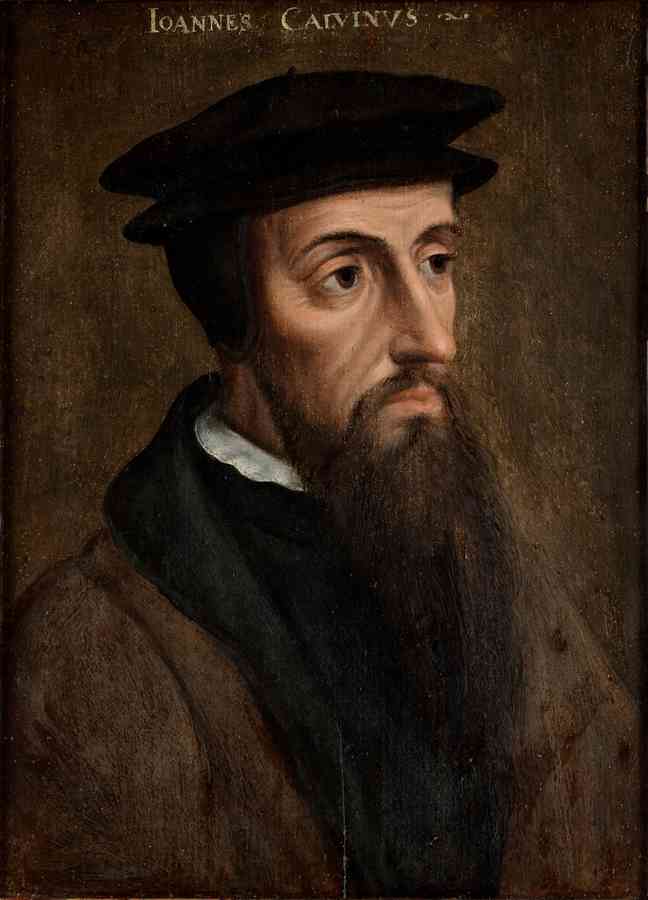
One would like to know more of the every-day personal life of this great spiritual genius. “He was a man of small stature, with a thin face, finely-cut features, a prominent nose, high forehead, and eyes that could flame.” Two English visitors to Geneva, who spent four months in the city, expressed their admiration of his gentleness of character, and his charm of conversation, and addressed him after his return home as “most gentle and learned.” The lines of Archbishop Alexander have been applied to him:
All his long life was given;
The heart of flesh was for his human brothers,
The heart of fire for heaven.”
His crest was a hand holding out a burning heart, with the motto: “Cor meum velut mactatum Domino in sacrificio offero” (I offer to the Lord my heart as if slain for a sacrifice). Ernest Renan has testified: “Lacking that vivid, deep, sympathetic ardor which was one of the secrets of Luther’s success, lacking the charm, the perilous, languishing tenderness of Francis de Sales, Calvin succeeded in an age which called for a reaction toward Christianity, simply because he was the most Christian man of his generation.”
HIS MONUMENT
He preached his last sermon on the 6th of February, 1564, and died on the 27th of May of the same year, not quite 55 years of age, worn out by his stupendous labors. When he felt death near, he gathered round him first the magistrates and then the ministers of Geneva. He forbade the erection of any monument over his grave, and “no man knoweth of his sepulchre unto this day.” But if you seek his monument, take your stand in any free and enlightened country and look around.