
Popery: Its Character And Its Crimes – Part II. Popery A Moral Pestilence. Chapter IV. The Worship of The Saints.
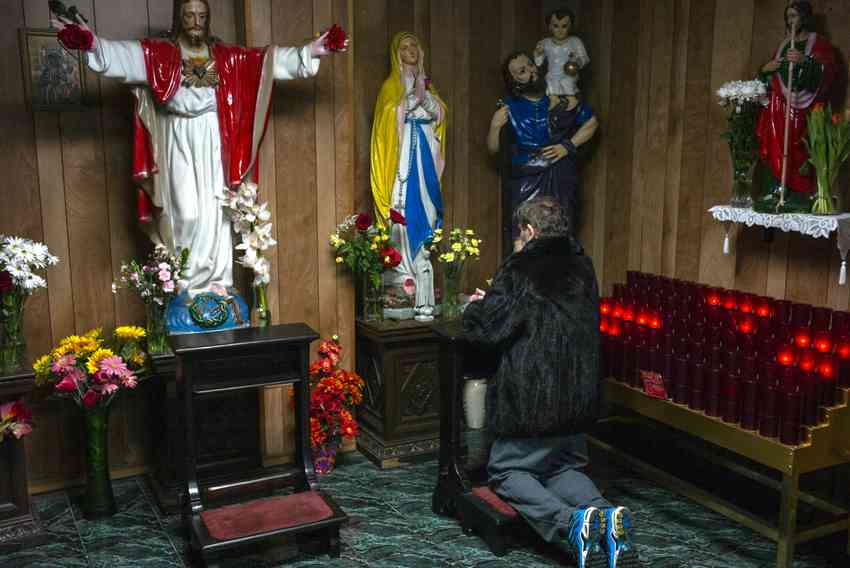
Continued from Part II. Popery A Moral Pestilence. Chapter III. Indulgences
CHAPTER IV.
THE WORSHIP OF THE SAINTS.
The worship of any creature, however good or great, must of necessity be a sin of the deepest dye. From Revelation we know that the Most High is infinitely Great, and Good, and Glorious. That He alone, of all beings, owes his existence to none. That He, moreover, created and upholds all things in existence, and “worketh all things, after the counsel of his own will.” These are the grounds on which God demands the adoration and service of all intelligent beings. And, since none, besides himself, possess any of these claims to our homage—all being placed at an infinite distance from their Creator—it must be an act of heinous iniquity to worship any but Him. Hence the frequent denunciations of creature-worship which meet us in the Word of God: “Thou shalt have no other gods before me; for I the Lord am a jealous God,” etc. “Thou shalt worship the Lord thy God, and Him only shalt thou serve.”
Accordingly, when Cornelius prostrated himself before Peter, the honour was instantly rejected. “Stand up, for I also am a man.” When the people of Lystra, struck with amazement at the miracles they beheld, would have worshipped Paul and Barnabas, they too refused to receive it. And when the beloved Apostle, in the isle of Patmos, “fell down to worship before the feet of the angel,” he was instantly rebuked by the celestial messenger: “See thou do it not: I am thy fellow-servant—worship God.”
From these remarks, it is obvious that the worship of any creature is not only an act of gross injustice to the Almighty, but also a sin expressly forbidden by God. How melancholy is the fact then, that for about fifteen centuries the visible Church of Christ has, almost universally, sunk down into this idolatry! And how important to attempt, by exposing this tremendous evil, to warn all other professing Christians against this accursed sin!
It may be laid down as an indisputable fact, that the invocation of the saints was altogether unknown in the Church of God for upwards of three hundred years from the Christian era. It is true that the martyrs were, from an early period, the objects of high veneration. Christians were accustomed to celebrate annual festivals in commemoration of them, at their tombs, on the day of their martyrdom; on which occasion it was usual to deliver orations in their praise. But these festivals were, as to their nature and object, undoubtedly innocent, and even praiseworthy, as we learn from the following passage in an epistle from the church at Smyrna, written on the occasion of the martyrdom of their bishop, Polycarp. After mentioning that they had buried his body in the usual place, they add, “To us assembling in this place, so far as it lies in our power, with triumph and with joy, the Lord will grant to celebrate the birthday of his martyrdom.” (Epist. Eccles. Smyr. § 18.)
This relates to the second century, but the practice of the Church continued the same during the third. “The honors paid to the martyrs,” says the learned Gieseler, “were the same during this period (A.D. 193–324) as in the second century. The annual festivals held by the various churches, at the graves of the martyrs, were only an expression of the same feeling which led them to assemble often in their burial places, which were not unfrequently caves, and therefore especially convenient in times of persecution.” (Vol. I. p. 368.) Although in adopting this practice Christians were merely echoing the praises of which the martyrs are the objects in the Word of God—“They overcame him by the blood of the Lamb, and by the word of their testimony; and they loved not their lives unto the death,” (Rev. xii. 11)—still, it is not improbable that, at times, immoderate honor was lavished upon the martyrs, and the true source of their faith and patience, ‘the grace of God that was in them,’ forgotten. Thus the soil was prepared for the creature-worship and idolatry which, in the course of after ages, wholly supplanted the worship of the one true God.
It has been stated that the invocation of the saints did not spring up in the church until the fourth century. The first step, however, towards it, was taken by Origen and his followers about the middle of the third. This philosophizing teacher, the orthodoxy of whose writings was so long disputed in the church, was the first to start the doctrine on which the whole superstructure of saint-worship rests, viz., “that the blessed above are conscious of what transpires below, and help their brethren by their prayers.”
At first, this was nothing more than a private speculation. Origen himself speaks of it, in some places, as a probable opinion, rather than a certain and indisputable doctrine. In process of time, however, this notion acquired fresh strength. The apocryphal books of the Maccabees were quoted in its favour: traditions—miracles wrought at the martyrs’ tombs—and imaginary apparitions of the dead, were adduced in its support. Until, at length, that which was, in Origen’s time, merely a disputed opinion, became, at the beginning of the fourth century, an article of faith.
Another step towards the invocation of the dead was taken by Cyprian, bishop of Carthage, about A.D. 250. It had already become the practice, in his days, for those who had denied their Lord in times of persecution to seek reconciliation with God and the church by means of the prayers and influence of the confessor; i.e., Christians who had undergone torture for their religion, but had escaped with their lives. Cyprian, however, set the example of entreating them, whilst still alive, to be mindful of their brethren after their death; and, when they reached the world of bliss, to offer up their prayers on the church’s behalf, before the throne of God. (Lib. 1. Epist. 1. ad Cornelium.) The seeds thus sown by Origen and Cyprian, finding a fertile soil in the peculiar circumstances of the church, in process of time, sprang up. The church had still continued the commemorations of the martyrs to which we have alluded; they still met frequently at their burial places, too, for worship—perhaps as being safe retreats from the fury of their enemies. But a change now took place in the nature of these meetings. Christians thought that the graves of the martyrs should be frequented in order to obtain an interest in their prayers before the throne of God. Hence, gradually, sprang up the desire to invoke the saints by name. (Chem. de cult. Sanct.)
Such was the state of things in the Church of God when Constantine embraced Christianity in the early part of the fourth century—and the profession of the gospel became at length as honourable as it had before been disgraceful. This sudden and wondrous change in the outward condition of the church naturally tended to increase the admiration and love of which the martyrs were already the objects. It was they who had achieved the victory over Satan and his associates. “There was war in Heaven: Michael and his angels fought against the dragon; and the dragon fought and his angels, and prevailed not; neither was place found any more in heaven”[1] … “And they overcame him, [i.e., the Christian did] by the blood of the Lamb, and by the word of their testimony, and they loved not their lives unto the death.” (Rev. xii. 7–11.)
Hence, when the Christians of the fourth century thought of the tremendous persecution through which they had just passed—and viewed with rapture the bright scene which had at length dawned upon them—the holy men whose faith and patience had wrought, under God, this blessed change, appeared invested with almost superhuman glory. Still, superstition for a time was checked by the Arian controversy, which had just commenced. One of the arguments commonly used by the orthodox party against those who denied the Deity of Christ was as follows:—“God alone is to be adored and invoked—but Christ is repeatedly the object of adoration and invocation in the Scriptures—therefore Christ is not a creature, but the true God.”
The natural effect of these truths being constantly brought before men’s minds was to prevent the growing desire to invoke the saints from breaking out. Hence the writings of those Fathers who lived in the middle of the fourth century—of course excepting the many spurious works attributed by Romanists to them—contain no mention of prayers to the saints. Eusebius, the ecclesiastical historian, says that “the souls of the blessed have a certain power by which, even after death, they help mankind.” But he nowhere teaches that they should be invoked. So far from this, he attributes to Christ alone the honour of presenting our prayers to the Father. Lactantius, a Latin father of this period, also teaches that God alone should be invoked. The works of Athanasius, the great champion of the Catholic Church, abound with sentiments totally opposed to all creature-worship. He often establishes the Deity of Christ from the fact that Christians have recourse to his help in time of need. “The saints,” says he, “do not ask any creature to assist them. Christ, therefore, whose help the saints do invoke is the true God.” (Orat. cont. Ar.) Hilary of Poitiers, who lived so late as the year 360, speaks about the intercession of angels, and the guardianship exercised by Apostles and Patriarchs, but he nowhere inculcates the invocation either of saints or angels. On the contrary, he defends the practice of calling upon the name of Christ on the ground of his essential Deity.
We have thus brought down our sketch of the state of the church, in reference to saint-worship, to the year 360, without finding any instance of Christians calling upon the martyrs by name to help them by their prayers. But the practice of invocation must have commenced soon after this period, since the writings of Basil, Gregory of Nyssa, and Gregory of Nazianzen (A.D. 370) contain many apostrophes to the saints and martyrs, as well as supplications for their intercession. It has indeed been contended that the custom of addressing the saints was, at this period, long established.[2] The foregoing remarks, however, are sufficient to prove the contrary. If further evidence were necessary, it would be easy to show—from the absence of all proof of the previous existence of the practice—the recent prohibitory canon of the Council of Laodicea against worshipping angels—the hesitating, undecided manner in which these fathers express themselves, even in their highest flights,[3]—the character of the writings in which these exceptionable passages occur—and the use occasionally made by them of spurious writings in order to promote saint-worship—from these and other considerations, it would be easy to show that the invocation of the saints in the time of Basil and the two Gregories was an innovation upon former usages, which the fathers had obtained from the monasteries in which they had been educated, and were doing their utmost to introduce into the church.
On the whole then, it appears highly probable that the invocation of saints arose in the church somewhere between the years 360 and 370; and having once crept in, the practice rapidly gained ground, so that in the time of Chrysostom (A.D. 400) we find the majority of professing Christians addicted to this superstition. “From the beginning of the 5th century,” says Gieseler, “prayer for the saints was discontinued, as unbefitting their glorified state. Christians were now, but seldom, called upon to address their prayers to God; the usual mode being, to pray only to some saint, for his intercession. With this worship of the saints were joined many of the customs of the heathen. Men chose their patron saints and dedicated churches to their worship. The heathen, whom the Christians used to reproach with worshipping dead men, found now ample opportunity of retort.” (Gieseler’s Hist. Vol. I. p. 282.)
At the commencement of the 5th century then, and not earlier, we may consider the worship of saints as pervading the visible church. The true church of God—the woman clothed with the sun—had already fled into the wilderness. (Rev. xii. 14.) And it is a fact worthy of remark, that the Christians in the extreme west of Europe continued to keep clear of these and other forms of idolatry, even so late as the 8th century.[4]
The Paulicians too, in the east, worshipped God alone. But although the worship of saints had thus early spread throughout the visible church, it must not be supposed that it was the same as the idolatry of Rome in the 12th century. The form in which it first prevailed was destitute of those malignant and gross features which attached to it in later ages. The monstrous blasphemies of Romish Mariolatry, for instance, were altogether unknown. “Throughout the fourth century there was no peculiar preference of the Virgin Mary above other saints, neither did the teaching of the fourth [century] scruple to attribute to her faults.” (Gieseler I. p. 283.) The worship of images and pictures too, was of later origin. “In the fourth century,” says Gieseler, “the worship of images was still abominated, as a heathen practice; but as early as the fifth century, various superstitions had become connected with them.” (Vol. I. p. 289.) Besides all this, the invocation of the saints did not, as yet, form any part of the public worship of the church.
The invocation of the dead acquired fresh strength in the schools of the poets. Prudentius and Fortunatus, who wrote in Latin in the fifth century, transferred the invocation of the muses and demi-gods of paganism to the Christian martyrs; and availing themselves of the license of poetry, offered them absolute adoration, and addressed them as mediators between God and man. At the close of the sixth century, Gregory the Great, Pope of Rome, did more than any one man, perhaps, to strengthen the growing superstition. From the chair of St. Peter, we hear him exclaim: “Our defenders are present, the holy martyrs; they desire to be invoked, they are solicitous to be sought after.” (Hom. 32 in Evang.) “Let the blessed Apostle Peter be the guardian of your empire. Let him be your protector on earth, and your intercessor in heaven.” (Lib. 12. Ep. 44.)
“We trust in the strength of the omnipotent God, and in the aid of the blessed Peter himself, the Prince of the apostles.” (Lib. 12. Ep. 22.) Previous to this time, the worship of the saints, though carried to a great excess, had been altogether of a private and voluntary character. Gregory, however, amongst other innovations, inserted litanies in the public services of the Romish church, in which each saint was in turn supplicated;—thus, “St. Mary pray for us,” “St. Peter pray for us,” etc. He also sanctioned the use of images in churches, which shortly after degenerated into their actual worship.
After the Gregorian form of invoking the saints was admitted into the public worship of the church (Sancta Maria, ora pro nobis!), it went on so far, that all things which are peculiar to God and to Christ were at length sought from the saints by name, and publicly. From the eighth century, all worship of God was merged in the worship of the saints. Festivals were appointed. Monasteries and churches were erected in honor of these Christian demi-gods. Not only were the saints able to heal all diseases, work miracles, and deliver from all dangers and evils; but their very bones, clothes, and in short everything which they had touched, was invested with the same powers, and regarded with the most absurd and impious veneration.
Although the whole church was thus, as it were, deluged with abominable superstition, it is a lamentable fact that idolatry reached a still more impious height during the following centuries; especially in the Romish church.[5] In the tenth century, creature-worship presented a most malignant form, and the Virgin Mary was the first idol who was absolutely exalted by the priests to a level with God. In the 12th and 13th centuries, the system of creature-worship may be considered as having at length reached its maturity; and assumed that form in which it has existed, with little modification, to the present period. It is, accordingly, to this matured form that we wish chiefly to direct the reader’s attention. The remaining portion of this chapter will therefore be occupied with an attempt to set forth the doctrines and practices of the Church of Rome in reference to saint-worship generally.
The theory and grounds of creature-worship, as practised in the Church of Rome from the 12th century to the Reformation, cannot be better set forth than in the language of Alexander Hales, the first and most ancient of the schoolmen (A.D. 1230). He says that “Prayer should be addressed to the saints for three reasons:
I. On account of our deficiency of merit; that where our merits are not sufficient, the merits of others may plead for us. Or on account of our deficiency of CONTEMPLATION; as being unable to gaze at the Supreme Light itself; but only as it shines in the saints. Or on account of our deficiency of LOVE; because the efficacy of prayer depends upon the ardour of our devotion; and for the most part, feeble man finds himself more affected towards the saints than towards God.
II. That prayer ought to be addressed to the saints on account of THEIR OWN GLORY, in order that, whilst we obtain the assistance which we implore, we may magnify and highly extol them.
III. That prayer ought to be addressed to the saints on account of our REVERENCE TOWARDS GOD; because a sinner who has offended God, though he dare not approach him in his own person, may flee to the saints by imploring their intercession.”*
These impious doctrines are repeated, word for word, in the Golden Legend, first published about 1260, which was read in the churches for centuries in place of the Word of God. All the great doctors of the Papacy, too, express themselves in similar language. Peter Lombard says, “Therefore the saints intercede for us with God, both by MERIT, whilst their merits assist us; and by DESIRE, whilst they desire that our prayers should be granted. We pray, therefore, that they would intercede for us: that is, that their merits may assist us; and that they themselves may will our good; because when they will it, God wills and does it.” (Book 4. dist. 45.) And Gabriel Biel—to mention no more—pronounces, that “by the appointment of God, we ought to have recourse to the help of the saints, THAT WE MIGHT BE SAVED BY THEIR MERITS AND PRAYERS.” (Super Can. Mis.)
The whole religion of the people was in strict accordance with the theory of saint-worship thus laid down by the very highest authorities in the church. In their public and private devotions, professed Christians offered up actual adoration, not only to saints and martyrs, but to angels and archangels. They supplicated blessings, both spiritual and temporal, directly from them—and invoked them as their helpers, preservers, guardians, and deliverers in all dangers and evils, both bodily and mental: whilst the atonement of Christ was altogether set aside by the practice of imploring these saints “to interpose their merits between the justice of God and their demerit.” In order that the reader may judge for himself whether the above remarks are exaggerated or not, we shall now quote several prayers from the old service-books used in the church of Rome before the Reformation.
Ancient Devotions of the Church of Rome
A Prayer to St. Claude
“O thou comforter of the desolate, deliverer of the captive, resurrection of the dead, light of the blind, hearing of the deaf, speech of the dumb, keeper of the shipwrecked, healer of the impotent and languishing, the refuge of medicine, the way of the erring, and THE SALVATION OF ALL THAT HOPE IN THEE! O St. Claude! the bountiful confessor of Christ; pray to God for us, who made thee famous by so many and great miracles; for by reason of thy most holy life, which thou didst lead, so piously and devoutly, in this vale of misery, despising the vanities of this world, and following after celestial things, for thy merits, he hath placed thee in the joys of Heaven above, and graced thee with innumerable miracles.” (Horæ sec. us. Rom. 6 die Junii. Paris. 1570.)
A Prayer to the Holy Innocents
“O all ye holy Innocents, pray for us. O Blessed Boys, flowers of purity, celestial gems, and consorts of the immaculate Lamb, that taketh away the sins of the world, look upon the servant of your sanctity, and express towards me your most tender bowels of pity, that, upon your intercession being presented to the Lord with a pure conscience, I may merit to praise the Lord Jesus Christ, with you, for evermore. Amen.” (Horæ sec. us. Sarum, Parisiis. 1519.)
A Prayer to St. Etheldrede
“Placed amidst the dangers of this present life, and uncertain world, that threaten to wreck us, we fly to thy safe port, O most pious and famous Virgin Etheldrede! that we may feel the bowels of thy compassions toward us, who always congratulate thy presence among us. Look therefore, thou compassionate Mother and Lady, with a pitiful eye, upon the poor but devout obsequiousness of our services; and let the venerable sublimity of thy virginity relieve and sustain those who are oppressed with the immensity of human frailty. For we believe, and are confident, that from that spouse of thine, who has desired thy beauty, thou canst obtain whatsoever thou shalt ask.” (Brev. Sarum. folio 100, Paris. 1555.)
A Prayer to the Holy Angels
“O inflamed Seraphim, burning with love. O ennobled Cherubim, shining with knowledge. O highest Thrones, judging in the session of God. O Supreme Dominations, bearing rule by the divine gift. O famous principalities, set over others in government. O wondrous powers, driving away devils, by God’s command. O admirable virtues, doing miracles for the illumination of the faithful. O holy Archangels, to the great, declaring things greater. O good Angels, exercising constant care over men. Attend to your ministry, for our preservation; directing our thoughts, words, and actions into the way of salvation and prosperity. That we, being willing worshippers of the commands of God, may be able happily to fill up the number of your orders (which was lessened by the fall of Lucifer), the divine mercy granting it.” (Horæ secund. us. Sar. fol. 92.)
Of St. Gabriel
“Now let the faithful people rejoice, whilst declaring the praises and renown of Gabriel. Let every one, daily, ask blessings of Gabriel and Mary. From them flow the fountain of virtue, the sweetness of life, the hope of salvation, and diffused grace.” (Missale Rom. Antiq. fol. 52.)
A Prayer
“Almighty and everlasting God! who, out of thy great clemency, hast wonderfully deputed the glorious PRINCE OF THY CHURCH, blessed Michael, the Archangel, for the salvation of human nature; mercifully grant, that, by his saving aid, we may merit to be most effectually defended, here from evil actions; and, when we shall die, to be freed from all temptation, and beatifically presented before thy high majesty. Through our Lord, etc.” (Horæ sec. us. Rom.)
A Prayer to St. Erasmus
“O Saint Erasmus, the precious martyr of Christ, who wast offered to God on the Lord’s day, which was an occasion of great joy to thee. Receive this prayer for the salvation of my body and my soul; that through thy prayer God may deign to give me food and raiment; in the hour of death true confession, contrition, and the saving sacrament, with the unction of holy oil, perseverance in good works, with a right faith and intention to die well, with those things that are pleasing TO GOD AND TO THEE: TO THY PRAISE AND HONOUR, and to my consolation. Now S. Erasmus, I commend my body and soul to thee, that God, by thy prayer, may be pleased to give me grace. I commend also to thee all my counsel, all my actions, and all things subject unto me; that thou mayest deliver me from all mine enemies, visible and invisible, which seek to oppose me. That they may not be able to hurt me, in anything, nor inflict any evil upon my soul, or body, basely, or craftily, secretly or openly. For God has promised thee, that, WHOSOEVER SHALL CALL UPON THY NAME, WHATSOEVER HE SHALL ASK HE SHALL CERTAINLY OBTAIN. Receive me, Oh Erasmus! into thy holy faith and grace, and preserve me, etc.” (Horæ sec. us. Sarum.)
To St. Agnes
“Agnes, the Lamb’s wife, illumine us internally; eradicate the roots of sins. O Lady singularly great, after the troubles of this life, translate us to the assembly of the blest.” (Missal. Rom. Antiq. f. 51.)
To St. Genevieve
“Now O Genevieve, Indulgent Virgin, look favourably towards those who intreat thee. Remove the weight of sin; defeat our foes that oppress us, and their designs. Grant us ever a healthy body, and a pure heart. And having finished our conflict here, unite us to the heavenly band.” (Horæ sec. us. Rom. Paris, 1570.)
A Prayer
“Grant unto us most merciful Father, that like as blessed Mary Magdalene obtained pardon of her offences thorough the love that she bare to thy only begotten son above all things: even so thoroughe thy mercy let her purchase for us the blysse everlasting. By Christ our Lord. So be it.” (Prymer. fol. 29. 1556.)
A Prayer
“We pray thee O Lord, look graciously upon thy family, for the merits and prayer’ sake of St. Wilgelort, thy Virgin and Martyr, the King’s daughter; and as in answer to her prayers, thou madest the beard which she desired to have, miraculously, to grow, so vouchsafe to augment the desires of our hearts, with the benefits of heavenly grace. Through Christ. Our Father. Hail Mary.” (Hor. sec. usum. Sarum.)
Of the Three Kings of Colen
“O God who by the guidance of a star didst lead without hindrance, the three Eastern Magi, Jaspar, Melchior and Balthasar to thy cradle, to worship thee with mystical gifts; mercifully grant, that, by the pious intercession of these three kings[6] and by the merits of their commemorations, etc.” (Ibid.)
To St. Michael, the Archangel
“Most glorious prince Michael, the captain of hosts, the receiver of souls, the vanquisher of evil spirits, the admirable general next to Christ, of God’s church, and of great excellency and power, deliver all that cry unto thee from all adversity, and make them to advance in the worship of God, by thy precious office, and most worthy prayer.” (Horæ sec. us. Rom. Sep. 29.)
A Prayer to the Martyrs
“All ye holy martyrs, pray for us; O ye most valiant soldiers of Christ, and princes and captains of the Lord’s hosts, whose life was wonderful and death honourable, by that insuperable love with which ye are united to God, I entreat you not to suffer me to perish in my sins; but in every necessity and danger be you my advocates and defenders, that, BY THE INTERPOSING MERITS OF YOUR PASSION, I may partake of eternal felicity. Which may he be pleased to grant, who is your love, life, salvation, and reward, Jesus Christ. Amen.” (Horæ sec. us. Sarum.)
To St. Christopher
“O St. Christopher the precious martyr of God, I entreat thee by the name of Christ, thy creator, and by that prerogative he bestowed on thee when he put his own name on thee alone, I beseech thee, in the name of the Father, Son, and Holy Ghost, and by the grace thou didst receive, to MAKE GOD AND HIS HOLY MOTHER PROPITIOUS TO ME thy servant, a sinner, etc.” (Horæ sec. us. Rom.)
A Prayer
“O God, who didst will that the blessed Anne should be the mother of thy mother; grant we pray thee, that BY THE MERITS both of the mother and daughter, we may attain unto the celestial kingdom.”[7]
To St. Francis.
“O Francis! the solar light. Crucified in a remarkable manner, already thou rejoicest with Christ in the choir of celestials. BE THOU UNTO US THE WAY OF LIFE. Always kind to us; DISPLAY UNTO CHRIST THY WOUNDS. Pray for thy servants, that being delivered from our troubles, we may with thee, sweetly praise the Trinity without end.”[7]
Of St. Thomas, Archbishop of Canterbury.
“O Christ, through the blood of Thomas which he spilt for thee, cause us to mount up whither he has ascended.[8]
Vers.—With glory and honour hast thou crowned him.
Resp.—And hast set him over the works of thy hands.[9]
O Jesus Christ! through the wounds of Thomas, loose the sins which bind us; lest the enemy, the world, or the works of the flesh, bear us to hell. After the gifts of God’s left hand, let his right hand, THROUGH THEM, O Thomas, embrace us.” (Brev. Sarum. in 7. Juli.)
The saints having been thus honoured and worshipped in the public prayers of the church, we cannot wonder at any excess of impiety and blasphemy of which Papists have been guilty. They have raised St. Francis, for instance—the father of the Franciscan friars—not to a level with, but absolutely above the Son of God himself.
In proof of this we have only to refer to a work entitled “The Book of the Conformities of St. Francis with Jesus Christ,” written originally in the fourteenth century and since repeatedly printed with approbation. The engraving at the commencement of this curious book represents Christ upon the cross, which, like a tree, sends forth several branches, from which hang altogether forty fruits, on each of which is inscribed one of the forty conformities of Francis with Christ! As follows:
- Christ sends forth his apostles—Francis aids men.
- Jesus transcends the angelic host—Francis is exalted to the highest place.
- Jesus brings men forth—Francis gathers them together.
- Jesus illumined the devout—Francis conversed with and instructed his disciples.
- Jesus shone resplendently—Francis is the searcher of hearts.
- Jesus was admirable in his life—Francis in action.
- Jesus changed water into wine—So did Francis.
- Jesus expelled devils—Francis made them flee.
- Jesus was a shining prophet—Francis was encircled with rays of glory.
- Jesus was submissive to all—Francis was to the least, etc.
Above this representation are placed the following lines: “O Francis, the typified Jesus, and leader of the friars minor, by thee, the acts and graces of Christ are wonderfully shadowed forth. O excellent father, defend our souls from all evil, and cause us to sit eternally in the kingdom of paradise.” At the foot of the page is: “O Francis, in following the doctrine of God the Creator, the stigmata of the Saviour Jesus Christ were imprinted on thee.”
The following extracts from the work itself will convey to the reader some faint idea of the horrid blasphemy with which it is stuffed:
“St. Francis was the pattern of every perfection, and human nature in him was dignified and adorned by the marks of the passion of Jesus Christ; so that they who follow his steps shall never be overcome by the devil. The day of his birth, the souls were delivered from Purgatory, and taken to glory. Francis is in the glory of God the Father. (Phil. ii. 4.) He is preeminent in the glory of the saints; to which may Jesus Christ bring us, through the merits of the said Francis.” (p. 5.)
“It is pious to believe that Francis was prefigured in the writings of the prophets and the figures of the saints. Francis was revealed to the saints in the same manner that Christ was, as is testified by the Abbot Joachim in his exposition of Jeremiah, and by Cyrillus, Hermit of Mount Carmel. Isaiah saw Francis when he heard the two seraphims saying ‘Holy, holy, holy, is the Lord God of hosts, the whole earth is filled with his glory.’ (Is. vi. 3.) Ezekiel too, when he heard a voice of a great rushing, saying ‘Blessed be the glory of the Lord.’ (Ezek. iii. 12.) Christ made St. Francis like to himself IN ALL THINGS, and a roll from heaven declared that he was THE GRACE OF GOD” (hic est gratia Dei). Elsewhere in the book, Francis is called “Jesus of Nazareth, King of the Jews.” (Lib. I. p. 268.)
“St. Francis strictly followed all the evangelical precepts, so that of him it may be truly said, that he did not transgress a single jot or tittle of them.” (p. 2 & 160.) The mother of Francis said, “What, think you, my son shall be? Know that, by the grace of his merits, he shall be the Son of God.” It was declared to the devil who St. Francis was, for it is written in an ancient legend that a demoniac being cured by him, the devil was interrogated concerning the sanctity of the blessed Francis, who, among other things, declared that at the time of his birth there was such a commotion in hell that they all believed the day of judgment was come. But finding that it did not arrive, they concluded for a certainty that some one was born in the world who should overturn and destroy hell. Being afterwards sent by the prince of darkness to traverse the whole earth, and finding that Francis was born at that precise hour, they were fully convinced that they were eventually to be destroyed by him.[10] (p. 14.)
To us, however, the worst thing connected with this saint of Rome is the tendency to regard the stigmata of St. Francis as bearing the same relation to mankind as the sufferings of our blessed Lord.
In the history of his life we are informed that Jesus Christ appeared to him in the form of a seraphim on the cross, and imprinted on his hands, his feet, and his side the five wounds that were given him on the cross. The same legend adds that he suffered even till his death—which happened two years after—the pains of Jesus Christ as sensibly as Christ himself felt them while hanging on the cross; and that his life was preserved, in the midst of a continual death, by a perpetual miracle. The annexed engraving of The Impression of the Stigmata is from an old Romish Breviary.[11]
A plate is given in the “Book of the Conformities of St. Francis” which represents the cross of Christ: but instead of the two arms of the Son of God, one of St. Francis’s arms occupies the place of Christ’s left arm; as though to intimate, that the salvation of man was equally divided between them. A book written by his followers, called “The Flowers of St. Francis,” distinctly states that “those men only were redeemed by the blood of Christ who had lived up to the time of St. Francis; but all others who had lived since that time were redeemed WITH THE BLOOD OF FRANCIS HIMSELF.”[12] (Wolf. Lect. Mem. I. p. 522.) An inscription too exists over the great gate of the convent of the Franciscans at Rheims, in France,[13] which, literally translated, is as follows: “TO THE MAN GOD, AND TO SAINT FRANCIS, BOTH THE ONE AND THE OTHER CRUCIFIED.”
We give you below an exact facsimile of the plate, in “The book of the Conformities.” Printed at Bononia. A.D. 1590.

A similar illustration to the one above, representing one arm of Christ and one of St. Francis nailed to the cross, is still, in the nineteenth century, published in the Breviaries printed for the use of the Franciscans. (See Horæ Diurnæ Breviarii Romani Seraphici A. SS. D. N. Pii VIII. Romæ, 1829.)
It is important to remember that the blasphemous legend of St. Francis, although at first the work of the order of Franciscans, belongs now to the Papacy itself. The Pope in his bulls commanded the doctrine of St. Francis’s Stigmata to be received by all the faithful. (Leon. Coquæus, Antimorn. Tom. II. p. 245, quoted by Foulis.) Nicholas III. also, in the decretal Exiit qui seminat, recommends the poverty and perfection of St. Francis to all Christians, and declares that “he had no bag; and he finds not those actions of infirmity which were in Jesus Christ, who had two actions of infirmity; viz., he had a bag and he fled. In these two things Francis surmounted Jesus Christ.”[14]
Besides, the numerous editions of the “Book of the Conformities” which Papists have published amply prove that they are chargeable with all the impieties and blasphemies with which that wicked work abounds. It was written, as we have already said, in the fourteenth century by Bartholomeus de Pisis, and published with the consent and entire approbation of a general chapter of the Franciscan order, held at Assisi in 1389, who entitled it “A Golden Book.”
It was first printed at Venice, in folio, without printer’s name or date;[15] the second edition was printed at Milan, 1510; the third in 1513, at the same place. Subsequent editions were published in 1590, 1620, and 1630. An apology for the book was also printed in 1607 by a Franciscan, with the approbation of the Antwerp censors, who pronounced it useful against heretics. It is not generally known, too, that in the middle of the seventeenth century a new treatise in folio, on the resemblances between Christ and Francis, was published in Spain, entitled “The Prodigy of Nature and Wonder of Grace.” In this work the author gives a much greater loose to his imagination than Bartholomew of Pisa. Instead of forty conformities, this prolific writer has given four thousand. An interesting account of this book may be found in the “Critical Literary Journal of Europe.”
Similar things are related of several of the other great saints of Rome to whom the prayers and vows of Europe are still presented. It is recorded of St. Dominic, for instance, that Christ raised only three dead men to life; but Dominic restored two men who had been quite crushed to pieces, and forty others who had been immersed for a long period in the water. Christ after his resurrection came to his disciples when the doors were shut; but Dominic, whilst in a mortal state, which is more wonderful, often entered the church by night when it was shut, lest he should awake his disciples. Christ, after he had left this world, drew innumerable multitudes to the way of truth; but Dominic, many more, etc.
Antoninus says “Christ was said to be the Lord, absolutely and authoritatively; but Dominic possessively.”[16] A writer in the fourteenth century also says that in his days “the Dominicans made their Dominic like unto Christ.” The above statements respecting this saint are taken from Wolf’s Lection. Mem. Tom. I. p. 510, where all the authorities may be seen.
St. Clare stands in the same relation to her own sex that St. Francis does to men. “Those women only who lived previous to her time were saved by the merit of the virginity of the Blessed Virgin Mary; but those who have lived since are saved by the merit of the same blessed Mary, but renewed in the body of St. Clare.”[17] (Flosculi Sancti Francisci, apud Wolf. Lect. Mem. I. 522.)
Many other instances of men and women being raised to an equality with Christ, and with God, might be enumerated. St. Katherine was taken up into heaven, and became THE WIFE OF JESUS CHRIST. The whole history of the transaction by a spectator is contained in the Golden Legend, published by Caxton, in the fifteenth century. We give the conclusion:
“Thus this glorious marriage was made, whereat all the celestial court joyed and sung this verse in heaven, ‘Sponsas amat sponsam. Salvator visitat illam.’ This was a glorious and singular marriage, the which was never more like before in earth.”
It is time, however, that we should consider the modern devotions of the Romish Church. The Council of Trent, which is the rule and standard of faith and practice amongst Papists to the present day, has virtually approved and confirmed the gross idolatry of previous ages.
The canons of that council decided that it was “good and useful, humbly to invoke the saints, and to have recourse to their prayers, their help, and assistance, in order to obtain blessings from God through Jesus Christ,” and condemned “those who reject the invocation of the saints, in order that they may pray for us individually.” It is true, the language of the council in the canons is so worded that they seem to attribute intercession only, not pity, favour, or the power of bestowing blessings, to the saints; yet since they distinguish between the prayers of the saints and their assistance, they plainly retain the very essence of saint-worship, as it was for centuries practised in their church.
The Catechism of the same council proves this far more clearly and fully, for Christians are there said to adore angels, though not with divine veneration. Concerning the saints, the catechism says: “The saints are to be invoked for this reason, that they constantly offer up prayers for the salvation of men; and God confers many blessings upon us, through their merit and grace. When invoked, they obtain the pardon of our sins, and conciliate God’s favour towards us.”
The Synodus Petricoviensis, held in Poland, attempted to modify the worship of the saints; for it says in its xviii. chap. “that we are not to implore mercy from the saints, but simply their intercession, as we do from those who are still living on earth.” The Catechism of the Council of Trent, on the contrary, teaches that “It is lawful to have recourse to the grace of the saints (gratiam), and to use their help.” (Chemnitii Examen Conc. Trid. p. 579.)
Thus the invocation and worship of saints is still retained and defended in the Romish Church, mainly, as it was practised previous to the Reformation. We now proceed to give as many instances of prayers to the saints as our space will admit, taken from the present Breviary, Missal, and other authorized books of devotion, all of them in use in the present day.
MODERN DEVOTIONS OF THE ROMISH CHURCH
To St. Peter and St. Paul
“O Peter, the Blessed Shepherd, graciously receive our prayers, and BY THY WORD unloose the bonds of our sins, to whom is given the power to open wide heaven to mortals. Illustrious Teacher Paul, instruct our manners, and snatch our hearts (to be) with thee.” (Breviar. Rom. June 29)
To St. Clare
“Now O Maid, thou reignest in the kingdom of light, with the Father (i.e. St. Francis). Grant that the steps of all thy followers may be in a right course.” (Officia Nova Sanctorum. 1672.)
A Hymn for Any Apostle
“Let the earth leap for joy, let the heavens resound with praise; let the earth and stars sing together the glory of the Apostles. O ye judges of the world, and true lights of the earth, we earnestly beg you to hear the prayers of our suppliant hearts. Ye that close the temple of heaven, and WITH A WORD unloose its bolts, we pray you, command us guilty ones to be freed from punishment. Ye whose commands, sickness and health at once obey, heal diseased minds and replenish us with virtues. That when Christ, the judge of the world, shall return, at the end, he may grant us to be partakers of eternal joy.” (Brev. Romanum.)
To St. Peter of Alcantara
“Now hear our prayers and preserve our morals pure without a spot. Infuse thy healthful ways (sensus) into our minds. O Glory of the Franciscans, receive the prayers and praises of thy suppliants. O blessed Father, kindly look upon thy (children) from on high.” (Officia Nova Sanct. Oct. 1672.)
To St. Venantius
“O most brave warrior, who didst give to thy perfidious tormentors water from the rock, water our souls with the dew of grace.” (Ibid. May 18.)
At Lauds: “Now O joint-partaker with angels, be present to the wishes of thy suppliants. Expel our crimes and impart unto us thy light.” (Ibid.)
A Prayer
“O God who, by innumerable miracles, hast honoured blessed Nicholas the bishop, grant, we beseech thee, that by his merits and intercession, we may be delivered from eternal flames. Through the Lord.” (Missal. Rom. Dec. 6.)
A Prayer
“We beseech thee, O Lord, by the merits of thy saints whose relics are here, and of all the saints, that thou wouldest vouchsafe to forgive me all my sins. Amen.” (Rom. Missal for the use of the laity, p. 18. Lond. 1813.)
To St. Francis Xavier, to obtain a generous heart
“Behold at your feet, O most generous Apostle! a soul that most shamefully neglects all things belonging to the service of God. I fear, I confess, the least thing that either seems difficult or any way terrible; and, by this my inordinate pusillanimity, I fly back and quit many a noble action that otherwise might very much increase the glory of God. O holy Apostle, GRANT ME but one spark of your great courage, wherewith you underwent such difficulties, ANIMATE and STRENGTHEN my pusillanimity; that, frightened by no opposition, I may most manfully and readily fulfil God’s Holy Will. Amen.” (Manner of performing the NOVENA, or nine days devotion to St. Francis Xavier, Dub. 1749. p. 67.)
Another prayer in the same work begins thus:—
To St. Francis Xavier
“Most Holy Father Francis Xavier, who receivedst thy praises from the mouths of innocent children; I most humbly implore thy bountiful charity, for the sake of the most precious Blood of Jesus, and of the immaculate conception of our blessed Lady, Mother of God; to the end, thou mayest obtain of God’s infinite Goodness, that at the approach of my last hour, my heart may be separated and withdrawn from all worldly thoughts and distractions,” etc.
To St. Joseph
“Great St. Joseph, I take you, this day, and for the whole of my life, for my especial patron, for my master, for the director of my soul, and my body, of my thoughts, of my words, of my actions, of my desires, of my inclinations, of my honour, and of my goods; of my life and of my death; and I purpose never to forget you, but to exalt your holy name, and to advance your glory, as far as I possibly can. I intreat you, therefore, O great saint, to accept me as your perpetual servant; assist me in all my actions, and do not abandon me at the hour of death. Amen.” (L’Ange Conducteur, p. 272. Bruxellis. 1802.)
Devout and loving elevations to St. Joseph
“Admirable St. Joseph, spouse of Mary, nourisher of Jesus; who will confer on me the happiness of seeing myself under your protection? Who will place me under your faithful guidance? Terrestrial angel, divine lamp of high perfection, mirror animated by virtues the most heroic, ravishing lily of purity the most perfect! O man the most happy and the most glorious of all men, alone chosen amongst all others, to hide for a time the adorable mystery of the incarnation of the Word; hide me from the sight of his wrath, who am always in danger of allowing myself to be surprised.
Divine Joseph think on me; watch for me, amiable cherubim, who dost guard the paradise of the new Adam; labour for my sanctification, dear nourisher of the sacred victim of our salvation; provide for all my wants, faithful depository of the most precious of all treasures. I conjure you, lastly, to exercise over me a sovereign authority, and to bring all my powers under your laws, O illustrious head of the holiest family that ever existed; tutor and governor of the incarnate wisdom, who didst as a father command the man-God, being, by commission, lieutenant of the celestial Father over the Infant-God.” (Ibid. p. 289.)
A Prayer to all the Saints
“Great saints, who have happily passed the dangers of this tempestuous sea, and who are in a safe port, enjoying a joy that is incomprehensible; I conjure you, for the love of Him, who has chosen you for his princes and for his favourites, to have the goodness to remember me, who am exposed to tempests, and subject to shipwrecks; so that stretching out your hand I may be sustained by you, so as not to fall under the conflicts and attacks of my enemies, who only seek my destruction. O fortunate bands, elevated by the great God, I recommend to you my body, my soul, my life, my death, my judgment, and all that relates to the eternal salvation of my soul; I recommend to you, equally, my parents, my friends, my benefactors, and the faithful deceased, especially my near relatives.” (Ibid. p. 369.)
A Prayer to be said six Sundays following, after reciting six Paternosters, six Aves, the Gloria Patri, and the Litany of St. Aloysius.
To St. Aloysius
“Angelical youth, most loving protector and powerful advocate, Aloysius! as thy most unworthy servant and client, yet sensible of the favours thou enjoyest with God, the just reward of thy merit, I humbly prostrate myself before the throne of thy glory. I rejoice, from my soul, not only for the renown of thy name, illustrious upon earth, by frequent and glorious prodigies; but am also overjoyed for the sublime pre-eminence with which God has been pleased to crown thy virtues in heaven… Be thou ever present with me, protect and defend me, as well in life as in death, when my weakness will stand in need of, and call for thy powerful assistance. Let me also, my dear and indulgent patron, most earnestly beg the grace of (N.N.) which I confidently hope to obtain through thy holy intercession.” (Devot. to the Sac. heart, &c., p. 307. Lon. 1831.)
In the same work (pages 301—303) occur The Litany of St Aloysius; The Litany of St Francis Xavier, &c. The following extract from the former is all we can find room for :—
From the concupiscence of the eyes, deliver us, O Lord.
From the concupiscence of the flesh, deliver us, O Lord.
From the pride of life, deliver us, O Lord.
By the merits and intercession of St Aloysius, deliver us, O Lord.
By his angelical purity, deliver us, O Lord.
By his sanctity and glory, deliver us, O Lord.
Such is the saint-worship of papal Rome, even in the nineteenth century. In the primitive church every Christian was a saint. The terms are synonymous; all real believers are holy, i.e., saints; they are sanctified by the Spirit; they are washed in the blood of the Lamb; they are “the temples of God.” Amongst Papists, however, no one is a saint until canonized by the Pope; and the meaning of saint is—one to whom prayer may be lawfully addressed!
The very fact of invoking the saints in heaven implies that they are omnipresent and omniscient; that is, that they are gods. “They must be everywhere present, and they must know all that transpires on earth; or otherwise why are they worshipped in a thousand different parts of the world?” At the time when the saints were first invoked, about the middle of the fourth century, it was only at the places where their remains were deposited, about which it was supposed their spirits hovered. But Papists at the hour of death make no scruple of calling upon the same saints in a thousand different places, at the same time, to conduct their souls to heaven! And the Council of Trent has decided that mental prayer may be lawfully addressed to the saints!
We are aware that many learned men amongst them speculate about the saints “seeing all things in God,” and others about having “the prayers of the worshippers specially revealed to them by the Most High”:—but all this is mere theory, and the people, who cannot philosophize, naturally imagine that the saints know all their wants, and hear all their prayers, by their own power. A sort of immensity is ascribed to them, and the knowledge of the secrets of hearts; and, thus, divine attributes are attributed to creatures, just as was done by the ancient idolaters of Greece and Rome.
Thus the mere act of invocation, in itself, is idolatry when a creature in heaven is the object. What shall we say, then, to the prayers presented by Papists, during the last thousand years, to the saints? The praises of which they were the unconscious objects were made up of the most fulsome flattery; and often, as we have seen, blasphemously ascribed divine perfections to glorified men and women; and, in many cases, mere fabulous saints who never existed were thus worshipped,[18] and in others they were worshipped on account of imaginary acts, as when St. Christopher was adored for having carried Christ across a river on his shoulder, or St. Wilgefort the Virgin for having a beard miraculously produced on her chin, etc.!
The petitions too, which are addressed to the saints, rob God of his glory, and attribute to creatures those perfections and those offices which exclusively belong to the Most High. We are aware that Gother, Bossuet, and other sweeteners of Popery direct us to the statement of the Council of Trent, in which they say, “We make use of two forms of prayer, widely different from each other; for whereas, in speaking to God, we say ‘Have mercy on us; hear us;’ in addressing ourselves to a saint we say no more than, ‘Pray for us.’”[19] A more direct and barefaced falsehood was never penned, as the most cursory glance at the prayers we have quoted will abundantly satisfy any one.
In these devotions, as well ancient as modern, not merely temporal, but also the highest spiritual blessings are sought, directly, from the saints. They are invoked, not merely to “pray for” their worshippers, but also to “HAVE MERCY UPON THEM,” to “IMPART LIGHT,” to “UNLOOSE THE BONDS OF SIN,” to “WATER THEIR SOULS WITH GRACE,” to “HIDE THEM FROM THE ANGER OF CHRIST,” to “OPEN HEAVEN” to their spirits. These are unquestionably the prerogatives of Deity, and in ascribing them to the saints, Papists are clearly guilty of giving divine honours to creatures and making them practically, true Gods.
In asking blessings too of the Most High, THROUGH THE MERITS OF THE SAINTS, as we have seen they still do in numberless instances (see also page 49), Christ is virtually denied, and his redeemed creatures constituted the actual Saviours of the world! If St. Nicholas the bishop is able “to deliver from the eternal flames of hell,” as the church of Rome teaches every sixth day of December in its Reformed Missal, then is HE the real Saviour of sinners, and Christ is a mere cypher!
It will be now admitted then, by all but Papists themselves, that the Romish church does openly and authoritatively enjoin polytheism, or the worship of more Gods than one, upon the people. And the actual result of this teaching is stated by the tutor of Queen Mary: “Many Christians,” said he, “worship he and she saints (divos divasque) no otherwise than God himself.” (Ludovicus Viv. apud Hall, in Townshend’s Accus. of Hist., etc.)
What language, then, is strong enough to express the malignancy of a superstition like this, which calls away the praises and service of mankind from the only wise God, to hundreds of real or imaginary creatures! And where, if not in such a priesthood as that of Rome, shall we find the fulfilment of the language: “And he that sat on him, his name was the PESTILENCE.” (Thanatos.)
If there be one sin more hateful to God than another, if there be one evil more deadly than another—it is surely the crime of creature-worship:—the act of transferring to those whom His breath has produced out of nothing the homage and service which Jehovah claims as His exclusive right! This crime has been fully and unanswerably proved against the Man of Sin. In every prayer-book, in every missal, in every book of devotion, in every sermon, in every mass, in every religious service, that apostate church has for twelve hundred years diffused the poison of idolatry over all Europe—robbing God of his glory, and deifying men, women, and angels.
Nothing then can save Romanism from the fearful charge of being a system of polytheism. And in the idolatry of the church of Rome, we recognize another element of that MORAL PESTILENCE called Popery, of which the word of God declares: “and power was given unto him over the fourth part of the earth to kill… with THE PESTILENCE!”
Footnotes
[1] Heaven in the figurative language of prophecy often denotes the place of political power—just as the sun, moon, and stars denote various grades of authority in Gen. xxxvii. 9. The dragon being cast out of heaven would thus signify that the supreme power was no longer in the hands of “the god of this world,” as truly as ever. But simply that he no longer ermployed the powers that be, as his tool to effect his designs against the church. And it is a remarkable fact, that although fifteen hundred years have since elapsed, no instance of the persecution of Christians, as such, by the supreme power has since occurred, within the limits of the Roman world.
[2] Especially in Isaac Taylor’s “Ancient Christianity,” made the scape-goat to bear away the sins of the Papacy.
[3] “Hear, oh, thou soul of the great Constantine, if thou hast any knowledge of this.” (Greg. Naz. Invect. in Jul.) “If thou hast any care for the things we do, and if holy souls receive this honor from God.” (Greg. Naz. Orat. II. in Gorg.) And similar passages occur in other orations of these fathers.
[4] See an interesting and valuable tract of Dr. Geddes. Tract I. in Vol. III. Lond. 1780.
[5] Spanhemii Opera Vol. I. p. 1268, Lugdun. A.D. 1701.
[6] The Romish Church has made the wise men kings, and invented names for them and fixed their number at three, and all without the slightest evidence. Equally fanciful is the following authorized account of the offerings of the wise men, taken from one of her Books of Homilies: “kept of the gold as much as him needed, to pay his tribute to the emperor, and also to keep our Lady with, while she lay in child-bed; and the rest he dealed to the poor. The incense he brent (burnt) to put away the stench of the stable there, as she lay in: and with the myrrh, our Lady anointed her child, to keep him from worms and disease.” (Festivale in die Epiph.)
[7] Ex cursu Horarum B.V.M. secundum ordinarium Ecclesise Hildensheimensis, (In Chem.)
[8] Tu per Thome sanguinem quem pro te impendit. Fac nos Christe scandere quo Thomas asendit.
[9] Hore sec. usum. Sar.
[10] This is, if possible, exceeded by the following awful blasphemy: “If God were not God he would be other than S. Francis,” which I have read in the saint’s life and often heard from the pulpit; the original Portuguese is “Se Deos nao fosse Deos nao seria outra cousa, senao S. Francisco.” (Authentic Memoirs of the Portuguese Inquisition, &c., Lond. 1761.)
[11] Breviarium Monasticum, sec. ritum et morem Monach. ord. S. Benedicti de Obs. 1502.
[12] Extat liber a Franciscanis concinnatus cujus titulus est, Flosculi S. Francisci. Ubi scriptum est, eos viros, duntaxat fuisse redemptos sanguine Christi, qui vixerant usque ad tempora S. Francisci: reliquos vero qui consecuti sunt, fuisse redemptos ipsius Francisci sanguine.
[13] See “Dissertation sur l’inscription du grand Portail, &c. par le Sieur de St. Sauveur, à Bruxelles 1670.”
[14] Christus egit etiam infirma, sicut interdum ut in fuga patet et in loculis. Quoted in “The Capucin.”
[15] It is worthy of remark, that, in all the subsequent editions, several passages are omitted. For example, the account of St. Francis swallowing a spider which was in the chalice, out of respect to the sacrament, which a few days afterwards came out of his thigh. Also, his killing a physician’s son, in order that he might have the pleasure of raising him to life, etc. etc.
[16] Dominicum dictum quasi totum Domini; ut Christus Dominus sit absolute et auctoritative; Dominicus vere possessive. (Wolf. Lect. Mem. Tom. I. 510.)
[17] Eas mulieres duntaxat fuisse redemptas merito virginitatis B. Mariæ, quæ vixerant ad tempora usque S. Claræ: reliquas vero quæ postea natæ sunt redemptas esse merito virginitatis ejusdem quidem B. M. sed renovatæ in corpore S. Claræ.
[18] St. Longinus, who is said to have pierced our Lord’s side with a spear, plainly owes his existence to some ignorant Romish monk having mistaken the Greek word for spear, λόγχη (longke), for the name of the soldier of whom this act is recorded.
The eighty-three soldiers who are set down as martyred on the twenty-fourth of July arose out of a similar mistake. The old martyrologies have on this day, “At Amiternum, eighty-three miles [octoginta tribus millibus] from the city of Rome, of St. Victorinus,” that is, his martyrdom. But the Romish church has ignorantly canonized the eighty-three miles into so many Popish saints, by mistaking the contraction of milliaria, miles, for the word milites, soldiers!
On the first of January, the first saint of the Romish Reformed Martyrology is St. Almachius, who is said to have suffered martyrdom in Rome at the command of Alipius, prefect of the city, for having said, “This day is the Octaves of the Lord’s day; cease from the superstition of idols, and from polluted sacrifices.” This Almachius is not named in any of the ancient martyrologies, but in his place is mentioned St. Corona, to whom this very same speech is attributed, and whose martyrdom is described in the same words as that of St. Almachius. The explanation is obvious: some ignorant scribe took the word Almanack, at the beginning of the calendar, for the name of a man! And having put him in the place of St. Corona, naturally enough attributed his speech and the circumstances of his martyrdom to this new saint. See more on this subject in Middleton’s “Letter from Rome,” and in a valuable piece in Geddes’ Tracts, Vol. II. pp. 187–244, “A discovery of some gross mistakes in the Roman Martyrology.”
[19] Catech. Rom. p. iv. de cultu Sanct.
(To be continued.)
Related posts:
The Six-Pointed Star – Chapter 7. The True Messiah and the Menorah
Lectures on Romanism By Joseph F. Berg - Preface

"And the Woman Was Arrayed in Purple and Scarlet Colour..." - Revelation 17:4

The Decline Of Historic Bible Protestantism – Chapter 5. Saving America From What To What

The Vatican in World Politics by Avro Manhattan

The Papacy And The Civil Power - Chapter XX. Papal Infallibility
The God of Rome Eaten By A Rat – The Jesuits: The Greatest Enemies Of Common Sense And Tru...

Roman Catholicism By Lorraine Boettner Chapter VII Mary Part 1
