
The Sower and the Virgin – Historical Retrospect.—First Period
Continued from More Witnesses
HISTORICAL RETROSPECT.—FIRST PERIOD.
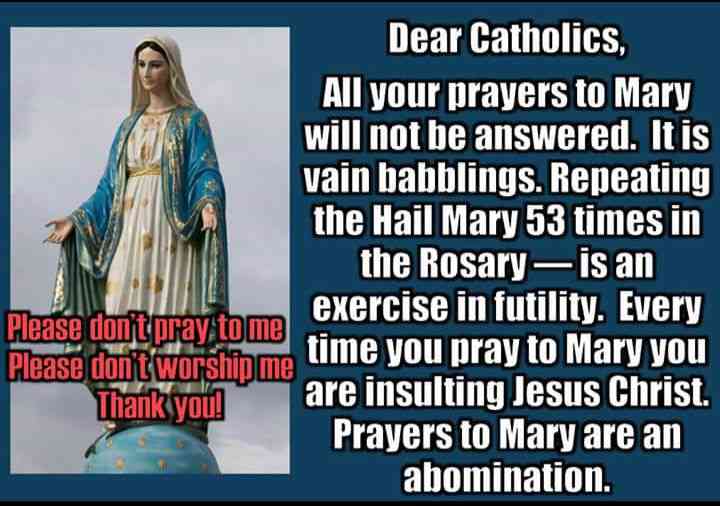
THERE is, as we have seen, not the slightest hint, throughout the Holy Scriptures, about prayers to the Virgin Mary or to saints. Nor, for 360 years after Christ, was a single word said or written in favor of such a practice. The Fathers of the first six centuries never, in the least degree, advocated a worship of the Virgin Mary or saints.
The epistle ascribed to Barnabas does not even mention Mary. Nor does the Shepherd of Hermas. Clement, Pope of Rome, speaks of the Lord Jesus as having descended from Abraham according to the flesh; yet he never alludes to Mary, the daughter of Abraham, who bore Him. Ignatius speaks of the Divine and the human natures of Christ; he mentions Him as the Son of God and the Son of man; and in one place he writes the mere name of Mary without adjective or epithet. In another passage he alludes to her virginity before the birth of Christ, and says she bore Jesus Christ, who is God. Yet he never calls her “blessed” nor “ever-virgin.”
In the Epistle of Polycarp there is an admonition to virgins, and precepts for leading a pure and chaste life with a good conscience; and yet he never alludes in the least to Mary. Justin Martyr (150 A.D.) mentions her twice—when speaking of the nativity of Christ, and when writing of the flight into Egypt; yet he does not apply to her a single epithet denoting dignity or elevation. Let us quote the following passages as examples:
- “He therefore calls Himself the Son of man, either from His birth of a virgin, who was of the race of David and Jacob and Isaac and Abraham; or because Abraham himself was the father of those persons enumerated, from which Mary drew her origin.”
A little below he adds:
- “For Eve being a virgin and incorrupt, having received the word from the serpent, brought forth transgression and death; but Mary, the virgin, having received faith and joy, answered, ‘Be it unto me according to Thy word.’ And of her was born He of whom we have shown that so many Scriptures have been spoken; He by whom God destroys the serpent, and the angels and men resembling the serpent, but rescues from death such as repent of evil and believe in Him.”
In the epistle which the Church of Smyrna wrote on the death of Polycarp, in 169 A.D. (Eusebius, lib. IV., cap. xv.), they say:
- “We were unable to forsake Christ, who suffered for the whole world of those that are saved; nor could we worship (sebesthai) any other.”
Then they continue thus:
- “For Christ, as being the Son of God, we adore (Greek text: proskynoumen); but the martyrs we love (Greek text: agapōmen), as they deserve, for being disciples of the Lord and imitators of Him: we love them because of their exceedingly great love to their King and Teacher, of whom may we also become partners and disciples!”
Neither Tatian (170 A.D.) nor Athenagoras (180 A.D.) nor Theophilus (180 A.D.) mention the Virgin Mary. Irenaeus, the Bishop of Lyons in 180 A.D., wrote (Contra Haer., lib. V., cap. xix.):
- “By the sin of our first father the whole of mankind contracted death; and, by the bite of the serpent, all men were poisoned. But by the cross of Christ, who alone came without sin in the likeness of sinful flesh, and drew all things unto Himself, and gave life to the dead, we, even in our sinful flesh, are healed of the world-old bite of the serpent.”
Then follows a confused passage which is much relied upon by Bellarmine, in which Irenaeus says that Mary’s obedience counterbalanced Eve’s disobedience, so that Mary was able to comfort Eve (for the Benedictine edition, vol. iii, ix. 3, explains the word as “consolari”). That is all. There is no allusion to any honor paid to Mary; nor does Irenaeus mention her with any term of reverence. In another passage indeed (lib. III., cap. xvi.) he says that “Christ checked the unreasonable impetuosity of His mother at Cana in Galilee.”
Tertullian (200 A.D.) mentions Mary four times: twice with regard to the nativity of our Lord, and twice when he speaks of Mary with indignation (De Carne Christi, and Ad Marci. iv. 19) for seeking to deter Christ from the performance of His mission. In one other passage (Apol., cap. xxx.) he says:
- “I cannot pray for these things, except to Him from whom I know that I shall obtain them; because He alone is able to give, and it is for me a duty to ask Him, for I am His servant, and worship Him alone.”
That passage is sufficient to exclude mariolatry and prayers to saints. There is, it is true, a passage (De Corona Mil., 3) which has often been adduced to support an opposite practice. He there narrates that it was their custom, on the anniversary of the natalitia, to make offerings for the dead: “oblationes pro defunctis, pro natalitiis annua die facimus.” The same custom is referred to in the epistle of the Church of Smyrna concerning the death of Polycarp. He said:
“they kept with rejoicing the hēmeran genethlion tou martyriou autou (tou Kyriou).” “They kept the dies natalitia, or the day of birth into a new life.”
They add:
- “The memory of the dead is kept as a discipline and preparation for the living.”
But what were the oblations? Offerings of provisions and necessaries and alms for the poor. On this point Gieseler (div. II., chap. iii, § 52) says:
- “In imitation of the family custom of annually commemorating, at the grave, the death of its deceased members, the Churches celebrated the deaths of their martyrs by prayer at their graves and by lovefeasts.”
The custom may have been the first working of “the mystery of iniquity”; but it in no way warrants a worship of the Virgin Mary or saints. There is also a passage of Tertullian in which, alluding to the fact that Christ was born of a virgin, he says she went to be married after His birth, in order that she might enjoy the two holy titles, both the title of virgin, and that of a mother once married.
Clement of Alexandria, writing about the same time, mentions the Virgin once in reference to Christ’s nativity, and records an opinion as to her virginity, but without one word of honor. On the other hand, he, like Tertullian, says (Stromata, vii. 7):
- “Since there is only one good God, both we ourselves and all the angels pray to Him alone.”
Hippolytus (220 A.D.) does not, I think, mention her. Origen (230 A.D.) mentions Mary’s name casually twice; and once more (Hom. XVII., In Lucam) he says of her that it was “the sharp point of doubt and the sword of unbelief” which pierced through the soul of Mary. The other times are as follows: In that same homily on Luke he says, “No history informs us that the Virgin was killed by a cut of a sword; nor do I think that this was predicted, since it is not the soul, but the body which is slain by iron.”
Again in his eighth homily, On Leviticus, he mentions Mary, as, before the birth of Christ, a pure virgin.
Origen, on the other hand, gives very strong testimony against the idolatrous practices of mariolatry and hagiolatry. For example (super Joann.):
- “The Man Christ Jesus had among men a great boldness; for not one of mankind can truly ask, Which of you convinceth me of a sin? Only our Lord could say this, in that He had no sin.”
Origen made no exception in favor of the Virgin Mary. Again (Super Levit., Hom. VIII.):
- “Every soul that is born in flesh is polluted with the filth of sin and iniquity.”
Again (Hom. XII):
- “It was our High Priest, Christ Jesus, who alone among mankind did no sin; and (John xiv. 30) the prince of this world came to Him, and found in Him no fault… Every one who comes into this world, ex hac ipsa quod in vulva matris positus, materiam corporis ab origine paterni seminis sumit, in patre et matre contaminatus dici potest; for (Job xiv. 4) no one can bring a clean thing out of an unclean, not one. Therefore every man has been polluted in his father and in his mother. Only our Lord Jesus Christ entered pure among the generation of men; and He alone knew no sin.”
Further (Super Num. xi, Hom. VI):
- “The Holy Spirit rested on the holy men; but not as He did on our Savior. He not only rested on Christ, but in Christ, and in Him alone He remained forever. This can be said of no one else; for of no one else can it be said, he did no sin (1 Pet. ii. 22)…It follows that every other saint or holy person was under sin for a time; and the Holy Spirit cannot be said to be remaining in a man while he is sinning.”
The dogma of the Immaculate Conception is, of course, in utter contradiction to the Christian teaching in the time of Origen. With regard to the worship of saints, he says (Contra Celsum, lib. v.):
- “Every desire, and prayer, and intercession, and thanksgiving must be sent up to God, who is over all, through our High Priest, who is above all the angels, the living Word who is God. For it is absurd and irrational to call upon angels when we do not possess full knowledge concerning them, which is indeed out of reach of men.”
Further (in Ep. ad Rom., lib. viii. cap. x.):
- “St. Paul said, in the beginning of his letter to the Corinthians, With all, in every place, who call on the name of the Lord Jesus Christ, their Lord and ours. He thereby affirmed that Jesus Christ, whose name is invoked, is God. And therefore, if Enoch and Moses and Aaron and Samuel called on the name of the Lord, and if He used to hear them, then, without doubt, Jesus Christ was the Lord they called upon. And if to call upon the name of the Lord is the self-same thing as to adore God, therefore as Christ is called upon or invoked, He is adored; and as we offer up prayers to the Father, so also do we offer up prayers to the Son; and as we offer thanksgivings to God, so do we offer thanksgivings to the Savior.”
Again (Hom. In Ezek. xvii.):
- “To those who place their trust in saints, we properly apply the verses, ‘Cursed is the man who puts his hope in man’; and, ‘Put not your trust in man’; and, ‘It is better to trust in the Lord than in princes’… Oh let us abandon all others, and trust in the Lord alone!”
From that passage we see that in the year 230 A.D. the “mystery of iniquity was already working,” and that some had turned from the Lord to worship idols. Origen traced that “falling away” to the teaching of Celsus the heretic (Contra Celsum, lib. viii.):
- “Away with the counsel of Celsus, who says that we should pray to apotheosized heroes (daimones); and let us not give ear to it ever so little. For we may pray to God only, who is over all, and to His Son, the First-born of all creation, the Word of God. And we must ask Him, as our High Priest, to bear aloft our prayer, when it has come before Him, to His God and our God, and to His Father and the Father of all who live in accordance with the word of God.”
Bishop Novatianus (240 A.D.) argued in a similar sense (De Trin., cap. xiv.):
- “If Christ is a mere man, how is it that He can be everywhere present at our invocations? It is not in the nature of mankind to be present in every place at once. If Christ is a mere man, why is that Man invoked as a Mediator? For it is useless to call upon a man to save us. If Christ is a mere man, why do we place our hope in Him? For hope in man is said by God to be under a curse.”
Manifestly Novatianus looked upon prayers to Mary or the saints as under the curse of God.
Even Cyprian, Bishop of Carthage in 250 A.D., offered not a word of honor or reverence towards the Virgin Mary. In his letter to Firmilian, Bishop of Caesarea, he did not even mention her. Nor did Firmilian (266) himself differ in that respect from Cyprian. As to the notion that Mary was conceived without taint of sin, see what Cyprian said (Ep. de Parvulis Baptizandis):
- “Every infant carnally propagated since the time of Adam has, from the origin of its birth, contracted the contagion of the world-old death.”
Again (III, Ad Quirinum, apud Hieron.; I. and III., Contra Pelagium):
- “No one, except Christ alone, is without sin.”
To the same effect wrote his contemporaries, Dionysius, Bishop of Alexandria, and Methodius, Bishop of Tyre (255); for a Homily on the Purification, which was ascribed to Methodius, and which I have previously quoted, has been rejected as a forgery, even by Romanist writers. Indeed the Festival of the Purification was not invented until 542 A.D.
Gregory Thaumaturgus, Bishop of Neocaesarea (250 A.D.), similarly wrote (Ekthesis tēs pisteōs):
- “He prays rightly to God who prays through His Son, who approaches Him through Christ. But no one can approach the Son without the Holy Spirit.”
We must bear in mind that two homilies on the Annunciation, which used to be ascribed to this Gregory, have been proved to be forgeries of a late date, and have consequently been rejected by Du Pin and other Romanist writers.
Victorinus (279 A.D.) must also be enumerated among the defenders of the exclusive invocation of God.
S. Rethicius, Bishop of Autun in 312, bore testimony against the immaculate conception of Mary. For he wrote (Contra Novatianum), “All mankind, except Christ alone, are guilty of the first offense.”
While Lactantius Firmianus, about 300 A.D., spoke of Mary as “a holy virgin,” chosen for the work of Christ; but without uttering one word of honor or worship, all the while that he was enlarging on the incarnation of the Son of God. Further (II. 2), he informed us that “the common vulgar people imagine that the souls of the dead hover about their tombs and the relics of their bodies.” Yes, truly; that was the pagan idea, which was still haunting the more ignorant portion of the Christian population.
On this ground the Council of Elvira (Concilium Illiberitanum), in 305 A.D., decreed (cap. xxxiv.), “Candles may not be lit in cemeteries or about tombs during the daytime, because we may not disturb the spirits of the holy dead.” Lactantius himself vehemently attacked the vulgar practice of having images and lighted candles by day, in the temples and before tombs, “and such-like customs.” It was the pagan practice that he attacked. But, in after times, they were all adopted, from the pagans whom he had denounced, in Christian churches. Thus he wrote:
- “Would a man be thought sane who should offer, to the great Author of all things, a wax light? It is true that He requires of us that we should have light; but not the smoky light of candles. No; the pure and liquid light of the mind is that which He desires. For that reason it has always been called phōs, because it cannot be offered by any one unless he knows God.”
The year 312 A.D. was the closing of a period; the end of the first Church of Asia, which had “forsaken its first love.” This Gieseler felt when he wrote (Text-book of Eccl. Hist., Second Period, div. I. cap. v., § 96):
- “The Church, having now triumphed over its enemies, and become rich and powerful, the effect of these circumstances was seen in the increasing splendor of its ceremonial. Many of the new converts too had brought with them the pagan propensity to external magnificence in religion, either simply, or as a gratification of taste, or as the offering of superstition. Even those who were capable of higher views yielded to this propensity, either that the pagans might be more readily won over to Christianity, or from regard to what they might deem mistaken piety.[1] But in proportion as the vital principle of piety died away, the greater stress was laid on external forms; and an endless variety of customs, which at first had only been tolerated, thus grew into laws.”
The efficacy of our Savior’s perfect redemption was darkened by the doctrine that men should appease God by undergoing voluntary hardships, or by offering Him rich presents and gifts. How utterly contrary to Christianity! Instead of believing that God is “reconciling the world unto Himself,” and that the Spirit, with “unutterable groanings,” is interceding in us, saying, “Be ye reconciled to God”—instead of this, man put himself on an imaginary pinnacle of equality with God, and set himself to propitiate God, and to reconcile God to himself. Instead of trusting in God, and thinking of the infinite love of the Father of all men in giving His Son to die for us, the Church now taught that men should endeavor to escape God’s just anger by substituting, for their own sins, the “good works” of other men, whom they were proudly pleased to judge to have been holy. Instead of believing the words of God Himself, “Whatsoever ye shall ask the Father in My name, that will He give you”; instead of giving credit to the apostle, who wrote, “If any man sin, we have an Advocate with the Father, Jesus Christ the righteous, and He is the propitiation for our sins”;—instead of accepting those Divine truths, the Church taught men to pray to the Virgin Mary and various saints, and to implore them to make intercession for us; as if God were too harsh to listen, or too far off to hear.
Therefore it was that the piety of the eighth century, and of those that succeeded it, consisted in building churches, and founding monasteries, and enriching prelates; in hunting for relics with a gullibility and infatuation that were extraordinary; in securing, as they vainly fancied, the patronage and protection of many saints, by means of gifts to the churches which were sacred to them, or by practicing rites and ceremonies in their honor, by worshipping their images, or by making tedious pilgrimages to their shrines. Those things were done to merit heaven; while the vices they indulged in, and the crimes they committed, were securing them fitting places in hell. They feared not to offend God by continuance in sin, and thought that He must be reconciled to them by the supposed intercession of dead saints, and turned from His purposes of justice, by some powers and virtues in their false relics.
The practice of offering prayers to angels had also come so much in vogue as to demand the interference of the Church. The thirty-fifth canon of the Council of Laodicea put under anathema every one who should practice the idolatry of praying to angels, because that, by betaking himself to that idolatry, he had thereby forsaken the Lord Jesus Christ. Before the year 320, it appears therefore that a grievous idolatry had sprung up in the Church, demanding the anathemas of a council to check it. Yet it is more reasonable to worship angels than to pray to dead men and women, however good they might have been during their lives; for angels are higher than the best of men. Even our Lord, when He had our human nature upon Him, was “a little lower than the angels.” If then it was a grievous sin, in the eyes of the early Church, to offer a prayer to an angel, how much worse is it to invoke a dead saint!
Footnote:
[1] See also Baptista Mantuanus, in Fastis; mense Feb. et Nov.: and Polydore Vergil, De Rerum Invent., lib. v., cap. i.: and Baronius, Ann. 58, § 76, and Ann. 200, § 5.
(To be continued.)