
The Sower and the Virgin – Historical Retrospect. 417 A.D.
Continued from Roman Paganism
HISTORICAL RETROSPECT. 417 A.D.
Pope Zosimus, who was made Bishop of Rome in 417 A.D., condemned Pelagius in a letter to the second Milevitane Council (see Augustine, Ad Optatum: De Origine Animæ; and Pope Benedict XIV., De Festis, pars ii. c. 200). In that letter he thus decided: “We are freed from sin by the blood of Christ. But no one is made free, except one who is the servant of sin; nor can any one be said to be redeemed, unless he were before, by sin, really a captive of the Devil. So it is written (John viii. 36): ‘If the Son has made you free, then are ye free indeed.’ Through Him are we spiritually born again. Through Him are we crucified to the world. . . . Nor was there ever any one born in the world, who, before he had been freed by the grace of Christ, was not held captive by the devil and subject to sin.”
If, now, the Virgin was pure, and was not redeemed from sin, then it follows that the Virgin was Divine. But if she was redeemed, then, according to Pope Zosimus, she was held captive by the devil. That African Council, on receipt of the letter of Zosimus, seems to have decreed: “This is the rule of faith, without any exception, that all men naturally (seminaliter) descended from Adam, were conceived in original sin.”
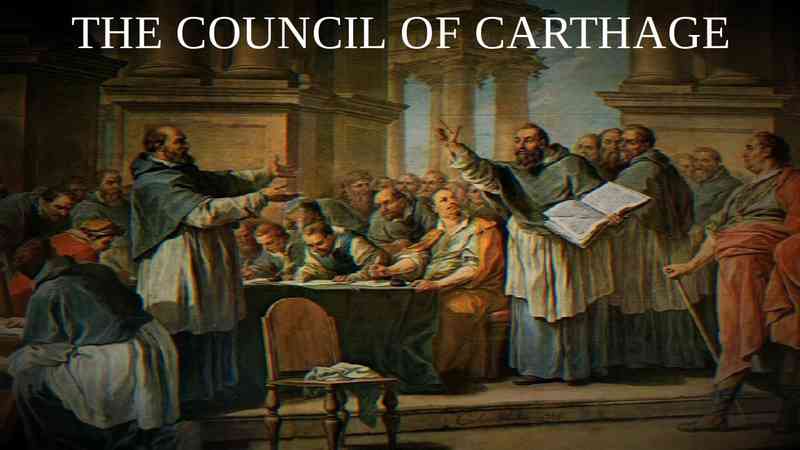
Pope Boniface I., in 419 A.D., decreed in the Council of Carthage of that year (De Consecr., dist. iv. cap. Placuit):
- “Whoever shall say that the first man, Adam, was created mortal, so that, whether he should or should not sin, he would in any case die—that is, that his soul would go out of his body by a necessity of nature, and not as a punishment for sin—let him be anathema. For we assert that death was the punishment for sin.
We decree, also, that whoever shall say that infants do not inherit original sin from Adam, let him be anathema. For the words of the Apostle (Rom. v. 12): ‘By one man sin entered into the world, and death by sin; and so death passed upon all men, for that all have sinned’—are not to be otherwise understood than as the universal Church has understood them. For, by this rule of faith, infants, who could not themselves have already committed any sin, are therefore baptized for the remission of sins, so that that should be purged from them by regeneration which they had inherited by carnal generation. For whoever has been generated by concupiscence must needs be afterwards spiritually regenerated, in order to attain to the kingdom of God, and be freed and purged from the condemnation of sin.”
The same Council of Carthage decreed: “That no one, in praying, shall address his prayers to any one except God the Father.” Such a decree was felt to be most necessary. For, at that time, few men addressed their prayers to God. They preferred to entreat some saint to intercede with God for them. We may quote the words, probably penned in 420 A.D., which Ambrosiaster applied to them (ad Rom. i. 22): “Struck with shame when charged with neglecting God, they usually mutter some miserable excuse, that they have to approach God through some saint, just as a king is approached through his chamberlain,” and so forth. Chrysostom, also, has much of the same sort.
Pope Celestinus was a Nestorian. He held that Mary was not the mother of Christ—not the “mother of God,” but the mother of Christ’s human nature only; merely the mother of His flesh. Laurentius Valla (De Donatione Constant. p. 16) vouches for that fact: “Papa Celestinus sensit cum hæretico Nestorio.” (Pope Celestine sided with the heretic Nestorius.)
Yet, according to the decree of 1870, that Pope was infallible in his ex cathedra pronouncements on faith and morals. Nestorius was made Patriarch of Constantinople in 428 A.D., just as Celestinus was made Patriarch of Rome in 422. At the elevation of Nestorius, the disappointed claimants, especially Cyril, felt envy, and watched him with prejudiced eyes.
When Nestorius denied that Mary was Θεοτόκος (Theotokos), “the bearer of God,” not Θεομήτηρ (Theomētēr), “mother of God,” affirming that she bore the Man Christ Jesus, “born in the world,” but not the Godhead “begotten before the worlds,” Cyril attacked him, and charged him with heresy. Cyril, finding that he was not listened to, resolved on the ruin of Nestorius. He misrepresented the Nestorian doctrines to Pope Celestinus, and endeavoured to show that they were the logical outcome of Pelagianism.
Nestorius was thereupon condemned at the synods of Rome and Alexandria in 430; and twelve anathemas were issued against him by Cyril. They were answered by as many counter-anathemas of Nestorius: Cyril confounded the two natures in Christ; while Nestorius asserted that Mary was the mother of the humanity of Jesus, but not mother of the Godhead. Cyril’s anathemas were therefore rejected by the Eastern Churches, and refuted by Andreas, the Bishop of Samosata, and by Theodoret, the Bishop of Cyprus (who died in 457).
Thereupon the Emperor Theodosius II. assembled a General Council at Ephesus, in 431 A.D. There Cyril attempted to procure the condemnation of Nestorius before the arrival of the Western bishops; but he failed in his precipitancy; and when the Western bishops came, Cyril and some of his adherents, such as Memnon, the Bishop of Ephesus, were deposed.
Cyril then bribed the monks of Constantinople and many of the great men at the emperor’s court. By this means the emperor was persuaded to restore Cyril and condemn Nestorius (who died 440 A.D.). It was, then, in consequence of the bribery and misrepresentations of Cyril that the doctrines of Nestorius were condemned.
Yet that doctrine was that Christ “was born of the Virgin Mary, as touching His humanity (κατὰ τὴν ἀνθρωπότητα), but of equal substance (ὁμοούσιον) with the Father as touching His Godhead.” Now Pope Leo (Epist. ad Leonem Augustum; Ballerini, 165) wrote: “Let Nestorius therefore be condemned because he says that the blessed Virgin Mary is not the mother of God, but merely the mother of a man; so that of the flesh of Christ he makes a separate person, and another person of His Godhead; and he does not believe that the Word of God and the flesh are one Christ; but he asserts that they are distinct and separate (separatim atque sejunctim), the one being the Son of God, and the other being the Son of man.”
Pope Leo was in utter error, in consequence of Cyril’s misrepresentations. For Nestorius had said nothing of the kind. The Eastern theologians replied that the doctrine of only one nature in Christ was the condemned heresy of Apollinaris. But, through the influence of the emperor, the Egyptian doctrine of Cyril and Pope Leo prevailed.
Nevertheless, the Archimandrite (or Abbot) Eutyches was condemned by a synod at Constantinople in 448 A.D. for holding those very doctrines of Cyril and Leo. Pope Leo wrote a letter to Flavianus, approving of the condemnation, in which he said: “He who is very God is also very man; and in that unity of the two, there is no deception; for there is on one side the lowness of the man, on the other the eminence of the Godhead. For as God is not changed by the lowliness of the man, so the man is not absorbed by the sublimity of God. Each form has the action which is proper to itself, in communion with the other: the Word doing the office of the Word, and the flesh doing what belongs to the flesh,” etc.
Metaphysically speaking, Pope Leo disproved his own case by asserting that there were two “forms” in Christ, each with its proper operation. And if what he said was true, Mary was the mother of only one of those forms. It would have been otherwise had he asserted that man was created in the image of God—the perfect image, for God saw that it was good. Therefore human nature, in so far as it is perfect, is exactly like the Divine; and the more perfect a man is, the more is he like God.
But in Christ there was the perfection of both natures, Divine and Human; and they were perfectly alike. However, the Council of Ephesus, in 449, decided in favour of Eutyches’ and Cyril’s Egyptian doctrine, in order to please the Emperor Leo and the court; and Pope Leo (ad Pulcheriam, Ep. 75) sneered at the Council as Latrocinium Ephesinum (the Robber Council).
It would seem, then, that the Roman Church was Nestorian. Indeed, an œcumenical council was held at Chalcedon in 451 A.D., which declared the Eastern bishops to be orthodox, and therefore by implication condemned Cyril; and which made the doctrine of Pope Leo, as expressed in his letter to Flavianus, to be the rule of faith. Of course, the Churches of Egypt declared this decision to be the Nestorian heresy; and thus began the Monophysite controversy.
At the same time the idolatrous and essentially pagan practice of praying to saints received a forward impulse. It was allied with a “will-worship”; for each man chose his own patron-saint, and selected those austerities or pretended self-denials to placate the Deity which best suited his own disposition or frame of mind.
There is a remarkable passage in the works of Theodoret, Bishop of Cyprus, on Colossians ii. He wrote in 430 A.D. It is as follows: “Those heretics counselled that this should be done, pretending humility, I suppose, and saying that the God of all, being invisible and inaccessible and incomprehensible, must be approached by means of angels whenever we would acquire His goodwill or favour.”
Again (Græc. affect. curat. Disp. 8, Ed. Schultze, vol. iv. pp. 902 and 921), he speaks of the opinion that the saints wander about the sky (as long as their bodies are not buried in their own tombs, but are divided up and partitioned among cities and towns and families) in the capacity of the “healers” of men and the “saviours” of men’s souls and bodies; so that they are generally reverenced as “the guardians and defenders of cities. . . . If men are sick, they run to their guardian angel or patron-saint to be made well; those who are childless ask him to give them boys; and the sterile women pray to him to be made mothers; οὐχ ὡς θεοῖς αὐτοῖς προσσιόντες, ἀλλ’ ὡς θείους ἀνθρώπους: not as gods do they approach those saints, but as apotheosed or deified men. To them they make their votive offerings—the image of an eye, or a foot, or a hand; whether made of gold, or of silver, or simply of wood. Then they keep the festivals of those saints—not indeed the Dionysiacs or feasts of Bacchus, nor the feasts of Apollo, or of Jupiter, or of Cybelé; but feasts of Peter and Paul, and of Thomas, and of Sergius, and of other martyrs.”
Such is in effect, and almost in the very words, the description which Theodoret, in justly indignant rebuke and scorn, gives of the Christians of his day. How could those Christians have answered the reproaches which Arnobius had, one hundred and thirty years before, hurled against the pagans of his time (adv. Gentiles, vi. 6)? “It has been shown that many of your temples cover the ashes and bones of your heroes or demi-gods, and are, in fact, but the shrines of their corpses,” etc.
Cyril, Bishop of Alexandria, the Egyptian opponent of Nestorius, whose rage was successful through the influence of an Eastern court, may be said to have flourished about 430 A.D.—the same time as Theodoret. Although his envy exploded in the cause of the Virgin Mary, yet he gave no manner of support to any worship of Mary. Writing on Luke, he said: “Peace on earth was brought about by Christ, because He reconciled all mankind to the Father by taking sin from us—sin which caused our enmity against Him. Therefore He was rightly called Jesus or Saviour, because He was incarnate for the salvation of the whole human race.” That was the key-note of Cyril’s teaching; it had no evil flavour of mariolatry in it.
The Venerable Sedulius, a bishop and an Irishman, flourished at the same time—a fitting forerunner of that great Irish Protestant, S. Patrick. In the Commentary of Sedulius on the Romans (chap. i.) he wrote: “To worship any other person than the Father, Son, and Holy Spirit, is an impious crime.”
Again (chap. ii.): “If the soul shall have paid to any other than to God what it owes to God, it commits adultery.” Further (ap. Pasch., lib. ii.): “The Virgin once lay, with a vitiated nature, under the dominion of death; but when Christ was born she was born again.”
Pope Leo the Great came to the throne in 440 A.D. What is his testimony, now regarded as infallible (Sermo viii., De Passione)? “In Christ alone was human nature without sin.”
Again (Sermo in Assump.): “This admirable virgin was found worthy to give birth to Emmanuel, who came to redeem both her and the whole human race.”
Further (Sermo v., de Nativ. Domini): “Our Lord Jesus, alone of all men, was conceived without sin; because He alone was begotten without concupiscence. . . . Christ was begotten on the Virgin without seed of Adam. According to the angel’s testimony, she was with child not by human intervention, but by the Holy Spirit. And since, in all other women, conception does not take place without the pollution of sin (?), therefore the Virgin alone, among women, was enabled to be washed from her sins by the Son whom she conceived.”
We have S. Paul’s testimony that, in the case of married women, that premise is false, and “the bed is undefiled” by sin. The falsehood of the monastic idea, which caused the decree of celibacy, vitiated the conclusion which Pope Leo drew from it.
In the same sermon there is a passage quoted by Zoller, which strangely puts the baptismal water on a level with the Virgin Mary: “That first Cause whom the Virgin received in her womb, Christ put into the baptismal font. He gave to the water what He gave to His mother—namely, the power of the Highest, and the overshadowing of the Holy Spirit. That which made Mary give birth to the Saviour, also makes the water regenerate the believer.”
In the fourth Sermon on the Nativity he says: “That earth—namely, human flesh—which was cursed in the first sinner, brought forth a blessed fruit in that sole birth by the Virgin—a fruit which lacked all the vice of its parents.” In fourteen other passages Leo the Great declared that, of all mankind, Christ alone was without sin. Yet the writings of Leo, as will have been perceived by the above extracts, contained the germs of the errors of Rome.
Once the people had succumbed to the notion that other intercessors were required besides the one Mediator and Intercessor, Christ Jesus; once they had returned to the pagan practice of praying to dead and deified heroes, the next step, of course, was speedily taken, and the number of intercessors, protectors, patrons, and guardians was quickly increased, and most recklessly multiplied. Not only martyrs, not only distinguished bishops, but unknown monks, and even Old Testament characters, were huddled into the worshipful ranks of hagiology (Literature dealing with the lives of saints.).
Joannes Cassianus, Bishop of Marseilles, in 440 A.D. (Collat. v. c. 1), relates that a number of monks in Palestine having been put to the sword by the Saracens, all the places in the vicinity at once claimed the glory and safety of having those monks as their guardians; and their monkish bodies and monastic clothes were quickly torn to pieces by those who were anxious to possess relics of them. At this period, indeed, every obscure grave was held to be the grave of a martyr, and was accordingly ransacked of its decaying contents to feed the superstitions of a decaying Christianity.
Unknown martyrs were invented, and appeared in vision to enthusiasts, announcing their places of burial, which no one but the enthusiast himself already knew; the result was a stampede to a sort of gold-finding of relics, at which those few who knew any anatomy contemptuously sneered as bones of dogs or apes (Sulpicius Severus, De Vita Martini, c. ii.; Ambrose, Ep. 22, ad Sororem; Augustine, De Civ. Dei, xxii. 8).
Even Faith, Hope, and Charity are entered in the Roman Martyrology, issued by Pope Gregory XIII. (Rome, 1583), as three virgins and martyrs who ought to be worshipped; while Bacchus himself even appeared in the Christian hagiology to grace the pagan festivals of Rome. October 7th in the Popish Calendar is sacred to “Saint Bacchus, the martyr.” This day was the festival of Bacchus in ancient Rome, at the time the vintage was finished.
On October 9th, there was a festival of the pagan Romans to “Dionysus Eleutherius,” the Greek Bacchus. He was called “Dionysus Liber” (Pausanias, Attica, p. 46). The day was called “Festum Dionysi Eleutherii rusticum.” It was a rustic’s or countryman’s holiday.
In the Popish Calendar for October 9th we find: “The festival of Saint Dionysius, Saint Eleutherius, and Saint Rustic.” There is also a Saint Orestes, to whom a convent close to Rome was dedicated. But as it stands on Mount Soracte, Addison suggested that Soracte had been changed into “S. Oracte,” and read “Saint Oracte,” and then further metamorphosed into “Saint Orestes.”
There is also a Saint Quirinus, Saint Romula, Saint Redempta, Saint Concordia, Saint Nympha, Saint Mercurius, etc.; so that Mabillon (Iter. Ital. p. 225) exclaimed: “They should be more scrupulous, and not forge so many fabulous stories of saints, without any certain name.”
The testimony of Cassianus against the Immaculate Conception was as follows: “It is one thing to be holy—which can be said of many men—and it is another thing to be immaculate and without sin, which is the peculiarity of our Lord Jesus Christ’s majesty alone. Of Him the Apostle said, as quite a singular distinction, that ‘He did no sin, neither was guile found in His mouth’ . . . Christ is distinguished from the whole human race by that exception, in which He is alone.
None of us can be without sin; but He was without sin, for He alone was (Ps. xlv. 2) ‘fairer than the children of men’; and, therefore, when He took upon Him the infirmities of our flesh, He came under the condition of death, although He never suffered contact with the taint of sin. . . . How can we understand that passage of the Apostle’s writings (Rom. viii. 3) that He came in the likeness of sinful flesh, if any one of mankind can have flesh unpolluted by any stain of sin? For the Apostle ascribes this to Christ, as something quite peculiar: that God sent His Son, who did no sin, in the likeness of sinful flesh; because He, indeed, took upon Him true flesh, but without sin in it; so that we must believe that He took only the appearance of sin.”
S. Prosper, Episcopus Regiensis, in 456 A.D. (De Vita Contempl., lib. ii. cap. 21), was no less explicit: “Adam, by committing that grave offence, damned the whole human race; for he transmitted to all his posterity both the crime and the penalty. Christ alone was conceived without sin, and could not become obnoxious to our crime; but, by taking upon Him our penalty, He wiped out both our sin and the penalty; for He died not for any sin of His own, but for our sin; and every one of us dies to sin, not by our own deaths, but by His.”
S. Fulgentius Afer, Ruspensis Episcopus, wrote to Donatus in 460 A.D. (De Mysterio Mediatoris) and said: “Our Mediator was alone without sin, and underwent death in order that He might free from sin all that put their trust in Him.” He repeated the same words in his epistle to Theodore the senator; and again in his epistle against Faustus, the defender of Pelagius.
Continued in Historical Retrospect.—S. Patrick
Related posts:
Jesuit Hollywood
The World And Its God Chapter X. “Fig-Leaves.”
The Sower and the Virgin – Sleeping In Jesus
Pope, or President? Chapter II. The Romish Confessional. Part 2.

American Freedom and Catholic Power

Charles Spurgeon's views on the Pope
The Sower and the Virgin – The Resurrection
The Roman Catholic Church - the Snow White Hiding Behind Governments
