
The Sower and the Virgin – Historical Retrospect.—S. Patrick
Continued from Historical Retrospect. 417 A.D.
HISTORICAL RETROSPECT.—S. PATRICK.
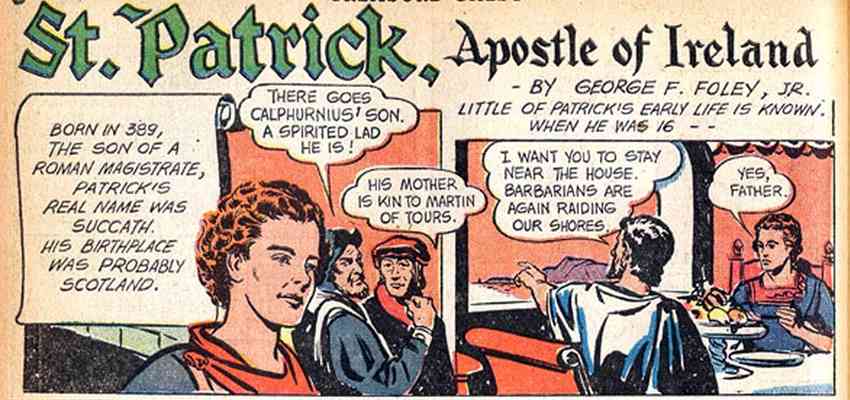
Now we come to that excellent old Protestant called Saint Patrick, who flourished in the year 464 A.D. He never once, in his writings, addressed a prayer, petition, or even ejaculation to Mary, or to any saint or angel. In the whole of his writings he never once so much as mentioned Mary; and as for purgatory, he wrote these words:
- “There are three habitations under the eye of the Almighty God: the highest, the lowest, and the middle. Of these, the highest is called the kingdom of God, or the kingdom of heaven; the lowest is called hell; and the middle place is the present world.”
The ancient Irish were taught by Saint Patrick; and concerning them we have the testimony of the Venerable Bede (lib. iii. 4): “They observed only those works of piety and chastity which they learned in the writings of the prophets, the evangelists, and the apostles.” That is to say, they were very good Protestants; and it was not until Pope Adrian gave Ireland to Henry, for him to Romanize, with fire and sword, that they began to imbibe the noxious and nauseating tincture of popery.
In France, at the same time, there flourished S. Remigius, Bishop of Rheims. Treating of Psalm xxii. 1, “My God, My God, why hast Thou forsaken Me,” what did he say? “The blessed Virgin Mary was cleansed from all the stains of her sins, so that she might conceive a Man, Christ Jesus, without sin. For as Original Sin comes to us in the very moment of conception; so, in the very beginning of the conception of Him, the Godhead of the Word was united to that Man by whom the world was redeemed from all sin.” He repeats the same when treating of Isaiah ii.; when writing on the Epistles of Paul; and when commenting on Romans viii.; on the 2nd Epistle to the Corinthians; and on the seventh chapter of the Epistle to the Hebrews.
In 492, Pope Gelasius I. came to the throne of the Roman Pontiffs. He too denied the Immaculate Conception of Mary.
In 498, S. Peter of Tripoli, who collected, out of the works of Augustine, commentaries on all the Epistles of Paul, wrote the following exegesis on the fifth chapter of the Epistle to the Romans:
- “Since Christ was born of a virgin, without the copula of carnal concupiscence, therefore He was not conceived in iniquity, nor did His mother nourish Him in sins within her womb. But that Infant was the only one who was ever innocent; and the reason was that He was not conceived by the operation of Adam. . . . It is the most fundamental proposition of the Christian faith, that: By one man sin entered into the world, and passed down to all men, so that all have sinned. Further, it has been declared that no one, born of Adam, is free from the chain of sins, and from the sentence of damnation; and that no one is freed from sin and damnation, except by Christ, who alone came into the world without sin. This we must believe firmly, and we must know that he who denies it, can by no means attain to faith in Christ.”
Again (on 2 Cor. v.):
- “All, without any exception, are dead in sins, both Original and Voluntary; and, for all those so dead, the Living One died; that is, He who had no sin.”
It was about this time that the “Apostolical Canons” were written. Yet there is in them no reference whatever to Mary, nor a single expression implying worship to her, nor invocation of her name. It is curious that the Romanists should have forged those canons at this time, attributing them to the apostles, and yet should have refrained from any reference to Mary, knowing that it would betray their date and origin.
In 520 A.D. Cassiodorus, the senator who had become a monk, wrote on the words:
- “O Lord! Thou hast searched me and known me” (Ps. cxxx9. 1, 23, 24) as follows: “The Psalmist adds a prayer: See if there be any wicked way in me. That prayer no one else could utter, excepting He who said (John xiv. 30): The Prince of this world cometh, and hath nothing in Me. For He was distinguished from all mankind by being without sin, and by bearing the sins of all men.”
Andreas, the Bishop of Crete, flourished in 560 A.D., and bore testimony against the dogma of the Immaculate Conception. In a sermon on the Nativity of the Virgin, he said: “The Son of God, in order to effect a blessed reformation of human nature, took flesh upon Him of a virgin, purging her, by His Holy Spirit, from the dust of sins in which she, until that time, had walked.”
The third Council of Toledo was held in 589 A.D., and the following canon of that council is embodied in the Canon Law (causa xiii. quest. 2, cap. 29), and is de fide:
- “It must be confessed that the dead do not know what is done upon the earth; at least, not while it is being done; although they may hear some things from those who die afterwards and go to the dead; but they cannot hear everything; only such things as the newly dead are permitted to report, provided that it is important that those who died before should hear them.”
The wise and inspired king (Eccles. ix. 5) was less reserved in his assertion: “the dead know not anything.” Yet even the decree of Toledo, which, as being part of the canon law, is part of the faith of every Roman Catholic, is a fatal blow to the practice of praying to Mary or to the saints. How much more deadly would the blow have been, if the bishops in that council had remembered the express statement of S. Paul, that those who are dead in Christ will not rise until the last trump, when they shall rise to meet their coming Lord in the air.
The gloss on the Canon of Toledo is as follows: “Gratian puts a very pertinent question: Whether the dead know what is done on earth by the living? And he replies that the dead cannot know; proving this by the authority of the prophet Isaiah lxiii. 16: Abraham is ignorant of us, and Israel knows us not.”
In the same Cause, chapter 20, the words of Jerome are given: “While we live together in the present world, we can help each other by prayers to God, and by advice to each other. But when we shall be called away to the tribunal of Christ, neither Noah, nor Daniel, nor Job can pray for any of us; but every one of us must bear his own burden.” If the Romanists are obliged to believe that, what utter fatuity it is in them to invoke Mary or the dead saints!
In 590 Pope Gregory the Great was elected. He too denied the dogma of the Immaculate Conception of Mary. He wrote (Moralia xi.): “Only Christ was pure from sin in the flesh; because He did not come to the world by means of carnal pleasure.”
Again (Moralia ix., cap. 7): “By incarnation, the Son of God was made the Redeemer of mankind. He, alone among men, was righteous; and He, alone without sin, suffered the penalty of sin.”
Further (Moralia xviii., cap. 35): “Although we may be made holy, yet we are not conceived holy (sancti efficimur, non tamen sancti concipiamur); because we are bound by the conditions of our corruptible nature, so that we may say, with the prophet (Ps. li. 5): Behold, I was conceived in iniquity, and in sin did my mother conceive me. He alone was truly born holy who was not conceived by carnal commingling; in order that He might overcome the condition of our corruptible nature.”
Also (Moralia xiv.): “There was never any of mankind who appeared just, before God; wherefore the Son of God made Himself Man, for the sake of men; and He alone appeared just in the sight of God.”
In his eighth Homily, on Ezekiel, he remarks as follows: “In one Redeemer alone was God well pleased; because, in Him alone no fault was found… What is meant by the word loins, except the propagation of mortality? For the Virgin Mary came out of the loins of Abraham,” etc.
As to the worship of saints, he shows, indeed, to what an extent the practice had spread, and on what a very slender basis of fact it was founded (lib. viii. Ep. 29, ad Eulogium, Episc. Alexan.): “Except those facts concerning the deeds of the holy martyrs which are contained in the books of Eusebius, there are no accounts in the archives of our Church, or in the libraries of the city of Rome, so far as I know, except a few bare scraps contained in a single volume. Yet we have, entered in one book, the names of all the martyrs, with the days and modes of their deaths; and every day of the year we offer masses in the worship of them. We have not in that book what each one underwent, but merely the name of the martyr and the day of his death.”
During the reign of Gregory the Great, two feasts were added to the festivals of the Church: the Purification, on Feb. 2nd; and the Annunciation, on March 25th (Bingham, ix. 107, etc.). That the latter day was a pagan feast, we have already seen. February 2nd was sacred to Ceres, or Juno Februata, and was adopted by Pope Gregory as the Feast of the Purification, or Candlemas.
Zoller the Benedictine, in spasmodic vehemence to find arguments in favour of mariolatry—or rather, in his fraudulent efforts to invent authorities in favour of the practice—has quoted some words of Pope Gregory—I know not whether they are genuine—from a commentary on the first chapter of the first of Samuel (1 Reg. cap. i). He makes Gregory allude to the well-known passage in Isaiah, and in Micah iv. 1, and then say concerning Mount Ephraim:
- “The most blessed Mary, the Mother of God, may be designated by the name of this mountain. For she was a mountain, in that she transcended, by the dignity of her election, the altitude of every elected creature. Is not Mary a sublime mountain? She reached up to conceiving the Eternal Word. She reached the topmost peak of virtues. She reached up above all the choirs of angels; even up to the throne of God Himself.”
This resembles, in its flowery bombast and extravagant hyperbole, the sermon of an Irish priest much more than a homily by Gregory the Great. Such as it is, it is a good specimen of the only arguments upon which mariolatry can be based. Whether Pope Gregory penned the passage or not, it certainly reflects the irrational and grovelling tendency to idolatry which was prevalent among the people, and all the lower type of the clergy, of that period.
(To be continued.)
Related posts:
The Jesuit Conspiracy Against Historic Bible Protestantism
The Six-Pointed Star – Chapter 7. The True Messiah and the Menorah
Book Report: The Jesuit Vatican Global Conspiracy
Christian Zionism And The Freemason Deception – Part VI: Freemasonry and the Cold War
A Protestant View of Church History: The Early Church by Ronald N. Cooke
The Perversion Of Dr. Newman To The Church of Rome - By Charles Chiniquy Part I.

Jesuitism Exposed!
A Disputation On Holy Scripture Against The Papists Question III. Concerning The Authority...
